
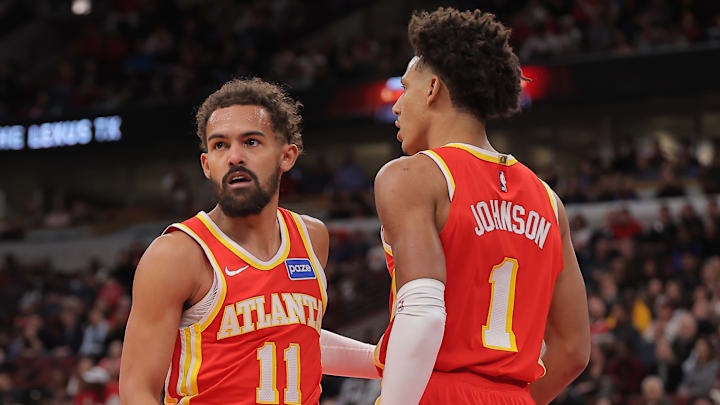
Trae Young appears poised to make his return to the Atlanta Hawks on Thursday night after missing 22 games with an MCL sprain in his right knee. After getting off to a 2-3 start with him in the lineup, they've gone 13-9 since, including wins over the Orlando Magic, Los Angeles Lakers and Cleveland Cavaliers.
In Young's absence, Jalen Johnson has emerged as a legitimate All-Star in his own right. He's averaging career highs in points (22.8), rebounds (10.5) and assists (8.2) while shooting 51.6 percent overall and 38.5 percent from deep. Johnson is currently riding a four-game streak of triple-doubles, which made him only the third player in NBA history to do so before the age of 24, joining Magic Johnson and Oscar Roberston.
Nickeil Alexander-Walker hasn't reached quite the stratospheric heights of Johnson, but he's having a breakout season of his own as well. He never averaged more than 11.0 points per game in any of his first six seasons, but he's chipping in 20.4 points, 3.6 rebounds and 3.4 assists per game while shooting a career-best 45.3 percent overall and 39.1 percent from deep (on a career-high 7.4 three-point attempts per game, no less).
On Wednesday, Young told reporters that he doesn't want his return to disrupt what the Hawks have going.
"I see certain things that our team is doing really good that I want to keep allowing our team to do," he said. "But then there are times when we are struggling or times when it looks kind of tough on guys, and I want to make it easier for them.
"For me since Day 1, I've always felt I was a puzzle piece to the big puzzle. I never felt like I was the whole puzzle. I'm about to come back and do the same thing, just be another piece to the puzzle and try to fit in."
That's the question the Hawks need to answer between now and the Feb. 5 NBA trade deadline.
Can Trae Young thrive in a non-heliocentric setup?
Ever since he made his NBA debut in 2018-19, Young has been among the league leaders in usage rate. There's good reason for that: No player has averaged more assists per game than Young over the past eight years. Despite a revolving door of supporting talent around him, the Hawks have boasted an above-average offense every year since 2020-21.
Now that Johnson and Alexander-Walker have proved their ability to carry the Hawks' offense without Young, it's on Young to prove that he can operate efficiently in more of an off-ball role at times.
Efficiency has never been a hallmark of Young's game. He shot above 44 percent from the field in exactly one of his first seven seasons. He's a career 35.1 percent shooter from downtown, in part because he's one of the highest-volume deep-three launchers in the league. While those extra-long-range shots help stretch defenses to their breaking point, he's knocked down only 33.7 percent of his attempts from 28 feet and beyond over his eight-year career.
If Johnson or Alexander-Walker handle the ball on certain possessions, Young will need to prove his utility as an off-ball threat. Most of his three-pointers are pull-ups rather than catch-and-shoot attempts, although he shot only 33.6 percent from deep on the latter last season. He's one of the league's most prolific drivers, but can he get more involved as a cutter? Could the Hawks run some inverted screen-and-rolls where he's off the ball at first?
Then there's the defense. At 6-foot-2 and 164 pounds, Young isn't likely to become an above-average defender at any point in his career. However, he's been one of the worst defenders in the league over the past half-decade, according to Dunks and Threes' estimated defensive plus/minus. He ranked in the 1st percentile of that metric last year and the 6th percentile in 2023-24. On a related note, the Hawks haven't been above 16th leaguewide in defensive rating since they landed Young in 2018.
Unless Young makes major strides at that end of the floor, he needs to be overwhelmingly impactful on offense to make up for his defensive deficiencies. The Hawks need to see whether he's capable of doing that without reverting to their previous heliocentric setup. Now that they know what Johnson and Alexander-Walker are capable of, they need to have a more egalitarian offense, if only to make themselves less predictable.
Trae Young's contract status looms large
Overhanging all of this is Young's contract status. He's currently in the last guaranteed year of his deal, although he has a $49.0 million player option for 2026-27. It's long seemed like a foregone conclusion that he'd decline that option and become an unrestricted free agent this coming offseason if the Hawks didn't sign him to an extension by then. However, Michael Scotto of HoopsHype reported Thursday that several executives around the league "are of the current belief that Young may have to exercise" his player option.
According to Keith Smith of Spotrac, six teams are currently projected to have at least $35 million in salary-cap space this offseason. The Washington Wizards, Los Angeles Clippers and Los Angeles Lakers all could be in line to have enough room to offer a max contract to a free agent, although the Lakers are set at point guard with Luka Dončić.
With four All-Star nods already under his belt, Young is typically the type of player who'd be a no-brainer max-contract candidate. However, the Hawks balked at offering him an extension over the offseason. They presumably wanted to see how he meshed with Alexander-Walker, Kristaps Porziņģis—who is currently sidelined with an illness—and Luke Kennard before making another nine-figure commitment to him.
If Young doesn't mesh as well as hoped upon his return, the Hawks may have to seriously consider shopping him by the trade deadline. But if Young elevates the Hawks toward the top of the wide-open East, that might make them revisit extension conversations either in-season or afterward.
With the Hawks lurking on the periphery of potential Giannis Antetokounmpo trade talks, how Young fares over these next few weeks could help shape both the Hawks' long-term direction and the trade deadline itself.
More Atlanta Hawks news and analysis:
 Add us as a preferred source on Google