
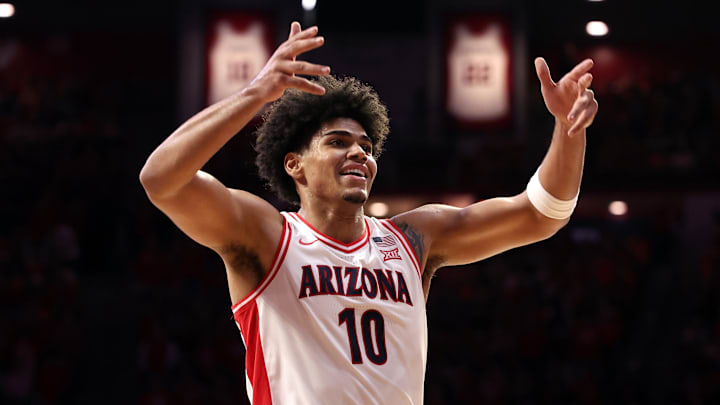
Conference play is underway in college basketball and the Stock Watch is back after a bit of a holiday hiatus. The non-conference portion of the schedule provided a lot of data points for us to analyze as we begin looking forward to March Madness, but one thing that is quite clear is that the Big 12 is the league to beat.
Entering the holiday break, the conference had six teams inside the AP Top 25 with a whopping four programs (No. 1 Arizona, No. 4 Iowa State, No. 8 Houston and No. 10 BYU) inside the Top 10. Is the Big 12 on pace to be this year's SEC, which sent 14 of its 16 teams to the dance last season, or is this simply a case of a top-heavy league? Read on to find out in the latest college basketball stock watch, where we'll start with the rising Big 12.
College Basketball Stock Watch: Rising
The Big 12
At the start of play on Jan. 5th, 9 Big 12 programs were inside the Top 50 of the NET rankings with six of the remaining seven inside the Top 100. Only Utah appears to be heading towards also-ran territory, meaning this conference has a chance at healthy representation in the NCAA Tournament field if its bubblers can pick up enough big wins in league play.
The conference also can count its four Top 10 teams as legitimate title contenders with a fifth, Kansas, also capable of reaching that status if they can ever figure out how to get Darryn Peterson's hamstrings to function through an entire game. It remains to be seen if teams like Cincinnati, Kansas State, West Virginia and Arizona State can build enough momentum to secure the extra at-larges to challenge last year's SEC barrage but no conference has as much quality at the top as the Big Ten does.
Miami (Ohio)

There are only six undefeated teams left in college basketball entering the first week of January: five power conference programs (Arizona, Michigan, Iowa State, Vanderbilt, Nebraska) and Miami of Ohio, which is off to a 15-0 start out of the MAC. While the RedHawks didn't exactly challenge themselves in non-conference play, earning as many Quad 2 wins (3) as they had against non-Division I programs, they made a big statement by winning 76-73 against the best the MAC has to offer, Akron.
The Zips were the MAC's NCAA Tournament representative a year ago and played a solid non-conference schedule this year, so seeing the RedHawks earn a win against them is a sign we should be taking them seriously as a bubble threat. An electric offense that averages 95.3 points per game makes the RedHawks a fun watch and if they can keep stacking wins they could make a case for inclusion in the field as an at-large if they can't secure the MAC's auto bid.
Nebraska

Of the aforementioned unbeaten teams, seeing Nebraska on the list is certainly a surprise. Entering Monday night's trip to Ohio State, the Cornhuskers were 14-0 and have a stacked resume, earning three Quad 1 victories and four in Quad 2, showing that they haven't earned their record by simply beating up on cupcakes.
The top of the Big Ten is certainly stacked as Michigan, Purdue and Michigan State all look like viable second weekend teams (at minimum) in March. Nebraska has already won its lone meeting with the Spartans and draws the other big dogs later in the season, but finishing with a Top-4 seed is certainly in play for the Cornhuskers, who want to snap their drought of being the only power conference team without an NCAA Tournament win.
College Basketball Stock Watch: Falling
St. John's

It feels like every year there is a team that starts out in the top five of the preseason poll before slipping into bubble territory and this year's example is St. John's. The Red Storm dropped a bad game at home against Providence on Saturday to earn a Quad 3 loss on their resume as Rick Pitino blamed his fan base for not showing up in strong enough numbers at Madison Square Garden, which is not a good look for the program.
Pitino's roster is flawed as it lacks perimeter shooting and a true point guard, which has been exposed in non-league games against elite competition from the SEC and Big 12. The predictive metrics still believe St. John's is a tournament-caliber team but they have squandered their chances of building a good resume for the selection committee, leaving them in an unenviable position of having to constantly avoid landmines in a down Big East to make the field.
Common sense

This refers more to the ongoing fiasco of eligibility, which has seen programs go through many unconventional routes to add talent to their roster. The lastest flashpoint has been Baylor's addition of big man James Nnaji, who was picked 31st in the 2023 NBA Draft and whose rights were a part of the Karl-Anthony Towns trade, being allowed by the NCAA, which granted him four years of eligibility.
Numerous legendary coaches, including Michigan State's Tom Izzo and Arkansas' John Calipari, have railed against moves like this (and earlier decisions granting former G League players like Louisville's London Johnson eligibility) while UConn's Dan Hurley called for a commissioner to create a set of rules for everyone to follow. The NCAA made one declaration, ruling that anyone who has signed an NBA contract is no longer eligible for collegiate play (ending rumors about teams pursuing Trentyn Flowers, who was on a two-way contract with the Chicago Bulls), but their lack of clarity has allowed teams to push the boundaries of amateurism much further than they should.
Kentucky

The return of Kentucky's healthy stars at the end of December, highlighted by a strong showing against St. John's in the CBS Sports Classic, led many to proclaim the Wildcats were back. That proclamation came a big early, however, as Kentucky was smacked by No. 14 Alabama on Saturday in a game that exposed many of the Wildcats' ongoing flaws.
Perimeter play remains a big issue for Kentucky, which was outscored by 33 points from beyond the arc in a 15-point loss, while Mark Pope's team wasn't great on the interior either by losing the rebounding battle to the Crimson Tide. There aren't any truly bad losses on Kentucky's schedule but there aren't exactly great wins either (especially if St. John's and Indiana can't right themselves in league play), meaning the Wildcats will need to stack wins in a strong SEC to play themselves into an at-large bid.
More college basketball news and analysis:
 Add us as a preferred source on Google