
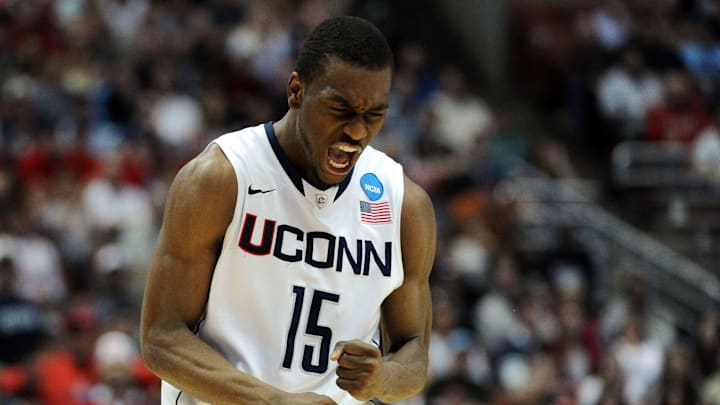
For as good as UConn has been, they have one of the strangest resumes for a top basketball program in the country. They win a ton and might be one of the best teams of this century, but they never feel that way during the process. They actually have just seven All-Americans in their program’s history. They have six championships and seven All-Americans. For comparison, Kentucky has eight championships and 22 All-Americans (not even considering the second team).
However, UConn wins on a system and culture that many of the other blue bloods can’t compete with in the 21st century. Connecticut has the most championships this century with five, and their sixth came in 1999. This isn’t a school that is built on pedigre or legacy, but it’s built a legacy that’s hard to deny.
And we’re not even talking about the women’s team, which might be the most dominant team in all of sports for a long time. Geno Auriemma has led that franchise to 12 championships since taking over in 1985. The men’s team has been trying to keep up with the women’s team this whole time, and they’ve done a great job of it because of the superstars that have come through in the process.
10. Caron Butler, 2000-2002
We’re starting off with a controversial pick. Coming to UConn on the heels of a championship, Caron Butler was immediately impactful on the court. In his freshman season, he averaged 15.3 points, 7.6 rebounds, 2.2 steals, and 3.1 assists per game. He led the Huskies in points and rebounds that season. It looked like something special was brewing here.
In that second season, he grew by leaps and bounds. Already a great talent, Butler became a leader for UConn. This was now a team people saw as a wrecking ball in the still-great Big East Conference. Butler dominated, scoring more than 20 points per game with 7.5 rebounds. His shooting efficiency was insane, hitting 40% from the three-point line. He actually hit double digits on the scoreboard in all but one of his games in college, which is consistency you don’t see from anyone in the NCAA.
Butler led the Huskies to a Big East Championship, winning tournament MVP in 2002. He was a finalist for the Naismith Player of the Year Award and the John R. Wooden Award, honoring the nation’s top collegiate player. Adding to that, he was named the Big East Co-Player of the Year and named to the National Association Basketball Coaches All-District I First Team. How he didn’t make the All-American team is beyond us.
In the NCAA Tournament, Butler carried UConn to the Elite Eight, shooting 50% from three for the tournament. He scored 117 points in just four games, including 32 against the eventually National Champion Maryland Terrapins. This is a bittersweet pick because many thought Butler would return to finish what he started in 2002-03, but he chose to go to the NBA instead.
9. Tristen Newton, 2022-2024
It’s hard to argue with the success of Tristen Newton. Possibly the best transfer in the history of the program, he went to UConn after spending three seasons with East Carolina University. He won championships in his two seasons.
When he arrived in Storrs, he felt like the final piece of the puzzle. This was a team that already had Jordan Hawkins, Andre Jackson, and Adama Sanogo. The Huskies just needed Newton to play in his role as an energy guard who could score. He did that and so much more. In his first year, his stats might look pedestrian (10.1 points, 4.7 assists, and 4.5 rebounds), but he went off in the National Championship. Against San Diego State, Newton had 19 points and 10 rebounds to secure the win.
It was like that game awoke something in Newton that turned him into one of the best players in the country. He still struggled with the occasional stinker (like his 0-for-6 performance against Illinois in the Elite Eight), but he was more often one of the best guys on the court.
Newton was a marvel for a dominant team. UConn lost one game after Christmas in 2023-24, and they didn’t play one close game in the NCAA Tournament. He once again had 20 points in the National Championship Game, this time against Purdue. He was two-for-two on runs in March Madness, making him one of the greats.
8. Ben Gordon, 2001-2004
Ben Gordon is another player who was as talented as anyone who ever wore blue and white. He scored close to 13 points per game in his freshman year despite spending most of the season coming off the bench. He brought a different energy to the team, and he was as impactful as any bench guy in the nation. This was a stacked team at guard, but Gordon forced his way into the rotation.
In his sophomore season, he started the entire season. He started every game and finished with 19.5 points, 4.7 assists, and 4.2 rebounds while enjoying second-team All-Big East honors. On the court, Gordon had a surprise element to his game that always ended the same way: with the ball going in the basket. He was a playmaker that UConn needed to get over the hump.
His marquee moment might have been the Big East Tournament in 2004. He dominated across all three games, scoring 33 against Seton Hall, 21 against Pitt, and 31 in the final against Syracuse. His 81 points is still a tournament record that will never be beaten unless we somehow get the Big East back, and he rightfully won tournament MVP.
The scoring did not stop when the lights got even brighter. Gordon scored a total of 127 points in the Tournament, the leader in that category in 2004. He acted as a closer on a team that was as talented as any this century.
7. Donovan Clingan, 2022-2024
Donovan Clingan came to UConn to dominate. It was written in the stars. He stands at over seven feet tall and plays with a set of skills that seems impossible in that frame. His compete level was unmatched, and his overall value to UConn was special.
Clingan was a typical stretch five, which again, you do not see in a player this tall. And he makes this list despite being a starter for just one season. He started his career as the backup to Adama Sanogo, who just barely missed this list. In his freshman year, he had just under seven points per game in that backup role.
Despite agents saying he could make the NBA right away because of his size and skill, Clingan returned for his sophomore season. And it was a smart move. He was able to be the Huskies starter, averaging 13 points and 7.4 rebounds per game.
Clingan helped UConn dominate both the conference tournament and the NCAA tournament. He scored 22 points in the Elite Eight versus Illinois and 18 points in the Final Four matchup with Alabama. He got into a little foul trouble against Purdue in the National Championship, but he ended his career in style with 11 points and another championship. Clingan played two seasons and won two titles. Not bad!
6. Khalil El-Amin, 1997–2000
Going from the most recent champion to the first champion, Khalid El-Amin was a key cog to the teams in the late-90s that set the foundation for what UConn would be in the 21st century. After a wildly successful run in high school in Minnesota, be committed to UConn, and the rest is history.
He jumped right in and became a high-impact starter for the team. He averaged 16 points, 1.8 steals, and 4.2 assists as a freshman. Unsurprisingly, he won Big East Rookie of the Year and made the All-Big East team in all three seasons he played at the university.
In his sophomore season, El-Amin was a legend. He actually took a step back in scoring with a better team around him, but he still averaged 13.8 points. In the NCAA Tournament, the best UConn players traded games where they were dominant. In the National Championship Game against Duke, El-Amin only had 12 points, four assists, and four rebounds, but he had six turnovers. It didn’t stop UConn from sneaking out a three-point win to cut down the nets.
In his junior season, El-Amin got back to 16 points per game and set career highs in average rebounds per game (3.1) and assists per game (5.2). He made first-team All-Big East that season, and he left the program in a much better place.
5. Shabazz Napier, 2010–2014
Shabazz Napier was incredible and consistent during his career with UConn. When he left the Huskies to join the NBA Draft in 2014, he was fourth all-time in points, third all-time in rebounds, and second all-time in steals for a career. He was dominant on both sides of the court, and he spent four years in college, which is somewhat of a rarity for this program.
Despite coming off the bench and backing up UConn legend Kemba Walker, Napier still had a solid freshman year with 7.8 points per game and 3.0 assists per game. He helped the Huskies win the National Championship, including two very important free throws in the semi-final against Kentucky. He built off of that in his sophomore season, averaging 13.0 points, 5.8 assists, 3.5 rebounds, and 1.6 steals per game.
There was some turmoil ahead of his junior season, with Jim Calhoun retiring as head coach and UConn facing a postseason ban, but Napier decided to stick around. It turned out to be the right move. He averaged more than 17 points per game and was a finalist for Big East Player of the Year.
In his senior season, Napier won the AAC Player of the Year, the first year of that conference's existence. He helped UConn earn a seven seed, then the Cinderella story began. Napier led UConn through St. Joseph's, Villanova, Iowa State, and Michigan State to make the Final Four. There, they beat Florida to make the National Championship. Once again, it was Kentucky in their way, and Napier helped them to a 60-54 victory to cut down the nets for the second time in his career. Napier was named the Most Outstanding Player at the end of the tournament.
4. Richard Hamilton, 1996-1999
There are players who take a program from tweener or even a laughing stock to a championship. Richard Hamilton is that player for UConn. When he arrived on campus in 1996, UConn was starting to get into a better position under head coach Jim Calhoun. Through the 1960s, 70s, and 80s, this program was awful. Now, they were starting to get somewhere, and Hamilton helped take them to the next level.
His ability to perform under pressure solidified his reputation as a competitor. That showed in 1998 when a two-seeded UConn avoided an upset by Washington thanks to a buzzer-beater by “Rip” Hamilton. That set the stage for a big 1998-99 season.
His defining moment came during the 1999 NCAA Tournament, when he led UConn to its first-ever national championship. That year, Hamilton was sensational. He averaged over 20 points per game and elevated that to 27 points in the national championship game to defeat the heavily favored Duke Blue Devils. He was named the Most Outstanding Player of the 1999 Final Four.
Does UConn win all of these championships without Hamilton’s incredible performance? It’s hard to say, but we know it didn’t hurt.
3. Emeka Okafor, 2001-2004
Weirdly, Emeka Okafor feels underrated now. His NBA career did not turn out as expected, which we think impacts his narrative, but he was one of the most dominant players in college basketball during his time. Which is interesting because Okafor was underrated before coming to UConn. He had a quiet recruiting process his entire high school career, but he got a lot of attention at the end of his senior season, and he ended up in Connecticut.
He quickly became a legend at UConn. He averaged around eight points and four blocks in his freshman season. Okafor would average more than four blocks in all three of his seasons, leading the Big East each time. He started every single game of his college career, and he seemed to get better with each one.
As far as statistics go, there are few who match Okafor. Actually, there is nobody who matches him in many stats. He finished No. 1 in field goal percentage (.590, blocks (441), blocks per game (4.3), and win shares (22.3). He’s fourth all-time in total rebounds and sixth in rebounds per game. He was probably the best defensive player in the history of the program, finishing with two Big East Defensive Player of the Year trophies.
His true “moment” came when he led the Huskies to the 2004 National Championship. In the Final Four is when he truly dominated, scoring 18 against Duke and 24 against Georgia Tech. He added 15 rebounds against the Yellow Jackets to help UConn cut down the nets.
2. Ray Allen, 1993-1996
Ray Allen is obviously a legend. He was one of the best three-point shooters in the history of the NBA. He’s a champion and a Hall of Famer, adding to multiple superstar rosters, including championships with the Miami Heat and Boston Celtics. His name is synonymous with success at the next level.
And he learned how to be that player in the early days of Jim Calhoun. Allen was the foundation for everything we now see from UConn. He took a chance on a program since he was heavily recruited by the best teams in the nation, but he picked Connecticut.
Allen became possibly the best pure scorer in the history of the program. While he’s only fifth all-time in scoring, Allen only played three seasons at UConn. He averaged 19 points in his career and never shot below 40 percent from the three-point line. In his final season, when he was a first-team All-American, he shot 46.6%. As a junior, his final season at UConn, Allen scored 23.4 points per game, 6.5 rebounds, and 3.3 assists.
In the tournament, Allen did everything he could to push the Huskies forward. In his sophomore season, he pushed UConn to the Elite Eight. In that game against UCLA, he scored 36 points with nine rebounds. In his junior season, he scored at least 22 points every game. His team lost in the Sweet Sixteen, with his team losing to Mississippi State and Allen scoring almost half of his team’s points (22 of 55).
1. Kemba Walker, 2008–2011
Kemba Walker in the top spot might be a controversial pick, but what he did when he was at his best is insane. Even as a freshmen, he was helping his team win. Let's focus on the big moments because there were a lot of them for Walker at UConn. He scored 23 points in the Elite Eight to send UConn to the Final Four in his freshman season.
Walker's greatness is defined by one of the most extraordinary postseason runs in college basketball history. It was truly March Madness. Let's start with the beloved Big East Tournament. His step-back jumper to beat Pittsburgh in the quarterfinals remains one of the most iconic shots in college basketball history. The next day, he scored 33 points to help beat Syracuse in overtime. He would go on to beat Louisville in the Big East Title Game, putting Walker on the map with tournament MVP.
Ahead of the 2011 NCAA Tournament, Walker narrowly lost the National Player of the Year to Jimmer Fredette. That’s okay because he won the big one. He scored 33 points against Cincinnati and 36 points against San Diego State to send the Huskies to the Elite Eight. There, UConn survived two game-winning three-point attempts to head to another Final Four. There, Walker helped the Huskies sneak by Kentucky and pretty handily beat Butler to cut down the nets, again.
Walker’s legend was built on these 11 games. He’s in the top spot because of those 11 games. It might be the greatest run in NCAA history. Yes, we’re going there.
More college basketball news and analysis:
 Add us as a preferred source on Google