
South Carolina found an NIL edge in Ta'Niya Latson and Raven Johnson
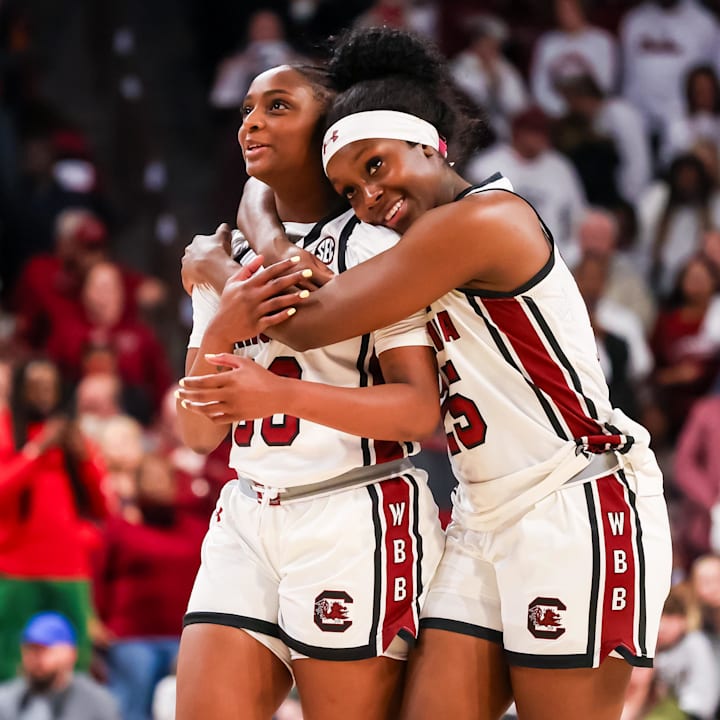
When Ta’Niya Latson and Raven Johnson speak, they can sound telepathic. Just last week, after South Carolina’s dominant victory over Oklahoma in the Sweet 16, the two sat side-by-side at a press conference as their team’s leading scorers when a reporter asked: “Was this the best game that y’all played together?”
Latson and Johnson paused, answered simultaneously, then looked at one another: “No,” they both smiled, shaking their heads with a laugh.
“Not the best,” said Johnson, while Latson continued her thought: “I think it was GEICO Nationals. It was like a monster game for both of us.”
The aforementioned GEICO Nationals wasn’t an NCAA competition — it was a high school championship in the spring of 2021. That’s when Latson and Johnson led Westlake High School of Atlanta to a revenge victory over Paul VI of Virginia, dominating the team that had ended their 34-game winning streak just two seasons before. Despite Paul VI’s coach calling for fans to “get their popcorn ready” for a second-half rally, the Lions of Westlake silenced the Panthers with a 70-50 victory; Latson poured in 31 points and Johnson scored 17, with 8 assists.
“They’re so in tune to what each other can do,” Westlake head coach Hilda Hankerson told The State, speaking about the duo. In three years of playing together, the pair won three state championships. But their connection “didn’t come from coaching them,” said Hankerson. “They just have that instinct.”
That their bond transcends coaching itself makes it unique: something of Latson and Johnson’s own creation. In an era defined by NIL money and transfer movement, this connection offers a different blueprint. It’s one where trust, rather than transactions, drives decisions.
After their years at Westlake together, Latson and Johnson parted ways for separate NCAA programs. But they remained close friends.

A connection built before NIL
Coming out of high school, Ta’Niya Latson was not recruited by UConn, her dream school. Instead, she signed at Florida State, where she became the nation’s leading scorer during the 2024-25 season. After losing to LSU 101-71 in the second round of the NCAA tournament last March (despite Latson’s 30-point performance), she entered her name into the transfer portal just three days later.
Of course, she was still talking nearly “every other day” to former teammate Raven Johnson. At the time, Johnson was in a totally different place — Birmingham, Alabama, competing in the Sweet 16 and Elite 8. By March of 2025, Johnson had already won two national championships at South Carolina, part of ‘The Birdies,’ a recruiting class ushered in by the program-defining ‘Freshies’ class that included WNBA star Aliyah Boston. Poised to become South Carolina’s backcourt leader during her final year of NCAA eligibility, Johnson responded to Latson’s decision to leave Florida State with familiar instinct.
“Trust me,” she told Olivia Thompson on The Coop podcast. “When [Latson] entered the transfer portal, I was the first person to call and text her.” Her memory checks out. Asked by a South Carolina beat reporter the day Latson entered the portal whether she would try recruiting her, Johnson responded: “I’m texting her right now. She’s coming.”
On paper — especially in terms of short-term financial gain — South Carolina wasn’t necessarily Latson’s best choice, as the hottest ticket in the transfer portal at the time. And Staley, in her own words, is blunt about finances. “I don’t like to promise anything that isn’t available to us,” she said recently, pointing to financial constraints as a primary driver of recruiting conversations. “After the pleasantries are done, you have to get to the question so you’re not wasting your time and spinning your wheels on somebody that you can’t afford.”
But in the era of a freewielding transfer portal, the impetus for players to choose where to place their trust — whether in coaches, agents or other players — is unfixed from a four-year commitment, open to negotiation. And it’s a dynamic that favors players’ ownership of their own experience.
At least, that’s what happened when Johnson got Latson’s attention last March. “That’s my sister,” Latson later reflected. “And I knew, me talking to her, she was gonna definitely convince me to come [to South Carolina].”
Less than two weeks later, Latson signed with the University of South Carolina for her senior season. And while the situation might feel rare, in today’s transfer portal, it’s also surprisingly instructive.

When money is everywhere, personal relationships can be the difference
Personal bonds aren’t the first thing you might think of when considering the cash infusion into the pockets of college athletes. But protecting relationships is more integral to navigating the system than you might think — including by design.
At South Carolina, where Dawn Staley is typically involved in every aspect of coaching, recruiting and even negotiating NIL deals for athletes, she also requires players to sign non-disclosure agreements.
“I do make them sign NDA’s about what they get,” Staley told Michelle Obama on her podcast last year. As part of her effort to keep conversations about money from affecting the locker room dynamic, Staley communicates separately and candidly with players. “I’m very honest,” said Staley. “And I tell them, there’s a reason why you get paid this, and you get paid that, right? And I will explain that to them.”
Distinguishing transparency about finances from other aspects of relationship-building is something that many programs are now addressing directly. Often, that begins with staffing.
In 2022, Duke University hired Rachel Baker to what was then a unique position: General Manager of both the men’s and women’s basketball teams. This year, of the programs competing in the Women’s Sweet 16 last weekend, seven included at least one “General Manager” position on staff. And while Front Office Sports has reported two main types of people holding such a position — the “big name NBA player” and the “athletic department employee with less notoriety”. But a third paradigm has also emerged: the former NCAA athlete, who — much like Dawn Staley — understands the sacred importance of locker room culture.
“We do a really good job of separating my role from the coaching staff,” said Meghin Williams, a former college player at the University of Nebraska, now entering her second season as the General Manager at the University of California at Berkeley. “It’s so that our coaching staff can still have really organic relationships. Our head coach doesn't talk to them about money.”
For Williams, one of the biggest stressors of the transfer portal today is the potential for a strong “fit” to be “obscured by the amount of shiny money promised.” Ultimately, one of her major priorities is doing a “culture check” on transfer portal recruits. “It’s almost like speed dating,” she said. “You have like three phone calls and maybe a visit. And the kid has to make a decision on you, and you have to make a decision on the kid.”
Developing a sense of conviction around relationships puts a new kind of onus on players to recognize their needs clearly. “Any time a player coming in knows what they want — when they come in with a vision that's transparent, its a lot easier to navigate recruiting them,” said Williams. “I respect that they're able to be models and actresses and basketball players. They get to form their own identities and that's really beautiful.”
Still, the future can be challenging, even overwhelming. “I could work on something for six months,” Williams said, “and then the NCAA could change legislation and everything could change. It requires a willingness to adapt and be flexible.” Asked about the role of personal relationships in the process, she responded, “Relationships are really important. Keeping that at the forefront is everything.”

Latson and Johnson are ready to carry South Carolina to another National Title
Since committing to South Carolina, Latson has revealed something she knew she wanted while in the transfer portal: to compete for a national championship. “I know a lot of people don't understand my why,” she told the Greenville News. “‘Why the hell would she go to South Carolina to give the ball up?’ But I want to win.” Raven Johnson must have understood this, too. That’s exactly the language she mirrored while “in [Latson’s] ear,” telling the press, "I would tell her, let's run it back.” Back to those Westlake high school championships, that is.
In some ways, Latson’s move to South Carolina reflects a familiar pattern of trusting Johnson (who is a year older) to lead. But if you observe the duo more closely, you can see a clear mutuality in their dynamic. “Ta’Niya, she gives great advice,” Johnson reflected during the interview Bestie Check. “To me, she’s like a mom figure kinda,” describing Latson as both the better advice-giver and breakfast cook. Latson laughed: “I’m the big little sister.” The consideration and respect between them is evident. “It’s certain people in my life that I text back fast -- and Raven Johnson is one of them,” Latson said. For the next question, “Who is your emergency contact?” Johnson pointed right back to Latson: “Right here.”
South Carolina head coach Dawn Staley appreciated this nuance, too. After redshirting her freshman season, Johnson had become the only remaining player from her “Birdies” recruiting class: a solitary position that Staley was deeply aware of. “If you can bring someone in that you shared a backcourt with in high school, I think it brought a certain level of comfort for Raven,” Staley told ESPN ahead of this year’s March Madness. After the Sweet 16 victory over Oklahoma, Johnson lit up when describing Latson’s 28 point performance: “When I see the ball go in for her, I’m like, ‘yes!’ Like my eyes get big.”
The Gamecocks faced their most formidable opponent of the 2025-26 season in the Final Four — the behemoth of UConn, who handedly dismantled South Carolina in last year’s national championship game by a score of 82-59.
In their sixth consecutive year in the Final Four, Dawn Staley’s program came in as underdogs. But they made a statement, outscoring UConn by 16 points in the second half and coming away with a 62-48 win. Latson put up 16 points and 11 rebounds; Johnson played ferocious defense. It still wasn't the best game they've played together, but it was the biggest.
They'll now get a chance at a national championship — Johnson's third, Latson's first — in a brutal matchup against either Texas or UCLA. Winning it all will require improbable belief, lasting trust and the power of well-tested friendship.
[Ed. Note — This story was updated to include details of South Carolina's Final Four win over UConn]
More women's college basketball news and analysis:
 Add us as a preferred source on Google
Maya Goldberg-Safir is an independent writer and audio producer based in Chicago and Oakland. She tells stories about the soul of women's basketball and is the creator of Rough Notes: https://wnbaroughnotes.substack.com/