
Key Points
Bullet point summary by AI
- UConn’s title repeat fell short against Michigan as shooting struggles and early foul trouble for key starters hampered the Huskies’ momentum and defense.
- A massive whistle disparity and poor shooting proved too much for UConn to overcome, as Michigan benefited from fouls on the offensive end.
- Beyond the box score, Dan Hurley focused on his own team's performance rather than blaming the officiating disparity.
The UConn Huskies are sitting at home after losing the NCAA Tournament title game to the Michigan Wolverines. No doubt, from players to coaches, they're all ruminating over everything that went wrong in that 69-63 loss. Fans certainly are, and more than a few have noted a key metric in the box score: Free throws.
There was a double-digit margin between the free throws each team was awarded throughout the game. Foul calls went against UConn more often, resulting in multiple key players getting into foul trouble. Whether they meant to or not, the refs' whistles played a significant role in the outcome on Monday night. But who was at fault for that outcome?
How many more free throws did Michigan take over UConn?
Stats | Michigan | UConn |
|---|---|---|
Free throws made | 25 | 12 |
Free throws attempted | 28 | 16 |
Free throw percentage | 89.3% | 75.0% |
Personal fouls committed | 13 | 22 |
Players with 4+ fouls | 0 | 3 |
The stat sheet doesn't lie. Michigan shot 28 free throws, making 25 of them. UConn shot 16 and made 12. That's a disparity of 12 free throws attempted. Michigan was +13 in points from the charity stripe.
The disparity wasn't just because UConn had to foul late to stop the clock. In the first half, the Wolverines were 11-of-12 from the line. The Huskies were 4-of-6.
So Michigan had a game-long advantage in terms of free throws and it affected UConn's ability to keep up. Of course, the raw numbers can never tell the whole story.
How did the free throw disparity impact UConn?
UConn and Michigan went into halftime at 33-29. The Huskies trailed by four after watching the Wolverines score 33 percent of their points at the free throw line. That, however, wasn't the biggest issue for Dan Hurley's team. Fouls impacted UConn both in terms of defensive aggression and momentum.
With 3:16 remaining in the first half, Alex Karaban was tagged for a flagrant foul for a "hook and hold." Michigan had missed all but one of their last nine shots and their previous six points all came from the line. They added two more after the Karaban flagrant and then hit three more layups in the minute that followed to build their halftime lead.
Alex Karaban was called for a Flagrant 1 foul for a "hook and hold" on this play@GeneSteratore breaks it down pic.twitter.com/9P6dHkzIqX
— CBS Sports College Basketball 🏀 (@CBSSportsCBB) April 7, 2026
It was a clear momentum shift, though one that few would argue was the fault of the refs. Karaban did indeed commit the foul he was charged with. Still, the foul shots that came before were the only thing keeping Michigan in the game.
The calls on Solo Ball, Silas Demary Jr. and Tarris Reed Jr. were more significant. Each of those players had two personal fouls to his name going into halftime. Early foul trouble can't help but change a game as players have to be more careful and less aggressive while defending. The Wolverines took advantage by attacking the paint, scoring 36 points in the paint to UConn's 22.
Almost immediately in the second half, Ball picked up a third foul. He had four with more than half of the second to play, resulting in just 17 minutes on the floor. Demary only played 21 minutes and ultimately fouled out just before the final minute. Reed managed his fouls, ending the game with three. Still, he could hardly be at his best defensively while walking that tightrope.
Whistle or performance: What actually caused UConn's downfall?

Foul disparities often mirror an age-old quandary: Which came first, the chicken or the egg? Did UConn lose to Michigan because foul trouble hampered them and the Wolverines benefitted from their trips to the line? Or did UConn have foul trouble and let their opponent rack up points at the line because they got outcoached and outplayed?
Two things can be true: The refs called a tight game that benefitted Michigan and UConn failed to adapt to the circumstances of the game.
Michigan missed all eight of their 3-point attempts in the first half. So it was natural for them to start attacking the paint. They had 22 points on the inside in the first half alone. That's as many as UConn had in the entire game.
The Huskies kept chucking up triples, going 5-of-15 in the first half and 9-of-33 in total. Nearly half of all UConn's attempts on the night were from distance. That explains their free throw totals relative to Michigan. UConn wasn't attacking the rim the way Michigan was. More than half of the Wolverines' points were scored in the paint.
So it's just not as simple as "Michigan attempted 12 more free throws than UConn." The flow of the game contributed to that number, certainly enough to reduce any concerns that the refs held some sort of bias.
UConn fans won't want to hear this, but the final verdict is clear: It wasn't the refs, it was the performance and the matchup.
Dan Hurley's postgame comments say everything
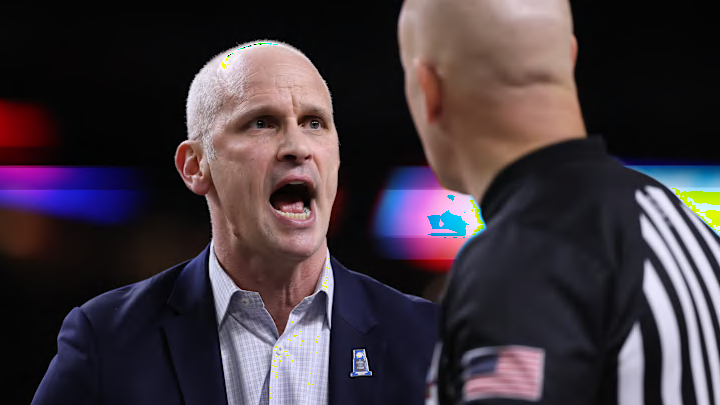
Hurley isn't afraid to criticize the refs when given the chance. During the game he was irate, as he normally is. However, after the game, his comments weren't directed at the refs. He instead focused on the two things that did doom UConn: Michigan's size inside and the Huskies' inability to hit shots.
"They're just so hard to score against at the rim," Hurley said. "I could talk about the threes that we missed tonight—I thought we had a lot of good threes that we missed. But they just made it so tough on us around the rim."
In the end, UConn lost the game not because Michigan scored more from the line, but because they were 21-of-68 from the field.
More college basketball news and analysis:
 Add us as a preferred source on Google