
Key Points
Bullet point summary by AI
- The women’s college basketball season concluded with record viewership, highlighting a growing fanbase and engagement levels.
- Recent data shows that female athletes are securing more NIL deals per player despite receiving a smaller share of revenue compared to male athletes.
- Female fans demonstrate stronger individual player loyalty and higher consumption of athlete-promoted content, presenting a lucrative opportunity for brands.
With UCLA taking home a hard-earned NCAA trophy — and Dawn Staley and Geno Auriemma back on good terms — the women’s college basketball season has officially ended on a high note. The championship game earned around 9.9 million views, the third highest of all time, up 15 percent from last year’s final. If that weren’t enough, Final Four viewership was the highest since ESPN began broadcasting the event in 1996.
Women's college basketball represents a highly effective yet underinvested market in relation to its fan engagement and consumer behavior within the economic sphere of NIL deals. Though superstars like Caitlin Clark and Angel Reese accelerated the sport's social and economic growth, audiences’ sustained interest after their transition to the WNBA suggests that women’s college basketball is a significant part of the broader women’s sports boom.
The question of how to compensate student athletes has long loomed over collegiate athletics. Until recent years, the only monetary compensation college athletes could receive for their athletic ability was scholarship. After July 2021, however, athletes gained the ability to profit from their name, image, or likeness (NIL). Athletes can now receive NIL money from three major categories: commercial dollars from merchandise, like autographed products, or advertising deals with brands; collective dollars from boosters and donors; and collegiate dollars from schools and conferences using players to boost engagement.
NIL dollars are flowing into women's hoops
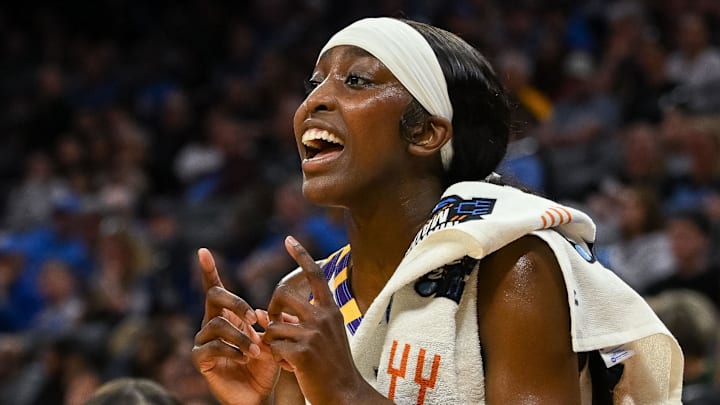
This season’s most valuable women’s basketball athlete was LSU’s senior guard Flau’jae Johnson, whose NIL valuation reached around $1.5 million. Her partnerships included national brands like Papa Johns, Doritos, Powerade, Footlocker, Apple, and Puma. Azzi Fudd, UConn senior guard and the projected first round draft pick, has a valuation close to $1 million, thanks to deals with companies including Chipotle, Geico, Doordash, Bose, Marriott Bonvoy, and more.
Johnson and Fudd are two of thousands of athletes who have used their marketability to earn money. This past year alone, ESPN reported that 8,300 NIL deals were approved by the College Sports Commission, totalling just shy of $80 million.
Women athletes represent only around 32 percent of all NIL deal submissions, yet often outperform their male counterparts in digital engagement. A 2021 study by Axios reported that when combining followings from both men’s and women’s Elite Eight teams, eight of the 10 most-followed players were women. Similarly, Opendorse reported in 2024 that across men’s and women’s Sweet Sixteen players, women’s teams had a social media following 3.2 times larger than their male counterparts.
Why women athletes provide more NIL value
Engagement translates into measurable commercial activity. According to Sports Business Journal, female athletes average more NIL deals per athlete than their male counterparts, even though football and men’s basketball receive around 90 percent of collegiate revenue sharing dollars. Some of that disparity can be attributed to the sheer number of male athletes participating in those sports. However, consistently high engagement with comparatively limited funding suggests that the return on investment for women’s college basketball players may ultimately be higher.
The market potential of these NIL deals becomes even more promising when we examine the profile of female women’s sports fans. Though just over half of women’s sports fans are male, female fans are more likely to identify as avid supporters. Of these avid fans, 45 percent report following a favorite player rather than a team, and are more likely to consume behind-the-scenes content on social media. Fans who engage with athletes as individuals rather than as part of a team are more likely to engage with athlete endorsements and purchase athlete-promoted products. Thus, fans who identify as avid followers represent a particularly lucrative consumer base for advertisers and sponsors crafting social media campaigns around a single athlete.
In addition to being highly engaged fans, women are increasingly powerful economic agents. Between 2018 and 2023, wealth controlled by women increased 51 percent. Women’s median deposit account balances were 35 percent higher in January of 2026 than in 2019, according to Bank of America.
Investors have the opportunity to target a highly-engaged, eager consumer group that will only grow larger as women’s sports continue to increase in popularity. In an NIL economy that is repositioning athletes as influencers, collegiate women’s basketball players may be the most promising yet underutilized market.
More women's college basketball news and analysis:
 Add us as a preferred source on Google