
College football continues its tailspin into a free-for-all market of transfers and NIL deals. The longer things go without a governing body to regulate and rein in the chaos (no, not the NCAA), the more student-athletes are going to be victimized by the consequences.
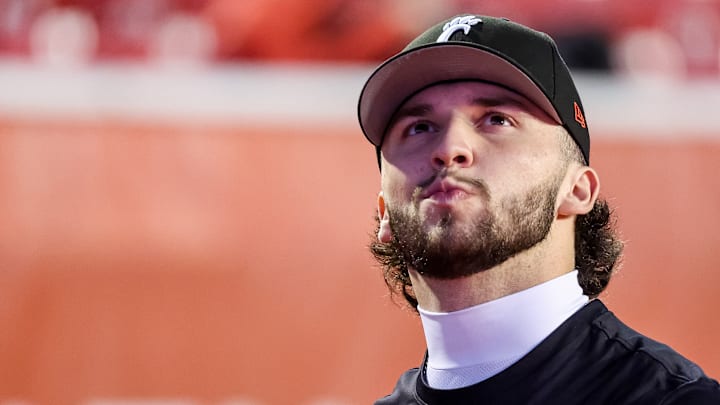
The latest unfortunate casualty of the current environment is former Cincinnati quarterback Brendan Sorsby. The 22-year-old transferred to Texas Tech after the 2025 season but was sued by his former school for allegedly breaching his NIL contract. The Bearcats are seeking a $1 million exit fee they claim Sorsby still owes them for departing to Lubbock.
According to the lawsuit filed in U.S. District Court for the Southern District of Ohio, Sorsby was contractually obligated to pay Cincinnati the $1 million within 30 days of transferring. He allegedly violated the terms of his deal by appearing in a Times Square billboard announcing his commitment to the Red Raiders.
Sorsby's agent called the lawsuit "misguided" in a statement released Wednesday but the defense he hinted his client would take was concerning.
"[Sorsby] generated millions in value for the program," Ron Slavin of Lift Management said. "Attempting to recover those funds now sends the wrong message to current and future student-athletes and risks damaging the long-term credibility of Cincinnati football. This is further disappointing given that Brendan parted ways with UC in what was a mutually agreeable manner. The money the university seeks to recover from him is nothing more than an unlawful penalty under Ohio law."
CFB 'street agents' are being exposed by lawsuits over breached NIL deals
I'm not in any way accusing Slavin of being a so-called "street agent" — typically an unlicensed individual representing a student-athlete — but his clear lack of legal understanding is just further proof somebody needs to step in and protect players from opportunists.
Firstly, deflecting blame from Sorsby (and really his representation of the QB) by making Cincinnati out to be a greedy organization squeezing his client after benefitting from his services isn't the own he thinks it is. The Bearcats finished 10th in the Big 12 last season and it's not like Sorsby's name recognition rose to the level of a Fernando Mendoza or Carson Beck either.
Second, it feels like he's attempting to distract from the appearance that Sorsby's camp misunderstood, or missed entirely, the exit fee clause triggered by his departure to Texas Tech. Perhaps the organization that published the Times Square billboard jumped the gun on the announcement but either way an agent's duty is to make sure his client's bases are covered.
Finally, it's a simple matter of contract law to be settled in court. Sorsby's camp can claim the penalty is unlawful (and that'll be interesting to see argued) but if he signed a contract that explicitly stipulated he owes the school $1 million in the event of a transfer before the termination date of the said agreement, then it can't get more black and white than that.
Sorsby isn't the first to be taken to court over NIL breaches and he certainly won't be the last. Duke sued former QB Darian Mensah in January in an attempt to prevent him from transferring to Miami by claiming he had to fulfill his multi-year NIL commitment. The two sides settled outside of court, however, and Mensah will be a Hurricane for the 2026 season.
It's actually a good thing that a case like Sorsby's will be publicly litigated because there will finally be some hard precedent to go off of in the future. It'll also hopefully cause athletes and their families to think twice about who represents them in negotiations.
It's unfortunate somebody's got to be the guinea pig but better a guy like Sorsby with seemingly established and reputable representation go through it than a no-name who signed a deal advised by an uncle or some dude who contacted him via social media (which happens more often than you think).
The outcome of Sorsby's case will influence future NIL negotiations and perhaps even cause athletes to refuse to sign deals unless such an exit fee clause is removed. This should empower them but also spark the need for the necessary governing body to regulate how those negotiations can proceed.
A legal lesson will be learned but its effects will hopefully have positive repercussions throughout the sport.
More college football news and analysis:
 Add us as a preferred source on Google