
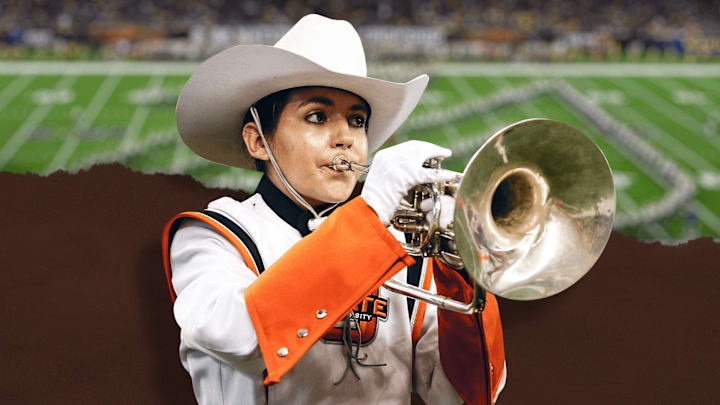
This story is part of FanSided’s Fandoms of the Year, a series spotlighting the teams, athletes and cultures that defined sports fandom in 2025.
As the morning sun begins is ascent, the dew glistening on the blades of grass is swept off by the steady stream of athletic shoes, and the sound of the morning songbirds becomes overshadowed by a thunderous barking of orders through a bullhorn. Hundreds of young people stand shoulder to shoulder, poised on chalked yard markers, ready to begin the day's drills.
No, this isn't a branch of the armed forces, nor is it a football team preparing for a practice. This is the common start of a daily grind for marching band members in colleges across the country.
College football sets itself apart from other sports — both professional and college — in multiple ways. The traditions, the passion of the fans, and the anticipation after a long layoff each season all add to the uniqueness of the sport.
But there's one thing that makes the ambience of a college football game enormously different, and that's the marching band. They provide the roar, the pulse, and the energy that makes a college football game an experience like no other.
At some schools, the bands are just as famous — sometimes even more — than the football team. But whether they're given accolades or not, they are an integral part of the game.
Is Marching Band an art form or a sport?
The members of a college marching band have come a long way from the "band geek" personae commonly associated with high school band members. But shedding the nerd label has given birth to another debate — art or sport?
Truthfully, both answers can be right.
The physical requirements for members of a college marching band can parallel those of many football players, and the health risks can be just as severe.
While marching band members aren't necessarily participating in full contact drills and running laps around stadiums, they do find themselves involved in activities that have similar effects on the body.
For instance, the average Sousaphone weighs between 20–35 pounds, a bass drum weighs between 15–25 pounds a snare drum around 15 pounds, and most other instruments weighing between one and five pounds each.
These instruments are either strapped over the shoulders, resting on the back, or being held up at shoulder height for hours at a time by a marching band member.
Rehearsals and games will go on in temperatures soaring over 100 degrees or dipping below the freezing mark, and in every known type of weather event from snowstorms to hurricanes and everything in between.
Randall Coleman, the former Associate Director of Bands at the University of Alabama and current Director of Bands at the University of Tennessee at Chattanooga, gave some insight into the demands made of members of a marching band.
"Marching band is a class that the students take for credit, so that impacts some schools," Coleman said. "At Alabama, the marching band class meets Monday-Friday, five days a week for 90 minutes each day. Most groups also have a rehearsal before the game on game days.
"Game days are very long for home games. Depending on the kick time, normally most groups do a 90-120 minute rehearsal early, and then there are typically different performances around campus for smaller groups all day, culminating with the game.
"Most game days are 14-16 hour days for the bands. At Alabama, we typically did three different shows each year. Some big university bands do a different show from each home game, making for six to seven different drills, it just depends on the tradition at the school."
And this one time, at band camp ... yes, it's a real thing but not what has been portrayed by Hollywood.
"At both Alabama at UTC, students are back a full week before classes start for a preseason camp, and do three blocks each day; morning and evening blocks are outside, afternoon blocks are inside for section rehearsals and full ensemble music rehearsals."
A marching band may even travel with the teams at times, eating up even more hours and physical exertion on its members.
"At Alabama, the full band typically traveled to Knoxville for the Tennessee game and to Auburn for the Iron Bowl. All other away games were attended by a Pep band of 50–100 members. Full band travel is being significantly reduced by the schools. My guess is, full band travel to away games is going to be a thing of the past very soon."
Coaches are learning to appreciate and recognize the marching bands
More and more, we see head football coaches giving a public nod to the band for all the hard work, support and — let's face it — noise they create to make an outstanding game atmosphere.
Before the 2025 season began, Florida State head coach Mike Norvell addressed the FSU Marching Chiefs, the organization who boasts to have "never lost a halftime show", to show his appreciation for what they bring to the program.
"There is no band in the United States of America that makes a greater impact on game day than you do," Norvell told the band. "And the world doesn't know just how hard you work on a daily basis, but I do!"
Many thanks to our Head Coach @Coach_Norvell, for stopping by our practice. His speech to us, as usual, was inspiring. So much so we were all ready to MARCH through a brick wall afterwards. Thanks for always taking time to show us your appreciation and support, Coach. #mcatdt pic.twitter.com/FPyE4XsLH2
— Marching Chiefs (@FSUChiefs) August 23, 2025
Georgia head coach Kirby Smart recognized the Georgia Redcoat Band after the Bulldogs' crucial win over Alabama in the SEC Championship Game this year, and the band members went bonkers upon hearing their head coach call them out.
"I want to thank the band especially. The band has been incredible, and loud, and rockin'. We love our band!"
Kirby Smart thanks the Georgia Band#GoDawgs pic.twitter.com/vOftQgK5f4
— Audrey 🐶 (@GothStatsNerd) December 7, 2025
When people as important as these head coaches bring the bands front and center, it makes all the hard work, sweat, injuries, and long hours more than worth it for these kids.
Marching bands carry the traditions
If you love college football, you are more than likely a fan of the traditions that follow the sport. Some of the greatest traditions in the game are carried by, and would not continue without, the marching band. Think about some of the great ones.
- Ohio State's dotting the "I"
- Purdue's "Big Bass Drum", the world's largest and loudest
- Florida State's tomahawk chop chant
- Georgia's Redcoat Band lighting up Sanford to the Krypton Fanfare
- USC's Trojan Band and the Parade to the Coliseum
- The Penn State Blue Band and their drum major's running front flip through the band (often linked to the superstition that the Nittany Lions will win if he lands it)
The list is endless, and every school's band brings something special to make a game day experience unique and energetic.
Traditional music, traditional chants, traditional uniforms -- all of this adds to the makeup of an extraordinary experience when you attend or watch a college football game. There is nothing quite like the sound of the marching band bringing the energy to impact the game and to rouse up the crowds.
The college marching band isn't an extra, it's a necessity, and the game would be a pale experience without them.
More FanSided Fandoms of the Year:
 Add us as a preferred source on Google