
The streets of Bloomington were still booming even after the noise and bustle had faded.
I arrived in the city just one day after Indiana had won the College Football National Championship, long after the streets had emptied and the barricades were gone, but the evidence was everywhere. Pieces of confetti were still scattered on the sidewalks. A few bent street signs leaned at odd angles. You didn’t have to squint very hard to imagine what had just happened here.
Bloomington finally had time to enjoy the fruits of Indiana's labor
This was my first time in Bloomington. My first time on Indiana’s campus. And it felt like I’d walked into a place still catching its breath.
Just one night earlier, Kirkwood Avenue had been swallowed by a sea of students. The stories were already becoming legend. People were seen climbing lampposts, scrambling onto rooftops, disappearing into bushes, the street so packed it barely looked passable. It was pandemonium, but the kind born from disbelief finally giving way to pure and utter joy.
Indiana football had just done the impossible. A program that once carried the weight of inevitable ineptitude now carried a trophy instead. And the celebration in Bloomington wasn’t over just yet.
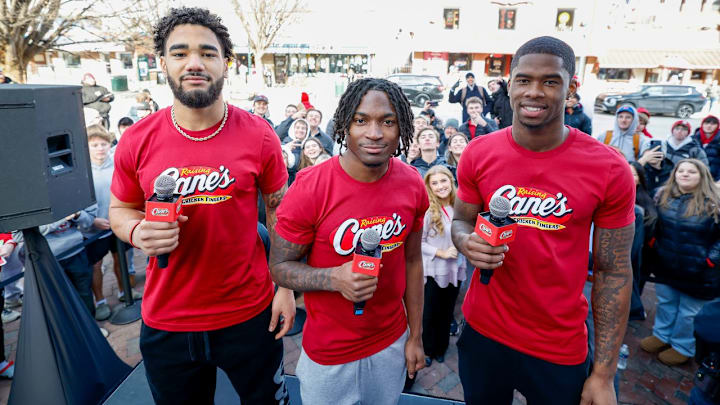
That’s what brought me here in the first place. I was in town for a Raising Cane’s event just days after the game, where Indiana players Elijah Sarratt, D’Angelo Ponds, and Jamari Sharpe returned to campus to work a celebratory “shift” and greet fans. They were back among their people, in the same place where the city had spilled into the streets not long before.
And it very quickly became clear that this story wasn’t just about a championship. It was about what Bloomington looked like once it finally had time to revel in the spoils.
For Indiana student Noah Eaton, his moment of celebration didn’t unfold on the street, at least not at first. It happened from above.
A senior, Eaton was packed inside "The Upstairs Pub," a popular bar overlooking Kirkwood, surrounded shoulder-to-shoulder by students who had lived every snap of Indiana’s meteoric rise. When Sharpe hauled in the game-sealing interception late in the fourth quarter, the tension that had been sitting on Bloomington all season finally snapped.
“I just looked out, and everyone flooded the street,” Eaton said. “People were climbing buildings, jumping into bushes, light poles, all sorts of crazy stuff.”
The scenes outside quickly took on a life of their own. Videos spread of students scaling storefronts, perching on traffic lights, and pouring into every inch of available space. This was a city exhaling after decades of being told this kind of moment wasn’t meant for them.
Eaton had traveled all season. The Rose Bowl. The Peach Bowl. The Big Ten Championship. He could have gone to Miami for the title game, too. Instead, he stayed home.
“I wanted to be here in Bloomington for it,” he said.
He wanted to be with his peers — his people — when it mattered most, in the place that had waited the longest. That instinct, to be here, showed up again and again with every person on the street I spoke to.
Bo Rodriguez, a sophomore at IU, watched the national championship from Assembly Hall alongside roughly 15,000 other students before making the short walk toward Kirkwood as soon as it ended.
There was no hesitation. He knew where the night was headed. The celebration felt too rare to risk missing. He didn’t know when (or if!) something like this would ever happen again.
“These guys are folk heroes,” Rodriguez told me. “I want to tell my grandkids I was here.”
Days later, that same impulse had him standing outside Raising Cane’s well before the event began, attending a Zoom class from the sidewalk while waiting to meet the players.
Indiana’s title wasn’t something students wanted to watch alone on a screen or process quietly after the fact. They wanted to be shoulder to shoulder — in Assembly Hall, on Kirkwood, in the cold — experiencing it together.
Because this was both a win to remember and a moment to be present for.
Curt Cignetti changed everything for Indiana football

In reality, the scale of what Indiana accomplished is almost easier to feel than explain. The Hoosiers entered the season at 100–1 odds to win the national championship. For most of its existence, Indiana football had been defined by losing.
That’s not hyperbole, either. The Indiana football team was quite literally the losingest major program in college football history entering the 2025 season. They were a punchline. A stepping stone. A place where lowly expectations were learned, not challenged.
Then came Curt Cignetti.
Hired after the 2023 season, Cignetti promised a new standard in Bloomington. Discipline. Belief. This was a team without a single five-star recruit that rarely beat itself and never backed down.
Indiana became the first team in modern college football history to finish a season 16-0. What followed was a perfect ending to a turnaround that still feels fictional. Indiana became the first first-time national champion since Florida in 1996, and maybe the most unlikely title winner the sport has ever seen.
This championship did something more powerful than rewrite the record books. It changed what felt possible for an entire university, and, really, an entire city.
But for some newer fans, this season felt like more of an established baseline under Cignetti than a sudden breakthrough.
Briana Kania, a sophomore at IU, admitted she’s never really known Indiana football any other way. By the time she arrived on campus, the losing years were already in the rearview.
“I’ve never seen Indiana football be bad since I’ve been here,” she said. “Which is wild, because that wasn’t the case for a very long time.”
She’d heard the stories, though. Her uncle, an Indiana alum, used to tell her about tailgating without ever going to the games. He’d tell her about tickets being handed out on pizza boxes. About when football barely registered as part of the campus identity.
That contrast is now impossible to ignore.
Kania watched the championship from her apartment, then walked straight to Kirkwood once the final whistle blew. Classes the next day felt optional. Many were. The city and campus moved on a different rhythm, still processing what had just happened.
Indiana has always been known as a basketball school. Five banners. A legend in Bob Knight. Football existed on the margins — but not anymore.
This championship rewarded decades of patience and altered expectations for an entire generation of students who may never know what Indiana football used to be.
Indiana players felt the magnitude of their season during Raising Cane's shift

By the time the players arrived at Raising Cane’s, the title had already been celebrated, but fans weren’t done showing their appreciation.
Sarratt, Ponds, and Sharpe were back on Kirkwood, bundled up against the cold, taking photos, signing autographs, and greeting familiar faces — classmates, friends, people they recognized.
Sharpe spotted a few of his own friends outside the venue. There were hugs. Handshakes. These weren’t global superstars returning from a title run. They were local heroes coming home.
Fans lined up again, days after the streets had already emptied once, willing to stand outside just to be close to it one more time. The event itself was simple and down-to-earth, and in a way, so was everything else about the celebration. It was Bloomington in a nutshell.
The celebration felt just as much like relief as validation for the players.
“It’s still just hitting me that we won,” Ponds said. “We were overlooked and underrated, and I’m glad we took advantage of the opportunity we had.”
That feeling — of being overlooked, of waiting for a chance — mirrored the program’s past as closely as it did the fans now lining up to see them. Indiana didn’t arrive here with hype or blue-chip pedigrees. But it did arrive as one collective unit. A sum greater than its parts.
Sarratt kept coming back to the people who had been there from the start.
“The fans deserve it,” he said. “We wouldn’t be able to have the success we’ve had without them.”
Sarratt also talked about the time spent together, the shared work, the finality of it all. About a season that ended undefeated, and how permanent that felt.
“We were undefeated,” he said. “And no one can take that away from us.”
As for Sharpe, he didn’t need many words.
“I’m happy for our fans,” he said. “I know they’ve been waiting for this for a long time.”
In a week filled with noise and spectacle, those moments definitely stood out. Players and fans meeting in the middle, each acknowledging what the other had endured to get here.
Football is no longer on the periphery in Bloomington

The impact of Indiana’s recent success stretches well beyond the celebration itself, too. Those I spoke to noticed it almost immediately — more people in town, more packed storefronts, more weekends that felt different than they used to. Indiana football was winning games, sure, but it was also changing the outlook of the entire city of Bloomington.
Local businesses have felt it. Hotels have filled up. Restaurants are busier than ever. Game days stopped being something to plan around and started becoming something to build toward.
For years, football existed on the periphery here, something tolerated rather than embraced. Basketball carried the identity. Football filled the gaps.
But that’s not the case anymore. Football has become synonymous with the University of Indiana, and that’s not a phrase that anyone believed would be uttered just a few short years ago.
This championship didn’t just elevate a college football program. Instead, it altered the rhythm of the city itself. It created a feedback loop of energy and pride that Bloomington hadn’t experienced before. What happened on the field spilled into the streets, into businesses, into the way people talked about the town they lived in.
And once that community shift happens, it’s hard to reverse it.
Eaton spoke one last time about watching a program he’d grown up with go from four wins as a freshman to perfection as a senior.
“I want to tell my kids someday what a special story this was,” he said. “That the impossible became possible here.”
That idea kept surfacing in different ways, from students who planned their days around being present, from players who never stopped hearing they weren’t enough, from a city that had waited decades for a moment it wasn’t sure would ever come.
Indiana football won a national championship. On paper, that’s the headline.
In Bloomington, it was something a little deeper. It was a release. A reset, if you will. Proof that a program — and a city — could shed the weight of its past without pretending it never existed.
There were still remnants of confetti on the street by the time I left. Not everywhere, but enough. A reminder that the celebration may have already happened, but its meaning will linger.
And in Bloomington, it certainly still does.
 Add us as a preferred source on Google