
Key Points
Bullet point summary by AI
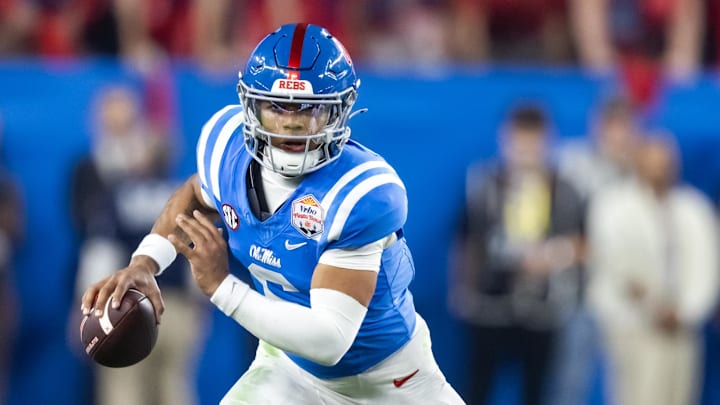
- The Mississippi Supreme Court denied the NCAA's appeal, allowing Trinidad Chambliss to gain an extra year of eligibility.
- It's clear the NCAA's influence over college football is diminishing with every verdict. They've lost more often than they've won.
- It's only a matter of time before college football breaks free completely from its governing body.
The end is nigh for the NCAA. It knows that and Friday's legal loss in the Mississippi Supreme Court was just the latest sign college sports — and college football specifically — is going to long outlive the so-called governing body.
The NCAA's appeal of a ruling that grants Mississippi quarterback Trinidad Chambliss an additional year of eligibility was denied by the panel of nine justices, meaning the 23-year-old is immediately eligible to play for the Rebels in the upcoming season.
NEWS: The NCAA’s appeal to the Mississippi Supreme Court in the Trinidad Chambliss eligibility case has been denied. He’ll be eligible to play for Ole Miss in 2026. pic.twitter.com/GbrhRLNhxI
— Pete Thamel (@PeteThamel) March 27, 2026
Since November 2024, the NCAA has lost 12 of 16 eligibility cases in which a court of law has granted an injunction or stay in favor of the player suing. It's navigated over 55 lawsuits dealing with other issues such as NIL in that span as well.
It doesn't take a sports fan to know winning four out of 16 times is not good.
NCAA's latest legal loss signals its desperate to cling to power and relevance
The supposed governing body of college sports is consistently having its regulations determined to be illegal. That should tell the NCAA it needs to adapt rather than double down.
In its whopping 658-page filing to the Mississippi Supreme Court, the NCAA essentially argued state and federal judges shouldn't have jurisdiction over its rulings.
"If courts can intervene in NCAA eligibility decisions to provide special treatment to favored athletes...then the NCAA’s ability to ensure fair athletic competition in which all participants play by the same rules will depend upon the whims of trial courts throughout the country," its attorneys wrote scathingly.
In fact, the NCAA is getting so desperate its gone to Congress to ask for a way to circumvent the U.S. judicial system altogether on things like eligibility rulings to invalidating NIL deals. On Thursday, the Senate held a committee hearing to field ideas and learn about the impacts of potentially passing legislation — the SCORE Act — that adds guardrails to compensation for student-athletes.
If the NCAA needs the federal government to step in and validate its power over schools and conferences, then those institutions are just going to figure out a way to get out from under its thumb and enjoy the protection of the free market. College football and basketball alone generate enough revenue for conferences to go to their members and form a super league outside the NCAA's purview.
The continued evolution of the College Football Playoff from a one-bid per conference affair to now a dozen-or-more-team bracket designed to favor multiple bids from the Big Ten and SEC is most glaring example of how much power conferences already have over the NCAA. If courts continue to dilute its authority across other facets of the bylaws, then the NCAA will be completely toothless.
Perhaps that's a natural evolution. It took the League of Nations withering away to give birth to the United Nations (regardless of how toothless anyone thinks that organization also is). For all we know a more effective organization may rise to finally rein in the robber barons in the Big Ten and SEC. We can only hope.
More college football news and analysis:
 Add us as a preferred source on Google