
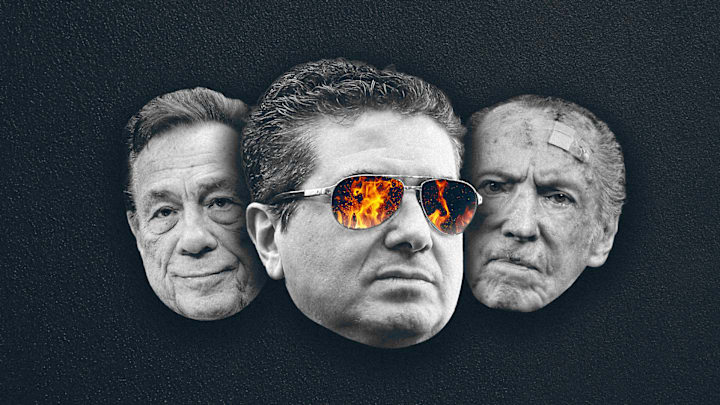
There’s little pain that’s like the pain that comes with loving sports. It’s a different type of heartbreak; one that you can’t quit. We will return again and again no matter how many times our teams fail to live up to our lofty expectations. We are married to our sports teams, and the divorce rate is shockingly low.
There is nothing that makes having that sports relationship harder than having a bad owner. We can survive bad coaches. We see them get fired all the time. Even GMs and other front office personnel have a limited ability to ruin one’s fandom. Most GMs aren’t there for a full decade. These are all situations where the pain they cause is limited by time.
However, a bad owner can be forever. Bad owners are the one issue that can truly chase a fanbase away, sometimes forever. Bad owners will cause a stadium or arena to empty. It forces season ticket holders to cancel their plans and burn their jerseys. And as long as franchise values keep skyrocketing, it’s unlikely those bad owners are selling their best asset anytime soon. Yet, there are some clear owners who stand out above the rest.
10. Al Davis: Oakland/Los Angeles Raiders
There are a few reasons why an owner can become a “bad” owner. Some are outright terrible and embarrass you to be a fan, making it near impossible to wear your favorite team’s gear out in public. Others are so unbelievably cheap that there’s no reason to buy your favorite player’s jersey. The second he or she needs a contract, they will be jettisoned to another franchise. Then, there is the owner who just meddles in everything and usually messes it up. That’s Al Davis.
Davis has his fans, and many remember the early days of Raiders football when they were a championship franchise. It was the dog days of football when knocking someone’s head off was a priority. Davis was ahead of his time in prioritizing skill and speed in the game. He wanted the flashy player. At the same time, he became a meme by the end of his life.
Davis was a great owner in many ways, pushing for civil rights both in the league and outside of it, helping with the AFL-NFL merger, and opening doors for women in the league. However, moving his team twice, breaking the hearts of millions in Los Angeles and Oakland in the process, has to get him on this list. He benched Marcus Allen, one of the best running backs ever, for two years over a contract dispute. He was resentful and vengeful to a point that it did hurt his legacy. Also, he brought Mark Davis into this world, and he’s much worse than his father in terms of competence.
9. Leonard Tose: Philadelphia Eagles

Can you imagine Philadelphia without the Eagles? Might as well remove cheesesteaks from the city, while you’re at it. Well, that almost became a reality thanks to Leonard Tose's incompetent ownership. A lifelong Eagles fan, Tose saw an opportunity to realize his dream of owning a team he loved.
On paper, it’s exactly what we want as fans. We want one of us to own the team. We want the emotions that come with losses to hurt ownership as much as they do us. This felt like a move the whole city would love. He started as a 1 percent owner of the team in 1949 before that share was bought out in the 1960s. In 1969, he had the opportunity to become the primary owner of the Eagles.
Unfortunately, Tose was a compulsive gambler, and those debts caught up with him. As he faced tens of millions of dollars in debt, he tried a few … interesting options, using the Eagles as bait. He tried to move the Eagles to Phoenix, Arizona, but that failed. Then, he tried to trade franchises with Ralph Wilson, who was the owner of the Buffalo Bills. That also failed, and he was forced to sell the Eagles for $65 million, $25 million of which went straight to Atlantic City casinos.
8. Peter Angelos: Baltimore Orioles

One thing people can’t say about Peter Angelos is that he was cheap, at least at first. As soon as he and a group of investors bought the Orioles in 1994, he went on a spending spree. That was rare since the league was heading towards labor strife, but it didn’t stop him from signing Rafael Palmiero, Sid Fernandez, Chris Sabo, and Lee Smith. Angelos got his riches from being a superstar labor attorney, yet he left many other owners taken aback with how he handled the 1994 players’ strike. He refused to sign the document canceling the season because it outright blamed the players, and when it came time to negotiate the return of baseball, Angelos was left out.
Fans really liked Angelos at first, but he started to be too involved in operations and even made decisions on firing managers on multiple occasions. It got to a point where it seemed like every decision made in Baltimore had to go through Angelos.
Eventually, the weight of Angelos caused the Orioles to go into a steep rebuild. The spending stopped, as did the winning. From 1998 to 2011, the Orioles finished in either 4th or 5th in the AL East every year except one, when they finished third and still missed the playoffs.
7. Fred Wilpon: New York Mets

The Bernie Madoff scandal was a black mark for so many in the finance industry, but once it settled and everyone faced their penance, it wasn’t discussed as much. That is, except for those in the New York Mets. See, Wilpon was one of the main investors in the Madoff scandal, and despite earlier reports that he was a victim, it turned out he was one of the few people who came out ahead. Because of that, he was sued by Madoff’s victims
Wilpon’s ownership of the Mets started in 1980, but it was incredibly small. He continued to buy more and more shares, eventually taking a 50/50 stake in the team in 1986. In 2002, the Wilpons bought the remaining shares of the Mets and became sole owners.
Then, the Madoff situation collapsed. The Mets were signing players to deferred deals, investing the money with Madoff, and hoping to profit from the deal long term. With that money gone, and Wilpon on the hook for many of the victims, as well as those deferred salaries, the money situation was dire in Queens. Eventually, they let free agents go and didn't make upgrades to the stadium because they just didn't have the money. The Mets continued to take on debt and ask for loans before eventually selling the team to Steve Cohen in 2020.
6. Ted Stepien: Cleveland Cavaliers

In the 1980s, Ted Stepien continued to buy more and more of the Cleveland Cavaliers until he held a controlling interest (eventually up to 82 percent). He made a few disastrous decisions, and he even considered playing some of the team’s home games in Pittsburgh, Cincinnati, and Toronto. At one point, with dwindling fan interest due to Stepien's mistakes, he threatened to take the team to Toronto for good.
Stepien was known to do interviews where he’d make racist or inflammatory remarks about the makeup of the league. He took over the team’s broadcasting rights, and that caused longtime play-by-play announcer Joe Tait to lose his job. On the last game of the 1980-81 season, the fans came to the arena to honor Tait, and that’s it. It was the best attendance for a game in four years. In the 1981-82 season, Stepien fired three different coaches.
Stepien’s lasting legacy was trading away first-round picks. He was so bad with draft assets that the league banned him from trading picks away. The NBA even considered banning teams from trading consecutive picks across the board, and they eventually opened up trading for the Cavs, but all trades needed league approval. When Stepien eventually sold the franchise to the Gund family, the league allowed them to pay a hefty sum to get the first-round picks back.
5. James Dolan: New York Knicks and New York Rangers

James Dolan is what happens when you make an egomaniac the owner of two of the most important teams in two different leagues. As the owner of the New York Knicks and New York Rangers, Dolan has had very little success. Both teams have spent decades closer to the basement than a championship. He puts terrible people in charge, gets into fights with franchise legends, fans (including banning them when law firms go after his business dealings), and much worse. Dolan is a stain on the legendary New York sports scene.
Obviously, there’s the losing, but the Knicks and Rangers are run by a special level of incompetence, and it falls on Dolan most of the time. The Isaiah Thomas era in New York was a disaster. Phil Jackson’s leadership role in New York did nothing to push them forward. That is literally the only black mark on Phil Jackson’s career.
And the real issue is he’s connected to multiple sexual assault and harassment claims. In 2007, he was part of a lawsuit brought on by a Knicks executive, which the Knicks and MSG lost and had to pay out $11 million. That also involved Thomas. After this all settled, Dolan made Thomas the president of the WNBA’s New York Liberty. That was obviously not well received, and one of the first moves after the Liberty was sold four years later was to remove Thomas from his position. On top of all that, he was implicated along with Harvey Weinstein in allegations of assault.
4. Harold Ballard: Toronto Maple Leafs

Shortly after taking control of the Leafs, Harold Ballard stood trial on 49 counts of fraud, theft, and tax evasion. We just wanted to set the stage for what kind of owner Ballard was. He was terrible on the ice and off of it. He thought he knew everything, but he was also not a good guy while managing the team. Also, to set the tone for the type of guy we’re dealing with, Ballard allegedly booked The Beatles at Maple Leaf Gardens for one night, but sold tickets for two. At the concert, which was in the summer, Ballard turned up the heat and turned off the water fountains to sell more soft drinks.
There are literally too many things this man did to list in one article. He told Hockey Canada they could use Maple Leaf Gardens to train for their Summer Series with the Soviets, but then, after getting the public goodwill during a trial with the Crown, he sent Hockey Canada a bill for the use of his facilities. He eventually lost the trial and went to prison.
He was a stern negotiator who often lost players to better deals elsewhere. That’s how he lost Hall of Famer Bernie Parent to the WHA. Then, when his son negotiated a deal for the WHA’s Toronto Toros to play in Maple Leaf Gardens, he made their lives hell by dimming the lights, removing access to locker rooms, and treating them like they didn’t belong, forcing them to eventually move to Alabama. He tried to end Dave Keon’s career simply because they didn’t get along, and he held his NHL rights. He fought with his captain Darryl Sittler because he had ties to the players’ union. He actually dismantled a team that had Stanley Cup aspirations just to get Sittler to waive his no-trade clause.
3. Marge Schott: Cincinnati Reds

At just 39 years old, Marge Schott became a widow when her husband Charles passed away from a heart attack. She gained all his assets, which came from his wealth in the city of Cincinnati. Over a decade later, Schott had a chance to purchase a controlling interest in her favorite team, the Reds.
She quickly gained a reputation for being cheap and generally horrible. She criticized players for taking paychecks while they were on the injured list. The Reds had one of the smallest staffs in baseball because Schott didn’t want to pay more people. She would even turn the lights down and turn down the heat in the winter to save on bills. Many even said she was upset the Reds won the World Series in a sweep in 1990, saying she lost a lot of revenue due to the series not going seven games. Feels like we’re focusing on the wrong thing here.
The worst of the worst came with the racist views many claim she held. There were allegations that there were bans on hiring certain people in the front office based on the color of their skin. She threatened the radio broadcast team that they would be fired because they put Macho Man Randy Savage on the air for entertainment purposes. There’s more, but this feels like enough to showcase the issues.
2. Daniel Snyder: Washington Commanders

The Washington football franchise was basically handcuffed to a bad situation when Dan Snyder took over the team. He looked to make a big splash in the NFC and attempted to build a “dream team.” He signed pass rusher Bruce Smith, quarterback Jeff George, and cornerback Deion Sanders to massive contracts in 2000. It obviously didn’t work out, and the Washington team blew up on the field.
His controversies piled up over years of incompetence. He was a bad owner in terms of the on-field product, but he was an even worse owner with how he treated his employees. It’s a laundry list of complaints, one more disgusting than the next. His treatment of Washington’s cheerleaders, if the reports are remotely true, was awful at best. He sued a reporter because he didn’t like how he was portrayed in an article. It was so bad to work for Snyder that his team was investigated by the House of Representatives, in which he testified before the Oversight and Reform Committee.
Of course, he would double down on the name “Redskins” despite calls from across the spectrum saying it was a racist name. He refused to meet with Native American leaders, despite one being depicted on the helmet of the team. He was on record saying he would “never” change the name, but after decades of public pressure and as a last-ditch effort to keep his team, he ushered in the change to “Washington Football Team,” and eventually “Commanders.” When he did sell the team to Josh Harris and his group of investors, fans celebrated like we’ve never seen.
1. Donald Sterling: Los Angeles Clippers

Most would agree that Donald Sterling is the worst person to own a team in North American sports. He was a joke for most of his time owning the second team in Los Angeles, and he was the main reason the Clippers never came close to the Los Angeles Lakers’ popularity. The Clippers were moved from San Diego, where they were the only NBA team at the time, and used Al Davis’ precedent to keep them there. Despite sharing an arena with a way more popular team, Sterling refused to sell the team or relocate despite multiple opportunities to do so.
Sterling hits all the big notes of a terrible owner. He was sued several times for both sexual harassment and discrimination. He got way too involved in operations, including the firing of several head coaches. When Sterling owed fired coaches money on their guaranteed contracts, he forced them to take him to court. He would even heckle his own players. He did this in full public view on the court during games.
The most impactful controversy was when he was caught on tape making racist remarks to his mistress. The recording blew up, gaining national headlines and forcing the NBA to react. It got so bad that Clippers players considered a boycott of an important playoff game, but they chose to instead block all Clippers logos during warmups. LeBron James said there was “no room in the NBA for Donald Sterling.” NBA commissioner Adam Silver announced that Sterling had been banned from the league for life and fined $2.5 million, essentially ending his terrible tenure as owner and forcing him to move on from sports ownership forever.
More NFL news and analysis:
 Add us as a preferred source on Google