
Key Points
Bullet point summary by AI
- Drew Bledsoe led the Patriots to a Super Bowl before an injury changed the team's trajectory forever.
- The veteran starter's resilience and arm talent kept him among the league's elite even after a major shift in dynamics.
- His overlooked career deserves recognition as one of the league's most impactful, yet underappreciated, signal-callers.
The NFL is built on the quarterback. Especially in the 21st century, the quarterback position has become the most important one in sports. Not only are they the highest-paid position in football, but it’s by a comfortable margin. The next highest-paid position is edge rusher, with Micah Parsons making $48 million on average over the next three years. That’s just $4 million more than Daniel Jones, who is making $44 million per year despite being kind of average his whole career and coming off a torn Achilles tendon.
So, it’s really interesting to go through the history of the league and see who we can consider “underrated.” By in large, quarterbacks are more overrated than anything. We give Trevor Lawrence $50+ million per season just to show up and be decent. However, when looking through the history of the league, there are dozens of quarterbacks who have fallen out of the lexicon because of one reason or another. Some are overshadowed by another star of that era, while others just didn’t live up to their draft stock.
For argument’s sake, we’re looking at players in the Super Bowl era. Where do we have the most underrated QBs in history?
10. Daunte Culpepper: 1999-2009

Some talk about Daunte Culpepper as a great career that fell off due to injury, and that’s true, but there are multiple reasons why Culpepper isn’t considered one of the best of his era. Despite making three Pro Bowls and finishing second one season for Offensive Player of the Year, we don’t hear Culpepper’s name too often anymore. In 2004, Culpepper had a league-leading 4,717 yards and 39 touchdowns.
Unfortunately, Culpepper will always be known as the player the Miami Dolphins chose over Drew Brees. While Brees went and won a Super Bowl in New Orleans, breaking records for them over more than a decade, Culpepper lasted just one season with the Dolphins, playing just four games after they traded a second-round pick for him that offseason.
Culpepper played for the Raiders and Lions to finish out his career, but those seasons with the Vikings deserve praise. His 2004 season ranks among the 50 best quarterback seasons in NFL history. Only 23 times has a quarterback thrown more than Culpepper’s 39 that season, and most of those names start with Tom or Peyton. His peak was as good as any quarterback of that decade. And that’s a darn good decade of football from the position.
9. Philip Rivers: 2004-2025

The most insane storyline of the 2025 season is when the Indianapolis Colts tagged in Philip Rivers to save their season. The 44-year-old quarterback hadn’t played professional football since the COVID season in 2020. Think about how much has happened since 2020. Rivers found a way to get back on the horse and restart his retirement timing. Rivers is considered one of the better players of his era, but playing in the same era as Tom Brady, Peyton Manning, Drew Brees, and Aaron Rodgers. Heck, he was drafted with Eli Manning and Ben Roethlisberger.
Despite his beloved storyline, Rivers is actually really underrated. His talent put him in the top five for almost his entire career. He threw for more than 4,000 yards 12 times in his career. He threw for 30+ touchdowns six times. However, he was dealing with a San Diego Chargers team that wasn’t built to go all the way. He would lose to Brady, but the next year he would beat Manning. Then, he would lose to Roethlisberger, but the next season, he would beat a good Bengals team.
The AFC remained stacked during this time, and it kept Rivers and the Chargers out of the Super Bowl. He also dealt with an ownership group that didn’t put the right pieces in place. The only year they got it all together was the peak season for Rivers, LaDainian Tomlinson, and Antonio Gates in 2006. Their defense ranked seventh in points against, but that was the only time they got close.
8. Brian Sipe: 1974-1983

We overuse the term “ahead of his time,” but it was true for Brian Sipe. He led the Cleveland Browns with a downfield attack. He played in the late 1970s and early 1980s. Throwing like he did was unheard of. He wanted to make the most of every throw. At his peak, he was averaging more than seven yards per attempt. He was a flamethrower under center, similar to the mold of Brett Favre.
Sipe is underrated for a few reasons. He joined the NFL late, and he was a 13th-round pick in the 1972 NFL Draft. Because he was such a long-shot prospect, he didn’t get a chance to play until he was 25 years old. If he were playing today, he’d be Jordan Love or Jaxson Dart. He goes for it. The Browns were looking for huge dividends after a really bad stretch.
In 1980, Sipe won the NFL MVP, throwing for over 4,100 yards and 30 touchdowns. Those were eye-popping numbers for that era. Sipe wasn’t just good; he was one of the most productive quarterbacks in football at a time when doing so was much harder. He was facing off with the best running backs of the era. Sipe did his best at the time to keep the Browns relevant.
7. Ken Anderson: 1971-1986

Sticking in Ohio, Ken Anderson is one of the most successful quarterbacks of his era from a statistics standpoint. He led the Cincinnati Bengals to new heights, even if it seemed like sometimes he was doing it by himself. Unlike quarterbacks on marquee teams such as the Dallas Cowboys or Pittsburgh Steelers, Anderson didn’t benefit from consistent media exposure or deep playoff runs that capture long-term public attention.
Despite this, when Anderson retired, he had totalled 32,000 yards and 197 touchdowns. At the time of his retirement, Anderson held NFL records for consecutive pass completions, completion percentage for a single game, completion percentage for a season, as well as the Super Bowl records for completion percentage (since broken by Phil Simms) and completions (Tom Brady holds the current record with 43). Anderson was incredible on the field and put his all in every single snap for the Bengals.
He was a dominant player in an era where that felt thankless unless it led to championships. He was doing all he could to get players in the right place to succeed, but he was still just one player. Anderson won the 1981 MVP, Offensive Player of the Year, and Comeback Player of the Year Awards. He was more than a one-hit wonder, as he made four Pro Bowls. It’s insane he never made the Hall of Fame.
6. Trent Green: 1993-2008

If Trent Green doesn’t get hurt in 1999 thanks to a big hit from Rodney Harrison, does he make the Hall of Fame? It’s an insane question, but it’s one worth asking. Kurt Warner’s story is famous, but it never happens without some divine intervention.
The Rams signed Green to a huge four-year contract to be the final piece to their puzzle. They had no idea what they had in Warner, but Green seemed like a great, young prospect to build around. We got to see a glimpse of what he could do in 2000 when Warner got hurt. In all of his starts, the Rams had Green throw between 38 and 45 times. He had 2,000 yards passing with just five starts to his name.
When he went to the Chiefs, he was statistically one of the best quarterbacks in the league. He was surrounded by competition, and the Chiefs weren’t exactly a dynasty at the time, but there’s no doubt every fantasy owner was happy with his output. For five seasons, he started every game and threw for 4,000 yards three times. He would have been much higher on the list if he were able to string out a longer career, but he still deserves his flowers for how well he played in an era and a conference where Manning and Brady dominated the headlines.
5. Jim Harbaugh: 1987-2001

Jim Harbaugh is 62 years old going into the 2026 season. He’s the head coach of the Los Angeles Chargers, and he’s one of the most recognizable coaches in football. He helped end the domination of Ohio State in the Big Game, and he even brought a national championship to Michigan. Prior to his coaching prowess, he was leading offenses on the field for the Chicago Bears and the Indianapolis Colts.
It’s almost like his coaching success took away from his on-the-field success. Harbaugh was a first-round pick in the 1987 NFL Draft. Three years later, he was the Bears starter after Jim McMahon moved on. He was decent in Chicago, passing for a career-high 3,121 yards in 1991, and became the first Chicago quarterback since Vince Evans to start all 16 regular-season games.
He eventually moved on to the Indianapolis Colts, and his success continued. He led the Colts to the AFC title game during the 1995 season. Harbaugh continued playing well, but his records started to falter. He was not on the right team to succeed. That is pretty much the narrative for Jim Harbaugh. He was on the Bears, but it was after that dominant 1985 team. He was on the Colts, but he basically kept the seat warm for Peyton Manning. He played with the Baltimore Ravens, but he was gone right before that dominant defense of the 2000 season, where Trent Dilfer was able to get a Super Bowl ring. He played in San Diego before LaDanian Tomlinson and in Detroit after Barry Sanders. This is a bad timing career if we’ve ever seen one.
4. Ken O’Brien: 1983-1993

Ken O’Brien is on this list for two reasons. For one, injuries caused him to shorten his career to just 11 seasons, and he’s not Dan Marino. The first side of that has something to do with O’Brien, who couldn’t finish seasons by the end of his career. The other issue was when he was drafted. The Jets took him 24th overall, just a few picks before Marino. 1983 is still considered by most analysts as the best quarterback draft class in history, but it’s because of Marino, John Elway, and Jim Kelly. O’Brien deserves more credit for the class getting over the hump.
O’Brien was the first player in NFL history to throw for 400 yards and have a perfect passer rating, doing this in November 1986. He also had a famous duel with Marino earlier that season, beating him 51-46 while throwing for 479 yards and four touchdowns. O’Brien was playing as well as he could given the circumstances.
At the end of the day, it’s the New York Jets. Did O’Brien ever have a chance to be good? Going to Gang Green has never been good for first-round quarterbacks. Even for guys who had flashes of brilliance, like Chad Pennington and Mark Sanchez, it always ends in terror. So, seeing his career record fall under .500 is no surprise, but his actual statistics will surprise you.
3. Donovan McNabb: 1999-2011

What makes a quarterback great? Is it an ability to dominate games in varied ways? Is it their game managing and decision making? Does it come from pure wins and losses? Donovan McNabb did everyone one could have hoped for from his position. He led Philadelphia’s football team for the better part of a decade despite getting booed at the NFL Draft.
McNabb repaid the City of Brotherly Love by making it to six Pro Bowls, made it to three straight NFC Championship Games and one Super Bowl, and he was a winning quarterback in almost every one of his seasons with the Eagles.
Like others on this list, McNabb is compared to this great era of quarterback play, including Brady, Manning, Roethlisberger, and Favre. It’s why he never won an MVP, although he did finish in second place in 2000. He was a dual threat before it was common for that to be the case. He was a difference maker under center, and he did it while the entire Eagles media bashed him at every turn. We still talk about the fact that he didn’t know there were ties in football. Would that be the case if he played in Cincinnati? We don’t think so.
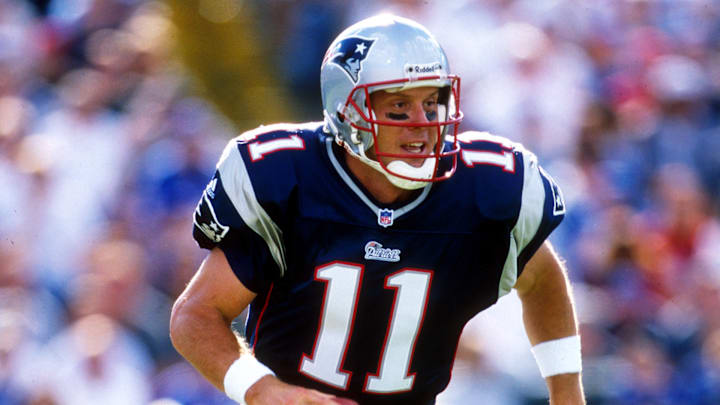
2. Drew Bledsoe: 1993-2006

We talked throughout this article about the impact of playing against Tom Brady had on the legacy of many of the greats. So many were overshadowed by the GOAT, along with Peyton Manning and Drew Brees. There were records being broken every season, and most were playing for number two or three. The gold medal was spoken for (or, in most cases, the Lombardi Trophy).
Bledsoe wasn’t just Brady’s opponent, but he saw the future TB12 come in as a fourth-string quarterback and eventually take his job. That might be the biggest what if in sports. If Drew Bledsoe never leaves the Week 2 game against the Jets with a rib injury, does Brady ever turn into the great player he became?
Here’s the thing: Bledsoe was great before Brady. Do we remember that Bledsoe went from first-overall pick to Super Bowl appearance? Did you know the Patriots asked him to lead the league in passing attempts three years in a row? Even after Brady arrived, Bledsoe was still great with the Buffalo Bills. Bledsoe falls under the radar in the history of the league, but he shouldn’t. This dude had a cannon for an arm, and he got really good under center.
1. Randall Cunningham: 1985-2001

Randall Cunningham wasn’t the first example of a quarterback who got destroyed by his offensive line, but he might have been the best example of a player who should have been great, but bad protection and a terrible scheme prevented that. His best attempt at dominating the league with both his feet and his arm was in 1988 when he had 3,800 passing yards and 24 passing touchdowns. He added 624 yards and six touchdowns on the ground.
He rushed for 942 yards in 1990, but he ended up missing all of 1991 with an injury. That was after years of big hits against him. He didn’t get the time on SportsCenter or the fans playing his highlights over and over again like players get today. His highlights package are stuck in a tape room on ABC7 in Philadelphia instead of living forever on the internet.
Cunningham surprisingly had a long, interesting history in the league, revitalizing his career with the Minnesota Vikings. He even finished second in MVP voting in 1998, stretching his career until he was 38 years old. This was as dynamic a player as there was in the league, and he was ahead of his time. Cunningham could dominate the game on the field, and he deserved more praise than he got.
 Add us as a preferred source on Google