
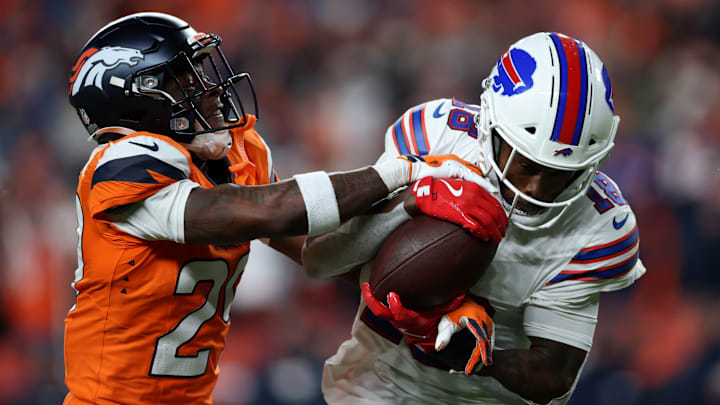
Rules are rules, but interpretation becomes a double-edged sword — especially when there's a spot in the AFC Championship Game on the line. Buffalo Bills fans had their hearts cut deep when a controversial interception in overtime created a domino effect that led to a 33-30 loss to the Denver Broncos instead of setting up their own game-winning score.
JA'QUAN MCMILLIAN INTERCEPTION
— NFL (@NFL) January 18, 2026
BUFvsDEN on CBS/Paramount+
Stream on @NFLPlus pic.twitter.com/S3yuoRu30c
Bills wide receiver Brandin Cooks looked to have reeled in a 43-yard pass thrown by QB Josh Allen at the Broncos 21-yard line, but Denver cornerback Ja'Quan McMillan emerged from the play holding the ball. Even upon expedited review on the field that showed slo-mo views suggesting Cooks was down by contact with possession of the ball, the officials stuck with the call on the field of an interception.
"Of course, I'm always going to think I caught it," Cooks told reporters in the locker room after the loss.
"It's hard for me to understand why it was ruled the way it was ruled," Bills head coach Sean McDermott told reporters post-game. "I'm saying it because I'm standing up for Buffalo, damn it. I'm standing up for us because what went on is not how it should go down... In my eyes it was [a catch not an interception].
Here is the full video.
— Matthew Bové (@Matt_Bove) January 18, 2026
Sean McDermott is not happy with how the Brandin Cooks play was called or handled @WKBW pic.twitter.com/HVu1rvzQw5
"The receiver has to complete the process of the catch," referee Carl Cheffers said in the officials pool report. "He was going to the ground as part of the process of the catch and he lost possession of the ball when he hit the ground. The defender gained possession of it at that point. The defender is the one that completed the process of the catch, so the defender was awarded the ball."
A reporter followed up asking if replay showed the ball touching the ground at all to which Cheffers said there wasn't any video evidence to support that. "The interception was confirmed," he said.
Gene Steratore came with receipts to shut up whining Bills fans
Former NFL referee and current CBS football rules analyst Gene Steratore made as detailed an explanation as he possibly could on television during the Bills-Broncos divisional game. But, of course, the internet will somehow find a way to debate whether the sky is blue.
So, Steratore took to X with an elaborate breakdown of the specific rule the in-game officials were having to interpret on that fateful play.
At some point when reviewing plays, the league should consider adding a speed threshold for anything involving the element of time.
— Gene Steratore (@GeneSteratore) January 18, 2026
When you slow plays down to 1/100th the speed, it distorts what actually happened and makes it look like, in this case, Cooks possessed the ball… pic.twitter.com/CgEQqWaqp9
"At some point when reviewing plays, the league should consider adding a speed threshold for anything involving the element of time," he wrote. "When you slow plays down to 1/100th the speed, it distorts what actually happened and makes it look like, in this case, Cooks possessed the ball for seconds prior to losing it. The game is not played in slow motion or frame by frame."
Steratore went on to lay out that Cooks needed to fulfill three separate criteria in order for him to be ruled down by contact on the play prior to the turnover.
He needed to have secured control of the ball (which he did), have two feet inbounds (also yes) but in addition he had to "clearly perform any act common to the game (e.g., extend the ball forward, take an additional step, tuck the ball away and turn upfield, or avoid or ward off an opponent), or he maintains control of the ball long enough to do so."
Steratore admitted the last criterium requires "judgement", but reminded folks there's a crucial note to the catch rule that the officials leaned heavily on in making their call.
If a player who has control of the ball and two feet in bounds but has not performed a football move "contacts the ground and loses control of the ball, it is an incomplete pass if the ball hits the ground before he regains control, or if he regains control out of bounds."
"Because Cooks did lose control of the ball when he contacted the ground and the ball never contacted the ground, it was ruled an interception by Denver," Steratore concluded in his post.
In layman's terms: When you watch the play in full speed, Cooks catches the ball but loses possession before the moment of being considered down by contact — which means the ball is still live as long as it doesn't touch the ground. McMillan gained possession in that moment and, therefore, completed the turnover.
Folks will argue this call all offseason until they are blue in the face, but this is as good an explanation as you're going to get from as unbiased a source as possible. Now, if you're going to judge that the call allowed Denver to win, that's just an irresponsible take.
Josh Allen turned the ball over four times. If you're going to complain about the officiating, two consecutive questionable pass interference calls that set up Denver for the game-winning field goal are more guilty of blame than the interception.
 Add us as a preferred source on Google