
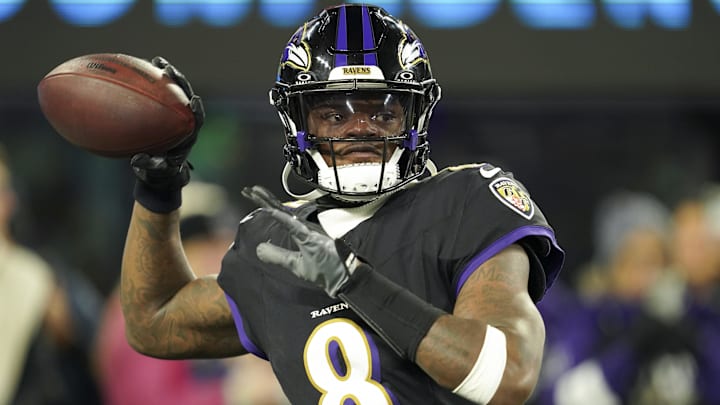
Lamar Jackson may not ever win another MVP award, but there's little debate over his status as a top-five starting quarterback in the NFL. That's enough to push the Ravens to hand him a massive new contract to keep in Baltimore for the remainder of his athletic prime.
To his credit, GM Eric DeCosta recently expressed his confidence that the team will be able to come to terms with Jackson on a long-term extension. Predictably, though, he made no public comment on exactly how much he might be willing to pay his franchise signal-caller.
The $260 million deal Jackson signed before the 2023 season currently ranks seventh in the league's quarterback rankings, per Spotrac. His average annual salary of $52 million on checks in at No. 10 in the positional rankings. That's a fact that should bother Jackson and his representatives as they prepare to enter substantive talks with DeCosta and his staff.
It's safe to assume Jackson will be looking for a contract that will rival the record-setting deal Dak Prescott earned from the Cowboys a couple of years ago. That pays Prescott $240 million over four seasons, which feels like a good starting point for negotiations between Jackson and the Ravens.
How much do the Ravens need to pay Lamar Jackson?

It's important to remember that the natural progression of NFL contracts means Jackson has a strong chance to sign a deal that resets the market at his position. That's the natural order of things in a league with a rapidly rising salary cap: Players with the chance to ink new deals always want to go bigger, since their agreements take up a smaller overall percentage of the salary cap.
The Ravens will try to push back on Jackson and his representatives by using his age against him. He'll be playing his age-30 season in 2026, a real concern for a quarterback that derives a significant portion of value from his running ability. Jackson's effectiveness as a player will drop dramatically as soon as his speed goes from excellent to something closer to average.
While Jackson has improved significantly as a pocket passer in recent seasons, it's not as if his game will age with the same grace as Tom Brady as he enters his late 30s. Jackson has a strong chance to hold his value through the first several years of his next contract, but Baltimore officials will argue that the downside of the later years should depress his annual average value.
Jackson and his team might see a little merit to that argument, but don't expect it to cause them to suddenly reduce their contract demands. They correctly know the Ravens have little choice but to lock him in with a lucrative new contract; the chances of them paying him anything short of the top of the market in terms of annual value are almost zero, considering that letting him walk would set the franchise back potentially years.
Add it all up and a five-year deal feels like the correct term for all involved. The Ravens will appreciate locking him up through the remainder of his prime without really getting into his late-30s. Conversely, Jackson will see the five-year team as a chance to get back onto the open market one more time before his game really deteriorates.
Jackson should not take anything less than the $60 million annual salary that Prescott receives from the Cowboys. He's not going to blow that away but he should be able to eclipse it. A five-year, $315 million contract feels like fair value for both sides. Expect Jackson to go over the $300 million mark and put his name on the top of the quarterback salary list. He'll stay there until the next top-10 signal caller checks in with an even bigger deal.
 Add us as a preferred source on Google