
If we looked at this list just two years ago, Bryce Young would definitely be on it. After trading multiple picks, including one that turned into the number-one overall (which was used on Caleb Williams) in the NFL Draft, it was starting to look like the worst trade and worst number-one overall pick of all time. Young lost his job to Andy Dalton, and the Carolina Panthers were facing an extended rebuild. Then, Young turned it around this season, and the Panthers might be able to compete in the NFC South.
There are some mediocre number-one overall picks, or some instances where a team made the wrong decision (like Baker Mayfield over Josh Allen or Travon Walker over Aidan Hutchinson), but these aren’t even close to the worst picks of all time. When looking at that, when a team flubs the first-overall pick, it takes years for that team to recover. Which were the worst of the worst?
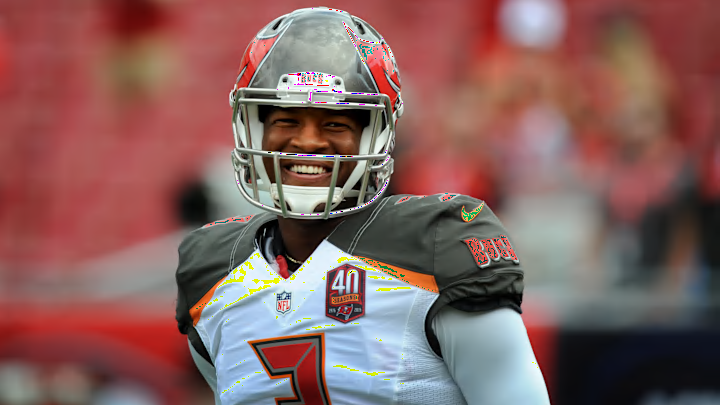
10. Jameis Winston, Tampa Bay Buccaneers, 2015 NFL Draft
This one will be controversial, but Jameis Winston was a terrible first-overall pick. He had his flashes, but he was not careful with the ball, and he was eventually let go with the Bucs deciding against re-signing him after his fifth-year option. They let Winston leave in free agency for free. Of course, the Bucs signed Tom Brady and went on to win a Super Bowl, but one must wonder what would have happened if Winston were better.
It started off well enough, with the Buccaneers rookie getting second in Rookie of the Year voting. He threw for 4,000 yards and 22 touchdowns. The next season, he had another 4,000-yard season, this time with 28 touchdowns. Then, he started getting injured. After two season where he didn’t play 16 games, Winston was back under center for one more run.
Winston threw for more than 5,000 yards in 2019. He led the league in yards and first downs, but he also led the league in interceptions. His 30 interceptions is the most since Vinny Testaverde threw for 35 on those terrible early Bucs teams. It was clear Winston needed a change, and he went to learn from Drew Brees and Sean Payton in New Orleans. When Brees retired, heh failed to take over as starting quarterback full time. He did lose his job due to injury, but he never got it back. He’s been moving around for a few years, but his lot in life is as a backup quarterback. As much as people like Winston, that’s not a good first-overall pick.
9. David Carr, Houston Texans, 2002 NFL Draft

Many will say that David Carr was only a bad pick because of Tony Boselli’s injury, but a bust is a bust. He was joining the Houston Texans, who were celebrating their first season in the league as an expansion team. This was 25 years ago, and the Texans were ready for their quarterback of the future. David Carr was the clear pick for the Texans. It’s not like the other options was any good (it was Oregon’s Joey Harrington).
Where this really hurts is the second-overall pick is Hall of Famer Julius Peppers. Hall of Famer Dwight Freeney was just a few picks later. The Texans could have built an identity and spent a year building the offense. This could have been a superstar defensive team eventually, but they went after the quarterback, which most teams would do.
And here’s where things really hurt with bad first-overall picks. They did get Andre Johnson in 2003, who is a Hall of Famer. If they had just waited until 2004, the Texans would have had Ben Roethlisberger as their quarterback. Instead, they took Dunta Robinson that season. Because the Texans were trying to make Carr work while he was getting demolished by his offensive line, they failed to make the playoffs every season. Five years in, the Texans moved on to Matt Schaub.
8. Walt Patulski, Buffalo Bills, 1972 NFL Draft

One of the few non-quarterbacks on the list, Walt Patulski, looked like he was going to be special. He won the Lombardi Award and was a unanimous All-American. The Buffalo Bills took Patulski first overall in 1972, betting on a high-motor defensive end who dominated at the University of Notre Dame. All the expectations point to a future defensive anchor and game wrecker. Not only did that never happen, but he didn’t even get to start long-term.
Instead, what Buffalo got was… fine. Like Hitch says, fine isn’t good enough. Patulski never became a premier pass rusher, never sniffed Pro Bowl consideration, and never really justified the idea that he was the best player in his draft class. That gap between expectation and reality is where the “bust” narrative is born. Not because he couldn’t play, but because he wasn’t transformative.
It’s also because his career ended quickly. While he was trying to be one of the best pass rushers in the league, he suffered a career-ending back injury just over a year after signing with the Cardinals. It was the type of story that ends in heartbreak for everyone. Patulski was not great on the field, and his career was done just seven years after it started.
7. Tom Cousineau, Buffalo Bills, 1979 NFL Draft

Ah, yes, another example from the Buffalo Bills. It's crazy to think that 10 years later, two failed number-one overall picks in the chamber, they were going to four straight Super Bowls. However, Tom Cousineau is part of their history of pain. It's one of the long list of failures that haunt the early days of this team. Cousineau was chosen first overall, and didn't even play for the Bills. He left.
Cousineau went and played in the Canadian Football League after he was drafted. The Bills were already taking a chance by selecting a linebacker first overall, and he never played a snap for them. He spent three years in the CFL before finally jumping to the NFL. After that, he was a decent player. He was never the best in the league, but he was someone worth talking about. He played for just six years though, before retiring at age 30.
Luckily for the Bills, they got something great for Cousineau. The Browns traded a first-round pick for his rights. That pick turned into Jim Kelly, the architect of those four Super Bowl appearances. Turns out the Browns bad luck trumps the luck of the Buffalo Bills.
6. Kenneth Sims, New England Patriots, 1982 NFL Draft

When the New England Patriots selected Kenneth Sims with the No. 1 overall pick in the 1982 NFL Draft, they thought they were getting a cornerstone who could anchor their defense for a decade. Sims came out of Texas with the resume, that checked every box. He came into the league as a two-time All-American with the size and skill to match. Sims was supposed to be a sure thing.
Here's the thing about "sure thing" athletes: they don't always work out. Sure thing is a trope for a reason. For every LeBron James, there's a Zion Williamson. And for every Myles Garrett, there's a Jadaveon Clowney. Sims was his era's Clowney.
Sims finished his Patriots career with just 17 sacks. Total. His career high was just 5.5 sacks in 1983. The injuries started to stack up on him, with knee, back, and leg injuries forcing him to miss games. That came to a head in 1988, when he tore his Achilles tendon and missed that entire season. The Patriots kept holding out hope he would break out, signing him to one-year deals to keep him in-house, but he was never worth the gamble that comes with a first-overall pick. The Patriots would have been much better off if they had just taken Marcus Allen or Jim McMahon.
4. Tim Couch, Cleveland Browns, 1999 NFL Draft

Tim Couch and David Carr had very similar trajectories. They were joining expansion teams with no real foundation of a roster. Even though the Browns technically existed before, the Baltimore Ravens pilfered their entire roster and brought it to the Bay. Now, Cleveland was forced to start over, and Couch was ready to leave Kentucky and ready to lead Believe-land.
Here’s the thing about belief: it can crush you. Hope can be fleeting, and the reality of playing for an expansion team is bleak. When that expansion team is the Cleveland Browns? That’s an uphill battle nobody is going to overcome. Ohio is for lovers and losers (when it comes to football teams, at least, the people are lovely).
Tim Couch took 56 sacks in his first season, and 50+ sacks one other time. He was out of the league in five years. A number-one overall pick quarterback was OUT OF THE LEAGUE by the time he was 27 years old. They took Couch over Donovan McNabb and Akili Smith (who wouldn't have been much better). Daunte Culpepper also went 11th in the draft. There are few failures in sports this bad. Couch wasn’t even catastrophic, but he was trying to lift up a team with little talent. And it only got worse in 2000…
3. Courtney Brown, Cleveland Browns, 2000 NFL Draft

We hear the term “unbreakable records” in sports all the time. Nobody will ever do as bad in back-to-back drafts as the first years of the return of the Cleveland Browns. Whiffing on the first-overall pick twice in a row with the number-one overall pick is a new level of failure. Couch over McNabb and Courtney Brown over LaVar Arrington changed the course of Browns history. Honestly, it changed the course of McNabb’s and Arrington’s history. Imagine if they were on the same team, even if it was an expansion team? We see dollar signs.
Instead, we saw front office changes and decades of futility. Yes, we’re blaming the Browns' current issues on failing in the NFL Draft 25 years ago. These picks have that length of stink. Brown had 33 sacks in his senior year, an NCAA record. It’s no secret why the Browns took him. So, what went wrong?
Injuries happened. Brown was on pace to have an incredible sophomore season, with 4.5 sacks in five games. Then, he was knocked out for the season. When he came back, he wasn’t the same, recording just two sacks in 11 games. Then six in 13 games before ending his career with the Browns, with just two games played in 2004. He tried to revive his career with the Denver Broncos, but it never went anywhere, and he was out of the league after just six seasons.
2. Ki-Jana Carter, Cincinnati Bengals, 1995 NFL Draft

What made Ki-Jana Carter special at Penn State was his second gear. He had this ability to turn a small hole into a 60-yard run. He was reliant on his elusiveness and his speed to be special. His vision only worked because he had the tools to take advantage of it. Then, seemingly out of nowhere, the house of cards known as knee injuries fell down upon him and the Cincinnati Bengals.
Carter is a lesson in injury risk that every team has been forced to learn. Carter was the start of teams understanding the risk that comes with running backs and why they aren't nearly as valued as other positions. Offensive guards make more than running backs today, and we think the lessons the Benglas were forced to learn with Carter was the start of that conversation. Carter
Carter played no games in his first season after tearing his ACL. He was never the same player after that. It took one injury to remove that explosiveness that made him a College Football Hall of Famer. He never broke 500 yards in a season, and injuries to his shoulder, wrist, and kneecap forced him to miss even more games.
1. JaMarcus Russell, Oakland Raiders, 2007 NFL Draft

We want to point something out that sounds like it’s not true, but it is. In a perfect world, JaMarcus Russell is still playing football today. He’s only 40 years old, but the fact that he has been out of the league for as long as he has been, and nobody was willing to give him another chance, is the reason he is here, and will remain here at the top spot, maybe forever. The Raiders, like they have a chance right now with Fernando Mendoza, thought Russell would be their franchise savior.
Then, in their first contract negotiation, the red flags started to surface. Russell missed part of training camp in those negotiations, taking them down to the start of the season. That missed training camp really impacted his first season, but he did get a few opportunities to flash his brilliance.
We’ve heard the story of Russell’s attitude and weight issues a hundred times. Let’s talk about what the Raiders left on the board. Immediately after Russell went Calvin Johnson and Joe Thomas, possibly the best wide receiver and offensive tackle of this era. Patrick Willis and Darrelle Revis, arguably the best linebacker and cornerback of this era, went a few picks later. The Raiders should have traded down and took their chances on Kevin Kolb or Drew Stanton in the second round. Anything would have been better than the Russell route, which was doomed from the start.
More NFL news and analysis:
 Add us as a preferred source on Google