
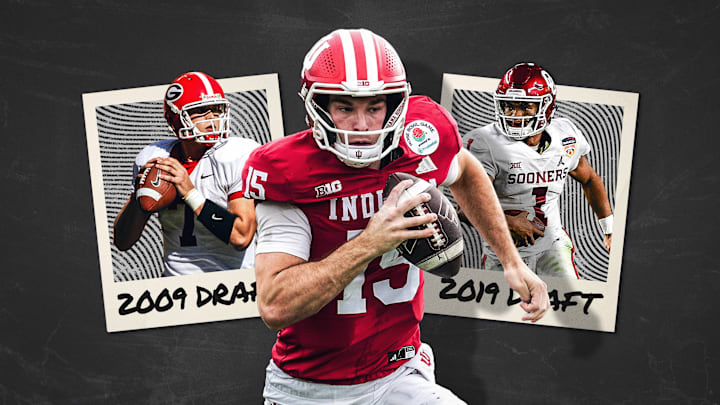
In the most wide-open NFL Draft in recent memory, there was at least one sure thing: The Las Vegas Raiders were going to take Indiana QB Fernando Mendoza at No. 1 overall. Mendoza was the clear-cut choice from the moment the confetti fell on the Hoosiers' national title win back in January, and sure enough, he was the first player taken as Round 1 got underway on Thursday night.
Mendoza was always an easy call for Vegas to make. He was by far the most accomplished quarterback in this year's class, and the Raiders were desperate for a new future under center. But the lack of drama around his selection has led to a relative lack of analysis about Mendoza — not as he relates to the other passers in the 2026 draft, but as he projects as an NFL starter.
Is Mendoza simply the No. 1 overall pick by default, the biggest fish in an unusually small pond? Or is he a legitimate franchise cornerstone in his own right? To answer that question, we decided to compare him to the 19 other quarterbacks who were taken with the first pick since 2000. To be clear, this is meant to compare each player as a prospect coming out of college, before taking a snap in the NFL. What they went on to do as pros isn't relevant here; the goal is to figure out where Mendoza falls among the best college quarterbacks of the recent past and what that means for him and the Raiders moving forward.
Where Fernando Mendoza would rank among No. 1 overall QBs since 2000
Mendoza is the 20th quarterback to go No. 1 overall since the year 2000, obviously the most popular position by a country mile. Most of those names went on to at least solid NFL careers, spending several years as starting-caliber QBs. But even among the best of the best, there's still quite the range of outcomes, from future Hall of Famers to outright busts. Here's how we rank them as prospects, from 20 to 1.
Ranking | Name | Year |
|---|---|---|
20 | David Carr | 2002 |
19 | JaMarcus Russell | 2007 |
18 | Cam Ward | 2025 |
17 | Baker Mayfield | 2018 |
16 | Bryce Young | 2023 |
15 | Jared Goff | 2016 |
14 | Sam Bradford | 2010 |
13 | Fernando Mendoza | 2026 |
12 | Carson Palmer | 2003 |
11 | Alex Smith | 2005 |
10 | Jameis Winston | 2015 |
9 | Kyler Murray | 2019 |
8 | Eli Manning | 2004 |
7 | Trevor Lawrence | 2021 |
6 | Caleb Williams | 2024 |
5 | Matthew Stafford | 2007 |
4 | Joe Burrow | 2020 |
3 | Cam Newton | 2011 |
2 | Michael Vick | 2001 |
1 | Andrew Luck | 2012 |
The elite tier

- Andrew Luck, Stanford
- Michael Vick, Virginia Tech
- Cam Newton, Auburn
- Joe Burrow, LSU
- Matthew Stafford, Georgia
- Caleb Williams, USC
- Trevor Lawrence, Clemson
- Eli Manning, Ole Miss
These are the no-doubters, the floor-raisers, the guys bandied about as potentially generational prospects (an adjective that gets overused these days — by definition, they only come around once in a generation!). All of these QBs were seen as players you could build the future of a franchise around, players who could elevate supporting casts to contention almost instantly.
It's easy to forget based on how his NFL career ended, but Luck was essentially the perfect prospect coming out of Stanford, with a rocket arm and ideal frame to go along with intelligence, athleticism and accuracy. If he were given a better ecosystem in Indy (and a better line in particular), he'd be recognized as the all-time talent he was. It's similarly difficult to remember just how earth-shattering Vick was as an athlete, now that mobility has become table stakes for pro quarterbacks, but he was quite simply something the league had never seen before.
Burrow and Stafford are the pocket passers on this list, and both came with a superlative track record against SEC defenses and superlative traits — Burrow's anticipation and accuracy, Stafford's unreal arm strength — that helped make up for athletic deficiencies. Newton was a physical marvel, a quarterback in a linebacker's body with sprinter speed, while Manning came with the famous last name.
You won't see Mendoza's name here, and there's good reason for that; he's athletic but certainly not a blazer. He has a good but not great arm. But that doesn't doom him at the NFL level — as you'll see, his tier still has its fair share of success stories.
Franchise starters

- Kyler Murray, Oklahoma
- Jameis Winston, Florida State
- Alex Smith, Utah
- Carson Palmer, USC
- Fernando Mendoza, Indiana
- Sam Bradford, Oklahoma
- Jared Goff, Cal
This tier can be defined as starting-caliber quarterbacks who nonetheless have weaknesses in their games that will need to be addressed at the NFL level. Goff is maybe the perfect example: He has a spectacular arm, but his stiffness and antsy feet under pressure mean that his ceiling is ultimately defined by the scheme he's in and the players that are around him.
Which feels about right for Mendoza. He is, in many ways, Goff (or Bradford) with a bit more fluidity to his game: He doesn't get skittish in the way that Goff does, and he's not as helpless when trying to navigate a dirty pocket, but his physical traits aren't elite — he probably doesn't have quite the arm strength Goff or Bradford did — and he can be guilty of holding the ball too long and taking too many hits. He should absolutely be a solid starter in the league; whether that will usher the Raiders into an era of contention, however, depends on whether the front office can protect him and give him the requisite weapons to throw to.
To be clear, that should be viewed as a win with the No. 1 overall pick; Vegas has been desperate for this kind of player for years now, especially on a rookie-scale deal. But you just have to look at the disparate fortunes of the other players in this tier, from Smith to Winston, to get a sense of how limited the ceiling can be if the environment isn't right.
Question marks

- Bryce Young, Alabama
- Baker Mayfield, Oklahoma
- Cam Ward, Miami
- JaMarcus Russell, LSU
- David Carr, Fresno State
I don't want to be too harsh here; Mayfield has carved out a respectable career for himself, while Young made real strides in 2025 and Ward flashed big-time potential. The goal of this tier isn't to bury the guys in it, but to simply point out that they entered the draft with real and significant question marks about their ability to thrive at the NFL level. For Young, and to a lesser extent Mayfield and Ward, those questions revolved around their height — specifically, whether they had enough of it. For Russell, it was a lack of experience and production. For Carr, it was the fact that he'd put up big numbers at a small school.
All five of these quarterbacks had real reasons to believe in them at No. 1 overall — yes, even Russell, who was a better prospect than his 2026 reputation would suggest. But the floor felt lower for all of them as well.
Why Fernando Mendoza lands among recent No. 1 picks

It shouldn't be an insult to point out that Mendoza wouldn't go No. 1 overall — or even be considered for it — in every draft class. Had he come out in 2024, he may well have ranked fourth behind Caleb Williams, Drake Maye and Jayden Daniels. He doesn't have physical ability that jumps off the screen at you, either with his arm or with his legs.
At the same time, though, I'd be surprised if he weren't a top 15-20 quarterback in the NFL at an absolute minimum. He processes well, he can make just about every throw, and he's brimming with the sort of confidence and toughness you need to succeed at the highest level. If nothing else, Raiders fans will be thrilled by his willingness to stand in and take shots when compared to their last franchise quarterback.
All of which makes his placement in the second tier feel about right. You should by no means feel badly about taking him at No. 1 overall, even if he's not quite as shiny a prize as you might hope for when you land the top pick. He absolutely has the potential to be a good NFL quarterback, even if he puts a bit more onus on the front office than someone like Luck or Newton.
 Add us as a preferred source on Google