
Key Points
Bullet point summary by AI
- ESPN faces mounting scrutiny over perceived conflicts between analysts and player representation agencies.
- A high-profile analyst publicly endorsed a quarterback prospect shared by his talent agency.
- This debate threatens public trust in sports journalism amid growing concerns over media integrity.
In the long and storied history of conspiracies, it very rarely matters if there is a conspiracy. It only matters that people think there is.
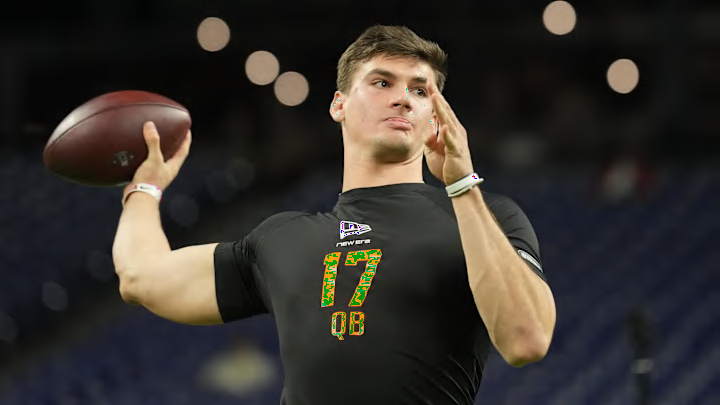
Which brings us to Dan Orlovsky, former NFL quarterback and one of ESPN’s most public TV analysts, who said on Monday that “I think Ty Simpson is the best quarterback in this class.” Simpson, generally seen as a late first-round draft pick, is not seen as the best quarterback in this class by every. single. talent evaluator. in existence. But Simpson does share with Orlovsky the lovely connection of both being represented by Creative Artists Agency (CAA), one of the most powerful talent agencies in the world. Conspiracy? The people think so.
Orlovsky vehemently denies that he's trying to gas (and thereby earn a bigger rookie deal for) a CAA client. I vehemently deny this, too: The concept that CAA is funneling cash under the table to TV personalities to hype up their players is, in reality, absurd — should that be made public, it would immediately torpedo both CAA’s credibility and Orlovsky’s career. The risk of destroying a multi-billion-dollar agency’s reputation for the reward of moderately boosting the stature of a 2026 late first-round NFL draft pick seems like a pretty lopsided calculation.
Dan Orlovsky and CAA are not conspiring to promote Ty Simpson — but it feels like they are

The problem is that it’s only absurd in reality. In theory, in concept and in the sphere of what is culturally possible these days, it is not absurd at all. The largest sports media outlets are no longer seen as promoters of legitimate journalism; they are sensationalist, reactive organs of an increasingly crazed American media climate. Orlovsky almost certainly wasn’t promoting Simpson as a paid shill of his agency, but simply as a paid shill of ESPN, the worldwide leader in contrived, engagement-farming narratives.
The lack of separation between media and sports institutions has created a maelstrom of doubt in which conspiratorial behavior probably isn’t happening but totally could be happening. Aaron Rodgers was paid millions of dollars for exclusive interviews on the Pat McAfee show, an ESPN product, which violates pretty much every standard journalistic ethic. In Boston, my hometown, the network with exclusive broadcast rights for Red Sox games, New England Sports Network (NESN), is owned by the Red Sox ownership group led by John Henry. Henry also, it should be noted, owns the Boston Globe.
These are reputable institutions, and I am in no way alleging that the ownership of these media empires is influencing the day-to-day coverage carried out by their excellent reporters; ESPN, for example, still employs many of the best in the game, and the Globe remains a paragon of sports coverage. But these ownership situations make it feel like there are conspiracies afoot.
"People can think what they want 😂😂
— Pat McAfee (@PatMcAfeeShow) March 24, 2026
There's no ulterior motive behind this"@danorlovsky7 #PMSLive pic.twitter.com/yzNGXbqeX1
Add in agency cross-contamination, and we have a full-blown tornado of financially interconnected leagues, players and media members. Whether or not conspiracies exist (they probably don’t), it damages the public’s trust in these institutions. When ESPN’s triumvirate of news-breakers (Jeff Passan, Shams Charania and Adam Schefter) tweet out that a new contract that has been signed, it’s hard not to imagine that a condition of agents texting them the deal first is that the agents’ names have to be in the tweet.
None of this is inherently conspiratorial; it all just looks really bad. And what things look like is all that matters in media. Slowly, it erodes confidence in what you read and watch. If we let that fully break down, we'll be left with only two things: Content that is crazy, or stuff that's just fake.
Today's sports media is a mess of doubt and conflict of interest
I don’t think old-style sports media — or … media media, for that matter — is coming back. The old format of newspaper reporters finding information with analysts and columnists commenting was largely a function of a much more constricted flow of information. Sports media institutions are arguably unnecessary in an age where anyone, your cousin Greg included, can be a “sports analyst” by freely publishing their thoughts on social media. Writers and analysts, myself included, post far more than we write. That has, however, created a chaotic soup of content that is quasi-impossible to navigate.

Institutions like ESPN are thus more important for credentialing and adding credibility to individuals rather than providing them with a platform. Within that digital soup, certain individuals are plucked out and branded as #reliable because someone with authority at some media outlet said they were — and is paying them for their service. But this creates even further distrust, because Orlovsky is not an “employee,” per se, but simply talent on a long-term contract like many of the most popular sports pundits. His thoughts are not those of ESPN.
Needing credentials but understanding the tornado of modern sports media, this climate has created a culture of independent mercenaries who have to say crazy stuff to survive. That crazy stuff then gets placed in the context of a conspiratorial-seeming ownership and agency structure, and one layer of public trust in the media is removed.
Fake content might be taking over sports media
This creates a cascading effect, wherein further sensationalism is needed to satiate a distrusting crowd. Mix in deepfake AI-generated content and you get the final product: media consumers like me, who literally assume everything they see online is fake, wrong or made up until they can verify that it isn’t.
ESPN has figured out how to walk this line. Saying that Ty Simpson is better than Fernando Mendoza might be wrong, but it isn’t factually incorrect. It’s an interpretation that is so blatantly stupid that people tap in to register their outrage. Heck, I'm writing an entire thinkpiece about this take and what it means for sports media. But it isn’t “fake,” and thus ESPN’s status as a credentialing institution can remain.
There are still tons of great people doing great work out there, for ESPN, for themselves and all over the map. This chaos has led to lots of creativity and innovation, and some genuinely awesome things might be coming in the future. But mark my words: The “fake” is coming too. It’s already here, and you don’t have to look that hard for it. Because in a world where sensationalism reigns supreme, people have figured out that the most sensational things are the ones that don’t actually exist.
 Add us as a preferred source on Google