
The 2026 Winter Olympics are here, and we couldn’t be more excited to welcome some of the best athletes in snow sports from across the world. It’s an exciting year for the Winter Olympics, as we head to Milan, Italy, for this iteration of the Games. We also welcome back NHL players in hockey for the first time in more than a decade.
That’s just one of the Olympic sports taking center stage this month. There are 16 disciplines within the Winter Olympics, each with multiple events for both male and female athletes. Unlike ice hockey, most of these other sports are things we only watch once every four years. But which events are we most excited for? Let’s rank each sport in terms of watchability.
16. Ski Mountaineering
We’re starting with a skiing discipline, but we have to warn you that most of what is in the Winter Olympics is a type of skiing discipline. Honestly, we didn’t realize there were this many ways to ski. The difference between all other skiing and ski mountaineering is direction. Mountaineering is the sport that involves climbing in skis.
Yeah, we’re climbing in skis in 2026. To explain the whole sport, mountaineering requires athletes to climb a mountain, either with skis on their feet or holding the skis for extreme summits. It often includes a series of checkpoints before athletes turn around and ski toward the finish line. Many of us have become accustomed to walking through snow and ice after recent storms across the United States. Now imagine if that was the sport you chose to dedicate your life to. Welcome to ski mountaineering.
This is the first year ski mountaineering will be at the Olympics, so we may be being too harsh on this event. However, we have to see it to believe it. We love the idea of a new event taking over the lexicon, and not in the way that breakdancing did in 2024.
15. Nordic Combined

For a sport that’s more than a century old, Nordic combined is pretty confusing. The concept is fine, which is combining long-distance skiing with ski jumping, but we’re trying to figure out why they decided to combine these two events. It’s pretty slow, and they have to happen at two different times. They started with the long-distance ski, then moved to the jump, but they felt the jump didn’t allow skiers to make up the deficit they had suffered in the earlier event. So, they switched the events, with the jump going first.
If they felt that the long-distance ski put too much distance between winners and losers, then it might not be the right event to combine. Maybe they should combine snowboarding and luge. That makes more sense!
However, let’s talk about the watchability. Well, the jump will be fine, but it doesn’t decide anything, so it falls a little flat. It’s also the only event without women at the 2026 Olympics. That's why there are only three events for this, tied for the fewest of any event on the calendar. It's just not a very watchable event, and we don't expect that to get many eyes while the rest of the Games are going on.
14. Biathlon

You probably know what Biathlon is, but have no idea that you know. It’s the Winter Olympics event with the guns. That’s right, biathlon is the mixture of cross-country skiing and shooting. We’ll get into cross-country skiing as a sport, as it’s considered its own sport, as well, but we want to talk about this absolutely wild concoction of an event.
As with many of the strange events at the Olympics, biathlon started as military training in Scandinavian countries. It debuted at the 1960 Olympics and has since grown to 11 events, including one mixed gender event. The race disciplines are broken down into three events: sprint, individual, and pursuit. The sprint is trying to push athletes to move as quickly as possible, and the results of the sprint can be included in the pursuit order. The staggered start of the pursuit can lead to some insane finishes.
Also, there’s the mass start. It’s not the most scientific name, but it explains it pretty well. Think about what the start of the New York City Marathon looks like. Now put everyone on skis and force them to race towards a shooting position. Honestly, the more we talk about it, the cooler this sport sounds. If a skier misses a target with their shot, they have to take a 150-meter penalty loop. That’s pretty crazy!
13. Cross Country Skiing

Cross-country skiing isn’t the greatest experience. It’s like the marathon running in the Summer Olympics. Cross-country skiing originated from the need to travel across snowy terrain in Northern Europe. It was not done for fun. It was done out of pure necessity. Now, hundreds of years later, we’re still doing it despite the invention of planes, trains, and automobiles.
There will be 12 different events in cross-country skiing at the 2026 Winter Olympics. It has been around since the first Winter Olympics in 1924. There are two main techniques for cross-country skiing: free and classic. In classic, there are carved-out paths in the snow for athletes to use. In free, the athlete is asked to make their own path. Both combine uphill, flat, and downhill skiing. It's definitely an interesting concept, but it might be a little too complicated.
Obviously, the downhill portion of the cross-country skiing might be decent, and it could be alright to watch at the end, but the races can be long. One of the races is 50 kilometers long. We might like some of the events where they compete against other athletes on the same snow, but we’re still not convinced this is the most watchable sport.
12. Speed Skating

Some might be asking, "What's the big difference between short-track speed skating and regular speed skating?" One might think it's obvious. One has a long track, and one has a short track, but it goes way beyond that. Regular speed skating is a race against the clock, while short track is very much a traditional race. Short track resembles roller derby, whereas this style focuses on straight-line speed and impact.
In speed skating, athletes race on a 400-meter track, similar in size to the track used at the Summer Olympics for running events. It's a massive oval where they can host multiple events. There are 14 speed skating events, with only freestyle skiing having more. Most of them come down to track length, with some focusing on a dash and others looking to loop the track multiple times.
We love the pure showcase of speed, but we want to talk about one specific event. It's basically a relay race for speed skating. The distance is eight laps for men and six for women. When the race is close, it's exhilarating. However, when there's a clear winner, it can be something not worth watching. It all depends on the competition on the ice.
11. Freestyle Skiing

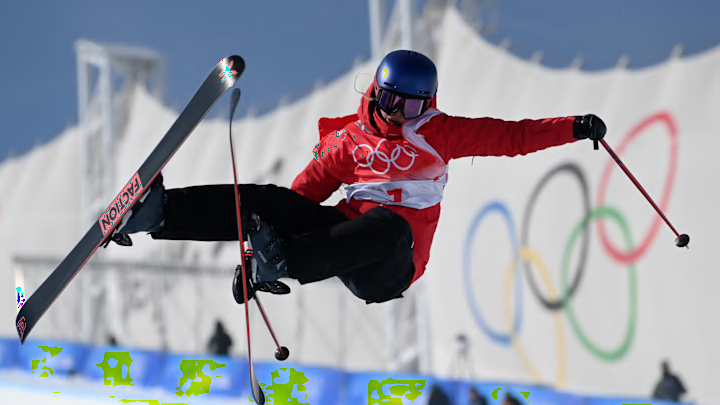
Freestyle skiing is the X Games version of skiing. There are tricks, big jumps, big air, and the drama that comes with scoring competitions. This year, they added multiple events, bringing the total to 15 in freestyle skiing. This includes moguls, big air, half-pipe, ski cross, and slopestyle. It’s hard to explain each one, but this may be the discipline with the greatest differences across events.
The events vary: some focus on height and tricks, while others emphasize technical skill and wow factor. For example, slopestyle breaks the course into sections with varied obstacles. Aerials is just about getting as high and landing softly. These are very different events. The half-pipe is pretty self-explanatory and works the same as it does in skateboarding. There is something for everyone here.
One reason this sport is especially watchable this year is the competition between the United States and Canada. Canada currently leads all countries with 12 gold medals in freestyle skiing. The Americans hold 11 gold medals. The next closest is Switzerland with just six. They should highlight this competition, as it elevates the event. We have a rooting interest, and we’re ready to jump through a wall to cheer on the team.
10. Short Track Speed Skating

There is a clear line between relatively boring sports to watch and really exciting sports. We really like speed skating, but we lose a little luster in the short track. The skaters go fast around an oval track, like they are human race cars. They go head-to-head with other skaters, making this a true race. We love that about this competition. Seeing these top athletes see their competition coming up from the rear puts serious drama into every race. Then, there's elation when someone wins.
The skaters are trying to move quickly, but as with other oval-track racing, speed isn’t the only factor here. There’s also an ability take turns precisely. It’s avoiding fellow skaters on the inside track. There are sometimes issues with leverage in terms of where and when a skater can move. It’s really a technical sport for how fast it’s moving.
Ironically, South Korea dominates this sport. They have 26 gold medals, by far the most of any country. It’s fun to see a dominant force take over a sport. Most of South Korea’s gold medals overall come from short-track speed skating. We’ll see if the South Korean team can take advantage of that in the Winter Olympics this year.
9. Skeleton

Do you like a sport that looks like it was invented by someone with a death wish? Then skeleton is for you! The sport involves placing an athlete on a flat sled on their stomach and hurtling them down an icy track headfirst at speeds up to 80 mph. It’s an insane watch from every angle. If you like a sport with risk, this is the one to set your DVR to.
The sport has an interesting Olympic history. It was originally added to the 1928 Olympics, but it was a one-time addition. It didn’t return until 1948, but again, that was a one-time representation. It wasn’t until the 2002 Olympics in Salt Lake City that skeleton became a regular part of the Winter Olympics. We see why. While there are sports that are similar, because of the positioning of the athlete and the speed they are working with, this is definitely the one with the most risk.
The turns in skeleton are wild, to say the least. It got its name originally because the sled was made to look like a skeleton. It's made that way so riders can turn it. Athletes must move their sleds with only centimeters of clearance on either side to avoid a crash. They have to use their body movements to get the sled turned. It’s nerve-racking, and we’re just watching it. Which is why it’s must-see TV!
8. Bobsled

Every year, bobsledding seems to take the Olympics by storm. It’s one of those sports that you have to watch from beginning to end. You may not be going out of your way to turn bobsledding on, but once it’s on your TV, you are watching until the end of the heat. There is something inherently watchable about the sport. It’s the speed of the sport that enthralls us.
And that’s why it’s here. The speed is hard to explain, and the vehicle that athletes are asked to control adds to the mystique. Bobsledders push their sleds down incredibly tight tracks with no room for error. The turns are absolutely insane. The camera angles are great, as well. Shout out to those at NBC shooting bobsledding like it’s meant to hold your breath.
Bobsledding is also great because teams can still make crucial mistakes, and the rest of the sledders have to make up for them. We’ve seen people fail to jump in the sled, forcing whoever is left to make up for the players who missed their mark. This is a crazy race against the clock, and we’ll continue to get caught up in the action.
7. Curling

Curling is one of those sports that we all want to try and we don’t know why. It seems really odd and unmotivating, but once it’s on the TV or if we’re in the crowd, we can’t get enough. It’s what happens when you mix shuffleboard, ice skating, sweeping the floor, and bowling. Competitors compete in teams, taking turns sliding granite stones across a 150-foot-long sheet of ice toward a target known as the house. It’s a giant bullseye painted on the ice.
What makes curling so thrilling? It’s the speed and precision. More so, the lack of speed makes each round more and more stressful. Each team goes, and the next team has a chance to know a player out or in the circle. Watching the stones head towards the middle, with only inches sitting between glory, has taken on the focus of thousands of fairweather fans.
Curling will be one of the most discussed sports at the Winter Olympics, and you should get on board! It’s truly an experience to watch the sport from start to finish. The reaction of the competitors is second to none. When they get one in the circle, they cheer like Novak Djokovic hitting a set point. That's worth the price of admission on its own.
6. Ski Jumping

When we think of Olympic sports, ski jumps tend to be at the top of the list for winter events. We think of the fresh powder on the ground and the show of elite athleticism on display. This is what the Olympics are all about. It’s also one of the more “extreme” winter sports, with skiers hitting heights of 15 feet in the air and traveling more than 300 feet from jump to landing point.
Results are based on both the distance travelled and the jumper’s body position in the air and upon landing. Judges will score the style of the jump, and those points will be combined with the length of the jump to come up with the skier's score. We don’t love that being the point system, as it seems to complicate a very straightforward direction of the Olympics (who can jump the furthest would be just fine as the event).
Still, this is one of the most exciting events on the docket. Seeing athletes fly in the air with skis on their feet and land pretty much perfectly is peak winter athletics. Seeing these athletes go for gold, especially if they are trying to desperately jump beyond their previous scope, it tends to keep us on the edge of our seats.
5. Luge

At the end of the day, luge, skeleton, and bobsled are incredibly similar in watchability, but there’s something about luge that helps it stand out over the other two sports. First of all, the difficulty is clearly higher in luge, as they use sharper blades that put more pressure on the riders to move perfectly through turns. Riders are feet first, which actually really helps the watchability. We really get to see the full slate of emotions, or lack thereof for some athletes, as they race 95 MPH down an icy track.
Then, there’s the drama at the end. The winners of the luge, which can be a competition of 100 athletes, can be decided by a thousandth of a second. With that kind of precision, we can’t rely on the eye test alone. Replay in sports isn’t the most popular right now, but for luge, it solidifies a winner and a loser.
It’s called the fastest sport at the Olympics for a reason. While many other sports on the list are fast, luge is ridiculously fast. And it’s not like it’s one and done. Riders are doing this four times for every round. That’s a ton of risk for one person!
4. Snowboarding

Snowboarding burst onto the scene in the 1970s and 80s as an alternative to skiing. Originally called the “snurfer” (wish we were kidding), snowboarding had an interesting history. They even held the National Snurfing Championshipin Michigan every year. Slowly but surely, snowboards moved away from the design of wrapping skis together and became a traditional board like we see today.
Snowboarding first joined the Olympic program in 1998. Interestingly, unlike most other sports, snowboarding skipped the process of becoming a demonstration sport (an Olympic sport that doesn’t offer traditional medals) and went straight to a general part of the program.
The interesting thing about snowboarding is that it combines two different skiing disciplines: freestyle and alpine. So you get the insane tricks and jumps from the half-pipe and the slopestyle, but you also get the big air and the slalom for downhill action. Snowboarding often involves more traditional and impressive tricks because snowboards are built for slightly more flexibility than skis. It should be a fun competition, even without Shaun White to do something we’ve never seen before.
3. Alpine Skiing

Watching alpine skiing is a unique experience. The entire time, it feels like one wrong move could ruin everything and lead to disaster. Yet, more often than not, skiers can make it downhill without mistake, and it leads to an incredible feeling for viewers and the athlete. It’s that traditional feeling of crossing the finish line that bears that feeling.
The different events mixed the speed and precision we love to see in sports. The downhill is pure adrenaline in snow. It’s a race to the finish, pure and simple. The slalom is where precision comes in, asking skiers to hit thin poles on opposite sides of the course in succession while going downhill.
Unlike many other sports in the Olympics, there is real name value in alpine skiing. Mikaela Shiffrin is looking to solidify her GOAT status at the top of the leaderboard. She has won eight gold medals, four silvers, and three bronzes at world championship events, but she was shut out at the last Winter Olympics. She’s trying to show she still has what it takes to be great. And of course, there’s Lindsey Vonn. The iconic American qualified for his fifth Olympics, but right before they were about to start, she suffered a serious knee injury. She says she’s going forward anyway, and it could be one of the greatest comeback stories ever told.
2. Figure skating

There is a clear top two when it comes to the Winter Olympics, and they both involve ice skates. However, they could not be more different disciplines of the Olympics. Let’s start with ice skating. It’s the gymnastics of the Winter Olympics. It’s often the headline grabbers, and we still talk about some of the storylines from ice skating at the Olympics today. There’s controversy, athleticism, drama, heartbreak, elation, and everything that makes great television all wrapped into one.
There will be five Olympic figure skating medal events: men’s and women’s singles, pairs, ice dance, and the team event. They all bring something a little different to the table. Singles tends to be the most popular today, as it brings an athlete into a program that asks them to put themselves at risk for crazy tricks while on ice skates.
There’s also a grace to figure skating that enthrals us all. It’s easy to find a rooting interest at the games, and you root hard for that person. There’s a lot of personality in the programs, so we get to see more of this person than in any other sport. Everything from music choice to trick difficulty makes us fall in love with these athletes. And at the end of the day, our rooting interest is what ultimately drives our enjoyment of certain sports.
1. Ice Hockey

And finally, the NHL is back in the Olympics. The NHL players are returning to international play for the first time since 2014. Professionals from every country are heading to the Winter Olympics. This becomes the first best-on-best tournament that’s not lopsided in any of the four major sports. While they try this with basketball at the Summer Olympics, the American team tends to be too good to beat. However, hockey is a global sport, and it impacts the games at the Games.
We’re preparing to see Connor McDavid versus Auston Matthews. The Tkachuk brothers versus Rasmus Dahlin, Erik Karlsson, and the stacked Swedish defense. The superstars (outside of Russia) of the NHL are ready to party in Italy, and this will be the most popular sport at the Olympics for a reason.
Even beyond the return of NHL players, ice hockey is the top sport to watch. It brings the speed of skating on ice with the precision of soccer, but we’ve added sticks and hitting. There will be no player rolling around in pain after a shin hit. Hockey players will skate on one leg to represent their country. We’re very excited for hockey, and we’re hoping those who enjoy the Olympics spend more time watching the NHL when it returns.
More Olympic news and analysis:
 Add us as a preferred source on Google