
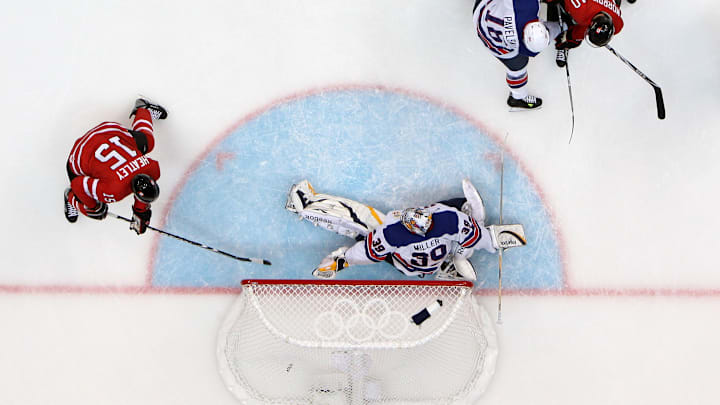
It’s been 12 years since the National Hockey League sent its top players to compete in the Winter Olympics. This year’s tournament will be a chance to watch the greatest hockey players in the world battle each other to be named the greatest hockey country in the world.
While this year’s tournament will feature NHL players and some NHL referees, the games will be played by a different set of rules. The International Ice Hockey Federation (IIHF) is the governing body for the Winter Games. If you regularly watch the IIHF World Junior Championships or World Championship, then you should be familiar with the rule differences. But if not, we’ve got you covered!
Game flow, timing and icing rules
The intermissions between periods are shorter. The NHL gives teams 18 minutes to recover, while Olympic players will only get 15 minutes in Milan.
As for the gameplay rules, they remain the same. They are still playing ice hockey, but there are subtle differences in how the calls are made. The NHL uses a hybrid icing rule, for instance, where opposing players race to the faceoff dot before the whistle is blown. In international play, the officials will blow the play dead as soon as the puck crosses the goal line, so races down the ice are eliminated altogether.
The trapezoids behind the nets also don’t exist in international play. In the NHL, a goaltender will receive a two-minute minor for delay of game. Under IIHF rules, a goaltender can play the puck anywhere he wants without being penalized.
Officiating and physical play rules
IIHF officials are far stricter on checks to the head, while NHL officials have the freedom to judge the severity of the hit and assess anything from a minor to a game misconduct. In the Olympics, officials can still give out a minor penalty for an illegal check to the head, but any major penalty comes with an automatic game misconduct. They tend to give out very few minors and go for the more severe penalties to deter dangerous hits.
Is fighting allowed at the Olympics?
The IIHF also has far stricter fighting rules than the NHL. Any player who drops the gloves faces an automatic ejection to go along with a five-minute major.
Everyone remembers the start of the Team USA/Canada game from the 4 Nations Face-Off, with three fights in the first nine seconds of the game. The chaotic scene got plenty of mainstream attention and generated a ton of buzz for the rematch a few of nights later. You won’t see this at the Olympics.
Overtime and shootout rules
The biggest difference you’ll notice will come when a game is not decided in regulation. During the preliminary rounds, teams will play a five-minute period of three-on-three sudden death hockey, where the first goal wins, the same as the NHL.
The difference comes in the shootout, which is a minimum of five rounds instead of three. After the third shooter, players can shoot as many times as they want, whereas in the NHL, every player must take an attempt before anyone else can go again. T.J. Oshie earned the nickname of “T.J. Sochi” with his memorable six-attempt shootout vs. Russia in 2014.
The overtime rules change once the tournament gets into the elimination rounds. In the playoff, quarterfinal and semifinal rounds, overtime expands to 10 minutes before heading to a shootout. The shootout is eliminated in the gold medal game, with teams playing 20-minute sudden-death periods until a winner is determined.
Now that you are caught up on the differences between NHL and IIHF rules, enjoy some of the best hockey we’ve seen in over a decade!
 Add us as a preferred source on Google