
On Monday, the WNBA and the players union met for the first time in 2026 in an attempt to reestablish “status quo” negotiations over the latest collective bargaining agreement. Though negotiations have been ongoing since October, the meeting concluded without significant progress. According to The Athletic, the last official proposal was submitted by the WNBPA back in December and has yet to elicit an official response.
Since negotiations began, players have publicly expressed frustration with the league. During WNBA playoffs in late September, WNBPA Vice President Napheesa Collier called WNBA Commissioner Kathy Engelbert’s leadership the “worst in the world.” At an Unrivaled press conference this past Friday, New York Liberty guard Natasha Cloud addressed the WNBA directly: “We will not f***ing move until y’all move.” After the league failed to make any moves during Monday’s meeting, Indiana Fever guard Sophie Cunningham called the WNBA the “laughingstock of sports.”
As negotiations have carried on and players have continued to publicly voice their frustrations, criticism has moved from the league’s inaction to player response. On her Jan. 16 appearance on WNBA legend Sue Bird’s podcast A Touch More, former WNBA star Rebecca Lobo stated she believed the most recent league proposal was a good one and that players’ reactions have been unnecessarily negative.
“Some of the rhetoric I’ve heard from their side has been a little bit troublesome. When a deal is presented that’s over a million max salary and revenue share, it’s called a ‘slap in the face.’ Like, just use different words. And I’m worried the players might be getting to a point where they might be losing some of the support from the public. And I think that has been a big part of this all along.”
Tone is the last thing WNBA players should be worried about right now
Lobo’s comment refers to Satou Sabally’s comments back in July. After being asked what she thought about the league’s decision to add three expansion teams — one in Cleveland, another in Detroit, and the other in Philadelphia — Sabally responded that she’d rather focus on the latest CBA proposal and how it could impact current players.
Though rhetoric by players may be blunt, it reflects an economic reality that WNBA players lag behind female athletes in other sports despite substantial market demand. In a recent article, The Athletic analyzed Forbes’ 2025 world’s highest-paid female athletes. They concluded that the most notable outlier was the fourth-highest-paid female athlete, two-time Olympic gold medalist and one-time silver medalist skier Eileen Gu. Of her $23.1 million in earnings, just $0.1 million came from skiing, with the remainder ($23 million) coming from endorsements.
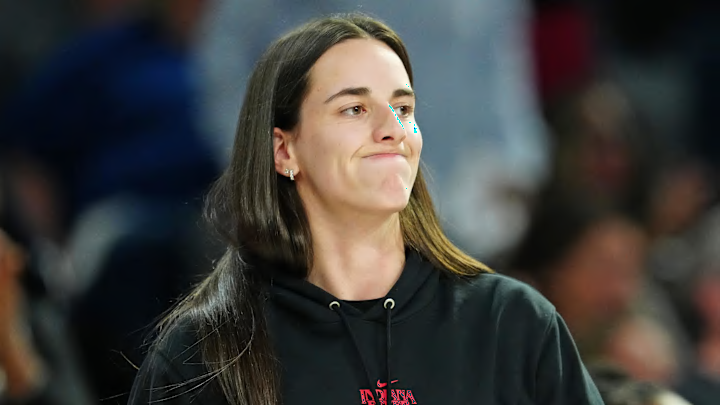
The highest-paid basketball player on the list is Caitlin Clark. As the eleventh-highest-paid female athlete in 2025, Clark’s earning breakdown mirrored Gu’s almost exactly: out of her $12.1 million, only $0.1 million came from on-court play, with the remaining $12 million generated off-court. The same applies to Paige Bueckers, who earned $9.1 million in total — $0.1 million on the court and $9 million from endorsements.
Similar trends hold true for the two other WNBA players on the list. Sabrina Ionescu earned $10.5 million in 2025, with $0.5 million coming from league salary and $10 million from endorsements, while Angel Reese earned $9.4 million total, split between $0.4 million on-court and $9 million off-court. The only other athlete on the list with just $0.1 million in on-field earnings was Ilona Maher, a former Olympic bronze medalist in rugby, who ranked 20th overall with $8.1 million in total earnings.
When compared to other top earners, the difference in WNBA pay structure is stark. Even the names responsible for boosting fan engagement and ushering in this new age of women’s basketball rely overwhelmingly on endorsements for compensation rather than league salaries. Until this changes, the focus of CBA negotiations should not be on players’ tone, or rhetoric, but on how the WNBA’s current pay structure continues to lag behind proven player merit.
More WNBA news and analysis:
 Add us as a preferred source on Google