
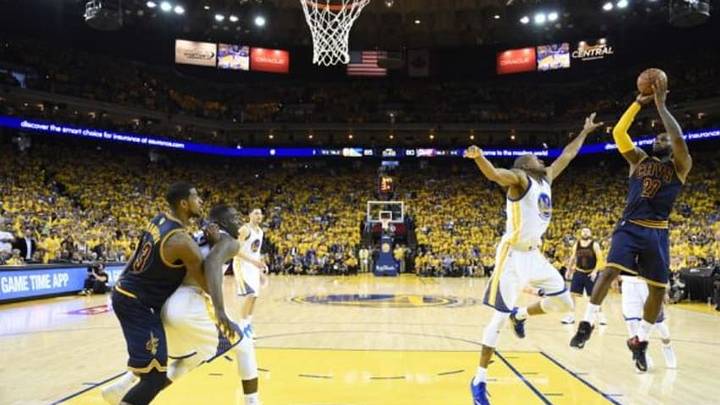

Leaving aside the silliness of blaming LeBron James for Kyrie Irving’s injury[1. You know who you are.] because of his miss at the end of regulation in Game One of the NBA Finals, there have been copious criticisms of the final play itself. “Another crappy iso, why don’t they run something?” is the basic form of the complaint. It’s easy to see the force of this argument, this is not good looking basketball:
HOWEVER[2. And you had to see that coming, as this is by design very much a #WellActually post.], it’s also far closer to correct strategy than is commonly acknowledged. The main factor, routinely ignored in discussing these late, tie game[3. The difference between being down one and tied is monumental in terms of the math, and quickly becomes much more complicated from a logic standpoint, so this only concerns the specific “game tied, shot clock off or close enough to off to not meaningfully differ” situation.] scenarios is timing. Both the timing of running a play – never an easy thing in a scenario where attempts to run any sort of off-ball largely end in rugby scrums – but more importantly, timing the shot so that it A) comes before the final buzzer, B) leaves no time on the clock for the opponent to either respond to a make or win outright themselves.
As an illustration of the importance of not leaving time on the clock, imagine the following scenario with completely made up[4. Though I think very reasonable and in fact highly generous to the “run something” point of view.] numbers and assumptions. Suppose you could guarantee your team a 25% two point shot which goes in or doesn’t with the clock expiring with Crappy Iso Ball (CIB), while the alternative is Prematurely Executed Perfection (PEP), whereby you get off a two pointer with 50% accuracy that leaves enough time for the opposition to take a (theoretically correct)[1. The math in “down two, time expiring” situations is really not close in terms of going for three and the win being better – the two-pointer has to be double the accuracy in a vacuum for the decision to be breakeven.] three-point CIB the other way. Which do you pick?
Knowing nothing else about the teams, the answer is CIB, and it’s not particularly close. To whit, your winning percentage with CIB is 62.5%. The first 25% is the shot going in. The other 37.5% is the shot missing, but you winning in overtime. With the PEP shot, your winning percentage drops despite getting twice as good an initial shot. You only win 75% of the time the first shot goes in, given that the opposition still hits their shot a quarter of the time, while when you miss, your winning probability drops from 50% to 37.5%, leading to an overall win percentage of 56.25%[2. (0.75 * 0.5) if you make the shot + (0.5 * 0.5 – 0.5* 0.25) to win in overtime if you don’t.]
Though the above an extreme example, it demonstrates the general point about how important it is to get the last shot. Even if by running a play you could double the accuracy of the initial shot, it probably isn’t worth it if the opponent gets the last possession. And this is before even considering getting the timing wrong in the other direction, not getting a shot off at all.[6. The math gets trickier but as a quick example:
CIB stays the same.
Going for PEP means a quarter of the time you don’t get a shot off at all as time expires, another quarter leaves the opposition time for a CIB, and 50% of the time everything goes off without a hitch and you get that same 50% shot.
What happens then? Winning percentage for CIB remains 62.5%, but for PEP, it rises slightly to 64.0625% ( 12.5% + 37.5% + 14.0625%) Great. Run something, all you have to do is double the effectiveness of the shot to gain a miniscule advantage over just taking the iso.] Now, design a play that’s going to be twice as a effective against a set defense, allowed to be far more physical than at any other point in the game. This play also has to ensure that the shot is taken in time, but leaves no time on the shot clock. Now, the players have to execute this stratagem on the fly, in a high pressure environment with adrenaline pounding. You almost certainly haven’t practiced it because first how could you duplicate the scenario in practice and second of all, NBA teams don’t actually practice that much in season. As a former NBA assistant told me last year:
"You’ll run something to get the ball into certain player’s hands because you trust them to be able to create for themselves or their teammates. While I’ll take a well executed action that gets the ball in the hands of the open guy every time, even the best coach will sometimes just put the ball in the hands of [the best] player because he trusts the player’s ability to create. Sometimes you just can’t come up with a clever play or don’t want to try something complicated so you do something simple."
This isn’t to say it can’t be done. But if you have LeBron James, which is more likely, him getting off a better shot in isolation than he did on Thursday night, or an A-Team like plan coming together in perfect harmony?
Speaking of LeBron, what’s been overlooked is allowing him to iso in that situation usually ends up with a better shot than he got on this occasion. Much like most of the time James Harden isn’t going to fumble the ball away in transition against as scrambled defense like he did in Game 2 of the West Finals, LeBron isn’t going to have to settle for a fading 26 footer if given an entire side of the floor and time to work. What he is going to do is get a reasonable shot, get that shot off in time at the right time. In an end of game, tie game scenario, you can’t hope for much more.
 Add us as a preferred source on Google