
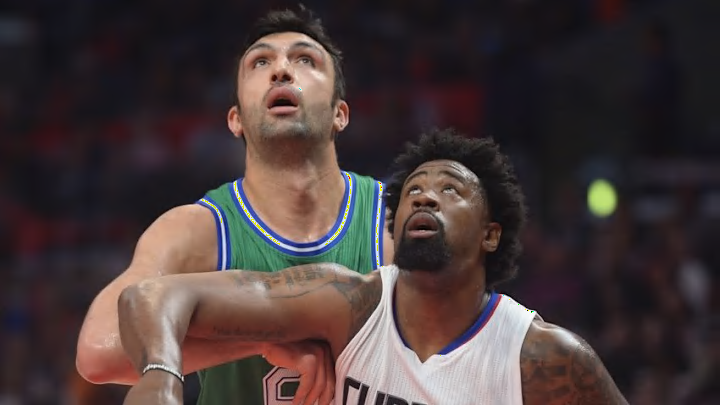
This is the first of a planned two-part post that focuses on defining a better player rebounding skill model that breaks up rebounding into its component skills. In the first part, I introduce the model and its applications. In the coming weeks, Scott Powers, a colleague and PhD student in statistics at Stanford, will join me for an in-depth discussion of the model and its interpretation.
A few weeks ago I wrote about a probabilistic rebounding model aimed to better describe a player’s impact on the likelihood of a rebound occurring while he is on the court. The model produced results based on the assumption that a player was on the court, playing with average teammates and opponents and there was a missed shot with a known distance. Its purpose was to answer the question: Given a known missed shot distance, what is the likelihood that an offensive or defensive rebound occurs while a player is on the court? The strength of the model is that it measures the indirect contributions a player has towards a rebound event happening and is a great tool to help explain why Russell Westbrook’s aggressive playing style can be highly effective when he channels his inner ‘maniac’.
However, the weakness of this model is that it does not explicitly account for direct actions and does not claim that the probability is a result of that specific player missing the shot or grabbing the rebound. For example, the model measures Westbrook having a 2.64% greater likelihood than DeAndre Jordan that an offensive rebound will occur when a shot is missed within four feet of the basket while they are on the court. Jordan is definitively the better rebounder especially near the basket, but since the model is not setup to measure direct actions, this is not reflected in the results.
While the probabilistic model provides insight that traditional and advanced rebounding statistics don’t show in terms of how a player impacts a rebound, it still doesn’t tell me who I should target in free-agency or in a trade if I am the Atlanta Hawks trying to improve from being the league’s worst offensive rebounding team.
Defining Individual Rebound Skill
To paint a more complete picture of a player’s direct rebounding skills and to complement my indirect probabilistic model, I embarked on creating a model that measured direct individual rebounding. In order to do this, I distinguished rebounding skill into two distinct characteristics:
1. Positioning – How well can a player locate and position himself to get the rebound.
2. Ball-Control – Given a player is in position, how well can he control the rebound.
A player’s total rebounding skill will be a combination of these two characteristics. Currently, rebounding statistics attempt to measure these two skills with:

Although REB% begins to measure a player’s positioning skills, it doesn’t completely reflect how often a player positions himself for a rebound since it only accounts for the times the player controls the ball. As a result, the statistic does not include the instances the player was in position, but didn’t get the rebound. Good positioning should lead to more rebounds, but the ability for a player to position himself does not require him to control the rebound, just that he is in the area.
A result of NBA player tracking data, %REB does a good job measuring a player’s ability to control rebounds, but it is important to note that this statistic alone does not describe a player’s total rebounding skill since it only looks at times when the player is near the ball. Perimeter oriented players will likely have a greater %REB than interior orientated players because of the relative difference in total opportunities each type of player is likely exposed to within 3.5 feet while he is on the court.
As a result, I modified the current REB% to better define a player’s specific rebounding skills and renamed both REB% and %REB for clarity and to better reflect their measurements as:

Put into practice, a player’s ability to position himself for an offensive rebound would be labeled as ORP% while his ability to control an offensive rebound would be labeled as ORC% and likewise for defensive rebounds as DRP% and DRC%.
The concept of rebound positioning and control percentage are not new and are identically defined by Seth as Chase% and Win%, but we differ in our calculation methods, specifically when measuring positioning percentage. In an effort to minimize the impact of luck and variance, I regressed each of the statistics towards the respective positional mean to get a more accurate representation of a player’s skill with respect to his positional peer.
More importantly, I take it a step further and view these two skills as independent events. A player must first get into position and then control the rebound. As a result, I measured the total rebounding skill of a player as:
(REB)T% = (REB)P% x (REB)C%
In combination, the model can more accurately measure specific aspects and total rebounding skills for a player. The depth of this model is extensive and provides a substantial amount of information on player rebounding skill during the entire 2015-2016 season. While there were a number of small case studies I wanted to explore, for the sake of brevity, I focused on one. To explore the entire results and interact with the data, check out my R-Shiny web application here.
The Cost of Durant on the Warriors
One of the biggest strengths of this model is the breakdown of a player’s rebounding skill into two categories, as opposed to just a single hard number that doesn’t entirely help our understanding of a player’s rebounding skill level. Being able to measure how well a player excels with respect to positioning and ball-control is important because deficiencies in either category require different solutions. If a team can’t specifically identify a player’s or lineup’s rebounding deficiency, solutions to the problem become much more unreliable.
Putting this model into practice, the breakdown of player rebounding skills makes it easier to understand what teams are gaining or losing in any player movement with respect to rebounding. Take for example one of this off-season’s most underrated free agency signings, Zaza Pachulia going to the the Warriors. Pachulia was brought in to fill the void left by Golden State offloading many of their front court players (Andrew Bogut, Festus Ezelei and Mo Speights) to create salary-cap space for Kevin Durant.
Looking back on the 2015-2016 season, the Warriors finished as the 20th best offensive rebounding team in the NBA. Their inability to contest and control the offensive boards was a recurring theme in many of their losses as four of their nine regular season defeats were to four of the top-8 rebounding teams in the league in Detroit, Portland, Boston and Denver. This was even more apparent during the Western Conference Finals when the NBA’s top rebounding team, the Thunder, pushed the Warriors to the brink of elimination.

As shown by the model, what the Warriors are getting with Pachulia is one of the NBA’s best offensive rebounders in terms of rebound positioning. Ranking 4th best overall and 2nd best at his position with an ORP% of 29.5%, the Warriors add a piece that should provide them with more opportunities at offensive rebounds. This is a significant upgrade over Bogut’s OREB% of 15.6% that is 98th best in the NBA, but ranked at an underwhelming 63rd for his position. Bogut’s lack of positioning skills could very well be a contributor to the Warriors’ weak offensive rebounding presence.
Bogut certainly brings excellent offensive rebound ball-control, which is something that the Warriors will be sacrificing with his replacement in Pachulia. Yet, at the end of the day, the Warriors need more opportunities on the offensive glass than ball-control and Pachulia brings that immediate impact. A player that is more often in position is going to make it more difficult for the defense to control the defensive rebound, an area where the Warriors saw themselves outrebounded by 6 defensive boards per loss. Yet, overall, Pachulia brings a significant improvement in offensive rebounding talent to the Warriors and, in terms of contract value and area of most need, is almost certainly the Warriors’ best off-season pickup aside from Durant.

However, to finalize the Durant signing, Bogut wasn’t the only player the Warriors had to part ways with as they let Harrison Barnes, Ezeli and Speights walk in free-agency, a group of players that combined for 45% of the Warriors total rebounds and 60% of their offensive rebounds per game. In an effort to fill the void left by the departure of their frontcourt depth, the Warriors signed David West and re-signed Anderson Varejao along with the addition of Durant. While the Warriors do lose production, they also lose impact across all offensive rebounding categories. In terms of positioning, control and skill, the Warriors replace their strongest group of offensive rebound players with a weaker composition, which was an area they already struggled in the most.
Perhaps the biggest loss comes in the departure of Ezeli who was one the league’s best rebounders, especially with respect to positioning and overall skill on the offensive glass. With an ORP% of 29.4%, Ezeli performed slightly better than did Pachulia in positioning, which is an area that should improve the Warriors presence on the offensive boards. While the Warriors lost Barnes to a high price tag, Ezeli signed a modest two-year $16-million-dollar deal with Portland, which is a small price to pay for his elite skills on the offensive boards. Assuming the Warriors still sign Pachulia, prioritizing Ezeli would not only have provide more offensive rebounding depth for a depleted roster, but would have given the Warriors two of the best offensive rebounders for about a combined $11 million per year.
Even though the Warriors will field one of the greatest shooting teams that has even been assembled in the NBA next season, it doesn’t make them immune to missing shots. As would be expected, their worst performances corresponded with poor shooting nights where they shot on average 41% from the field and 33% from behind the three-point line. For a team that relies heavily on perimeter shooting, if those shots aren’t falling, the Warriors have no substantial safety-net to create second chances opportunities with their lack of offensive rebounding presence, especially with the players they will likely rely on most to provide that threat. Come playoff basketball, when the style of play slows and becomes more physical as the Cavaliers forced in the Finals, the Warriors will be pressured into tougher shots, creating more rebounding opportunities that they are not built to control, especially against better rebounding teams.
While Durant provides another weapon on offense, his signing set in motion roster changes that failed to completely address, if not worsen, the Warriors ability to recover from poor shooting nights. Although not a fatal weakness in their quest to win the 2017 NBA championship, the lack of offensive rebounding talent will provide significant hurdles along their path.
 Add us as a preferred source on Google