
Key Points
Bullet point summary by AI
- The UMBC Retrievers made history as the first 16 seed to defeat a 1 seed in the men's NCAA Tournament.
- Fairleigh Dickinson followed UMBC's feat by stunning Purdue just five years later, defying massive point spread odds.
- Harvard achieved the first women's 16-over-1 upset in 1998, doing so on Stanford's home court in the opening round.
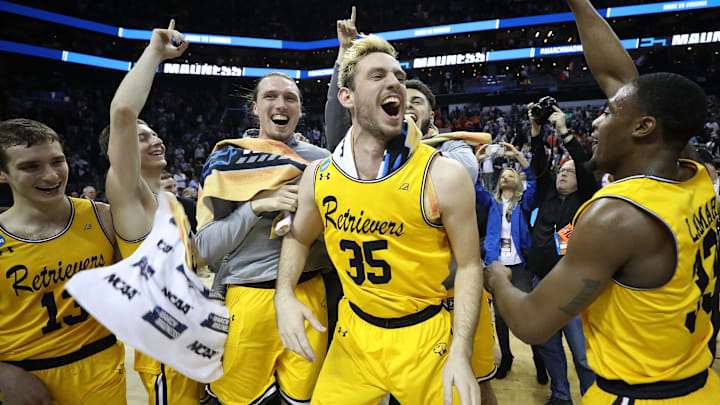
College basketball fans will never forget the March Madness shock of the UMBC Retrievers, a No. 16 seed in the NCAA Tournament, upsetting the No. 1 overall seed Virginia Cavaliers in the first round back in 2018. It was the first time in the men's tournament that a 16-over-1 upset had ever happened. At that point, we simply just thought it was impossible, considering that No. 1 seeds had won 135 straight games in such matchups previously. But it happened, and it happened again after that.
Even still, it's the rarest upset in March Madness, a 16-seed beating a 1-seed. So whenever college hoops fans see one of the bottome seeds in the tournament putting a scare into one of the top seeds, the anticipation and excitement increases quickly and exponentially. And it has fans wanting to know just how rare it is, both in the men's and women's tournaments. Well, we've seen it only three times, which is why it's such a fan moment to witness in March.
There have been three 16 seeds to beat a 1 seed in March Madness
Year | Upset Matchup | Final Result |
|---|---|---|
1998 Women's March Madness | (16) Harvard upsets (1) Stanford, 71-67 | Lost to Arkansas in Round of 32 |
2018 Men's March Madness | (16) UMBC upsets (1) Virginia, 74-54 | Lost to Kansas State in Round of 32 |
2023 Men's March Madness | (16) Fairleigh Dickinson upsets (1) Purdue, 63-58 | Lost to Florida Atlantic in Round of 32 |
While most people will call UMBC beating Virginia the first 16-over-1 upset in March Madness, it was only the first in the men's tournament. The 1998 Harvard Crimson took down Stanford in the women's tournament to become the first-ever No. 16 seed to pull off the upset.
However, the one thing that's worth noting is that upsetting the No. 1 seed is where the run has stopped for all three teams that have pulled off this upset. They all went on to lose in the second round of March Madness and not advance past the opening weekend of the tourney.
2018: How UMBC made NCAA history with a stunning win over Virginia

UMBC 74, Virginia 54
The first team to do it will always have a special place in March Madness lore. Somehow, against all odds, the Retrievers were the first men’s team to ever win as a No. 16 seed, knocking the No. 1 overall seed and favorites to win the whole thing.
It wasn’t just an upset, it was one of significant magnitude that finally made the impossible feel attainable. What made that win so massive wasn’t just the fact that a No. 16 seed did it; UMBC straight dominated Virginia, holding the Cavaliers to just 21 first-half points and outscoring them 53-33 over the final 20 minutes.
UMBC was led by Jairus Lyles, who scored 28 points in the game. The win breathed new life into what a No. 16 seed could truly accomplish in the NCAA Tournament. And the crazy thing is that, just five years later, it happened again.
2023: Fairleigh Dickinson follows suit to upset Purdue

Fairleigh Dickinson 63, Purdue 58
Just when UMBC thought it was going to be the sole owner of the No. 16 upset, Fairleigh Dickinson decided to join the party. The Knights stunned No. 1 Purdue in yet another shocking upset that featured a team that barely made it against a team favored to win it all.
This wasn’t a blowout, but it was arguably more shocking than UMBC's victory. FDU entered as the shortest team in the NCAA Tournament field with one of the shortest average heights in the country. They were matched up against the tallest player in Division I and in the NCAA Tournament in Zach Edey.
And yet, the Knights sprung the upset anyway, swarming Edey and watching his supporting cast wilt under the pressure. FDU's win over Purdue was the largest upset by point spread since the field expanded to 64 teams in 1985 – they entered the game as 23.5 point underdogs.
1998: Harvard’s historic win over Stanford, the first-ever 16 Seed to top a 1 in women’s basketball
Harvard 71, Stanford 67
Before the men’s tournament ever saw a No. 16 seed pull off the improbable, it happened back in 1998 for the first time in the women’s tournament. Harvard stunned No. 1 seed Stanford, 71-67. This one was significant because the first-round games are at campus sites, meaning Harvard did it on Stanford’s home court.
Allison Feaster led the way for the Crimson, scoring 35 points with 13 rebounds. Stanford had three players score in double figures, while they were limited by multiple injuries to key contributors.
It opened the door for the upsets we see throughout the women’s NCAA Tournament to this day. While there hasn’t been another No. 16-No. 1 seed upset since, it still was the moment when upsets became possible.
Why 16-over-1 upsets are so rare in March Madness

The No. 16 seed never wins in the NCAA Tournament, but when they do, it puts the rest of the field on notice. The lore of March Madness is unique because it often comes down to which team plays the best on game day, when a couple of bad hours can end your season.
Nothing that happened before the tournament starts matters. Which is why small schools that often play in gyms reminiscent of high school gyms sometimes find a way to stun the biggest blue bloods in the sport
When it comes to the NCAA Tournament the No. 16 seeds are usually teams from the smallest conferences that hardly ever make the NCAA Tournament. They don’t have the athletic budget to compete even with the mid-major teams and are hardly ever on TV. Meanwhile, they usually play the very best of the best: This year, it would end up being a team like Duke or Auburn, with rosters loaded with blue-chip recruits.
The Dukes and the Auburns of college basketball all have nearly unlimited resources to recruit the best players, retain the best coaching staffs and have the best facilities to compete in. That’s why the upsets around this time mean more. Most of the schools that pull off a crazy upset are a team that would lose nine times out of 10, but the only win they’ll get is in the NCAA Tournament.
Could there be more 16-over-1 upsets in future March Madness tournaments?
It’s been two years since the last time a No. 16 seed took down a No. 1 seed. That said, it took half a century for the first 16-over-1 upset and we had a second just five years apart. So there’s certainly room for growth here.
With the parity of college basketball over the last decade or so, there will probably be more No. 16 seeds going on tournament runs. We’re still waiting on the first No. 16 seed to make it past the second round, but we have seen No. 15 seeds like Florida Gulf Coast and St. Peter's do the honors in recent years.
I don’t think a run like that will happen this year, though if any team could get knocked out as a No. 1 seed, it might be Duke. They don’t have their best player for now, Cooper Flagg, who’s out with a sprained ankle and may not be ready to go for the Blue Devils' tourney opener.
But then again, that’s why March Madness is fun: Anything can happen. The pressure of a single-elimination tournament claims many victims year in and year out. With more parity than ever and the transfer portal leveling the playing field a bit, another No. 16-No. 1 is on the horizon. It’s no longer impossible. There just might be a No. 1 seed on upset alert when the first round tips off later this week.
 Add us as a preferred source on Google