
Key Points
Bullet point summary by AI
- Fantasy baseball leagues use scoring systems where players earn points based on performance metrics like home runs and strikeouts.
- Drafting strategies emphasize targeting players with consistent power and high strikeout potential, even if they aren't top-tier stars.
- Balancing simple intuition with data-driven insights and understanding park effects is key to building a competitive fantasy roster.
If you’re celebrating the 2026 Major League Baseball season by joining a fantasy baseball league, you’ve come to the right place.
We might not have snacks or a giant draft board, but what we do possess is knowledge. Whether you’re a seasoned fantasy baseball player or this is your first time trying it out, we have you covered with everything you need to know about how to win your league.
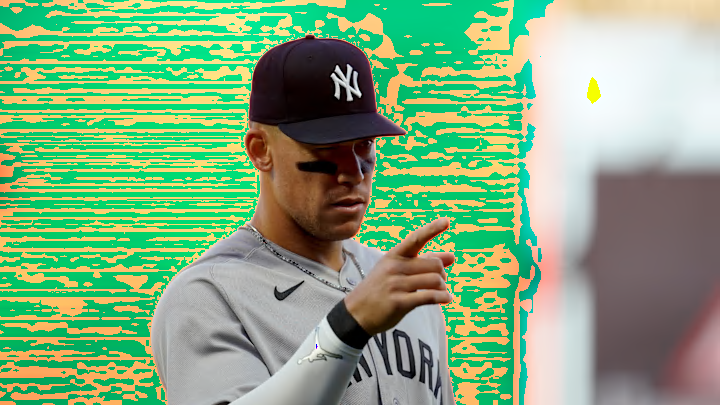
And, yes: When you have the opportunity to draft someone like Aaron Judge or Shohei Ohtani, you obviously want to do so.
What are the most common fantasy baseball rules?

If you’ve ever played any sort of fantasy sports before, then the basics of fantasy baseball shouldn’t surprise you too much: You draft a roster, then start a lineup each day. Typically, that lineup consists of one position player at each position, plus a pitching staff, several bench spots and several Injured List spots for players currently on the IL.
- Standard hitting positions: C, 1B, 2B, 3B, SS, OF, OF, OF, Util (any position), Util
- Standard pitching positions: SP, SP, RP, RP, P (any position), P, P, P
But the exact scoring system depends on your league, and can affect which players you should be targeting.
Rotisserie leagues
Rotisserie leagues, often referred to as roto leagues, are the OGs of fantasy baseball, a format as old as the game itself. Roto leagues track stats across a predetermined assortment of both hitting and pitching categories, with the best-performing team in each category awarded a point total equal to the number of teams in the league — the team that accrues the most homers in a 12-team league, for example, earns 12 points, with second place earning 11 and so on down the line. The team with the most total points at the end of the year wins the league.
Most leagues follow the 5x5 format, as in five hitting categories and five pitching categories:
Standard 5x5 categories |
|---|
R |
HR |
RBI |
SB |
AVG |
W |
K |
ERA |
WHIP |
SV |
The 10 categories above are the most traditional, and remain the standard at most outlets. But as the game has evolved, so too have fantasy formats: Some leagues have expanded to 6x6, adding things like on-base percentage and quality starts, while some leagues have contracted down to 4x4. You'll want to pay close attention to which categories your roto league is using, because player value can vary pretty widely. Kyle Schwarber, for instance, is a far more useful player is leagues that value on-base percentage in addition to or instead of batting average.
The appeal of roto leagues, beyond the fact that they've been around forever, is in the strategy involved in trying to build a balanced roster. Someone like Schwarber is great for the homers he provides, but you also need to make sure that you draft a speedy player who will help you keep pace in steals. Loading up on starting pitching will give you an edge in strikeouts, but you can't ignore relievers if you don't want to fall behind in saves — an equally important category.
That said, as the game has evolved, so too have the ways in which fantasy managers like to play. And recently, a new kind of format has emerged to try and bring fantasy leagues more in line with what's actually valued on the field.
Head-to-head leagues (points)
Head-to-head leagues are modeled after fantasy football. Rather than simply counting stats over the course of a season, teams face off against each other in weekly matchups that have a winner and a loser based on which team racks up the most points in a given period. Typically, the first 22 weeks serve as the regular season, with the final four weeks becoming the playoffs featuring the teams with the best regular-season records.
Most head-to-head leagues ditch categories entirely, instead using a points system much like you see in fantasy football. The idea is to ascribe a point total to the outcome of every play:
Hitting points | Pitching points |
|---|---|
Total bases: 1 points per base (1 point for a single, 2 for a double, 3 for a triple, 4 for a home run) | Innings pitched: 3 points per inning |
RBI: 1 | W: 2 |
R: 1 | L: -2 |
SB: 1 | HLD: 2 |
BB: 1 | SV: 5 |
K: -1 | ER: -2 |
H: -1 | |
K: 1 | |
BB: -1 |
Those newer to fantasy baseball might prefer this style of league, which takes category calculations largely out of the equation and allows managers to simply focus on point totals (which largely correlate to how good a player is). There are still strengths and weaknesses to know, though: Players who combine contact with contact ability (e.g., Vladimir Guerrero Jr.) are immensely valuable, and the points earned for innings pitched makes volume paramount (e.g., a workhorse like Logan Webb).
What kinds of players should I target in fantasy baseball?

There is far more to fantasy sports than just having the best player at their position. I lost in the fantasy football quarterfinals despite having Peyton Manning and his 55 passing touchdowns as my quarterback in 2013. Drafting Judge or Paul Skenes won’t guarantee you a championship, or even a head-to-head victory (just ask anyone who has Skenes and watched him fail to make it out of the first inning on Opening Day).
Personally, at least for hitters, I prefer players with power, especially at first base. There were eight first basemen who had at least 450 fantasy points at CBS Sports last year, and all but one had at least 24 home runs.
Compare that to Luis Arráez, who had a solid season for the Padres and led the National League with 181 hits. However, he only ranked 14th among first basemen in total fantasy points at CBS Sports. Unfortunately for Arráez, his 31 doubles and 11 stolen bases weren’t enough to overcome his eight home runs and .719 OPS.
In terms of pitchers, you want guys who are going to get strikeouts, even if they’re not necessarily an elite, perennial Cy Young contender. Nick Pivetta averaged a 4.33 ERA from 2021-24, though he also racked up 705 strikeouts over 623 innings. That alone would have justified drafting him last year, and he rewarded fantasy players with 16.9 points per game, largely because he recorded 190 strikeouts in 181.2 innings.
What are the best fantasy baseball strategies?

Personally, I believe there is a distinction between what players to target and what your strategy should be. Both are absolutely intertwined, and you can’t determine how you’re going to win without knowing who is there to help you win.
As I alluded to with Pivetta, an effective strategy is researching trends and finding sleepers who meet your league’s needs. Let’s stick with starting pitchers: Pivetta’s average draft position in CBS Sports leagues entering this year was roughly 96, despite his reliable history of accumulating high strikeout totals. On the one hand, he was a top-100 pick, but it’s also entirely possible that he could have slipped to the 9th round or later.
You also must avoid drafting players solely off name recognition or their team, unless they play in a stadium or situation that puts them at a disadvantage. Athletics pitcher Luis Severino is a two-time All-Star, but he — and other A’s pitchers — play their home games at Sutter Health Park, a Minor League stadium with extremely hitter-friendly dimensions. Fantasy players who drafted Severino might be regretting that decision, especially with his recent control problems.
Rays third baseman Junior Caminero caught everyone’s attention with 45 home runs last year, though he hit much better at George M. Steinbrenner Field (.313 with 22 home runs and a .954 OPS) than he did on the road (.218 with 23 home runs and a .743 OPS). Unfortunately for Caminero, he and the Rays have returned to Tropicana Field for the 2026 season.
Above all else, try to find a balance between being simple and overthinking things. Trust your gut, and don’t read too much into a player’s projected stats. Baseball-Reference is an excellent tool to investigate a player’s splits without worrying about their exit velocity or pop time.
More MLB news and analysis:
- What to know about replacement players ahead of a possible MLB lockout
- Konnor Griffin and 4 more prospects set to cash in next amid MLB’s extension frenzy
- Comparing the star-studded 2026 MLB rookie class to the best in baseball history
- Way-too-early MLB trade deadline preview: These stars won’t survive July
 Add us as a preferred source on Google