
We're into May now, which means the statistical dust has started to settle around MLB — and savvy fantasy baseball managers can start to identify underperformers to buy low on and overperformers it's best to sell high. After a bad six weeks or so, you never know which big names others in your league might be willing to cut bait on, while there's still a ton of time to profit if you're able to land the perfect trade.
That's why we're here to help. Below, we've identified four slumping stars who are destined to turn it around sooner or later, as well as four early breakouts that we don't think will last. As always, this isn't a strict recommendation; everything is dependent on price, and what you can get for a given player in your league. But it's worth sniffing around, because now is the time of year when managers can really make hay.
Players to target in fantasy baseball trades
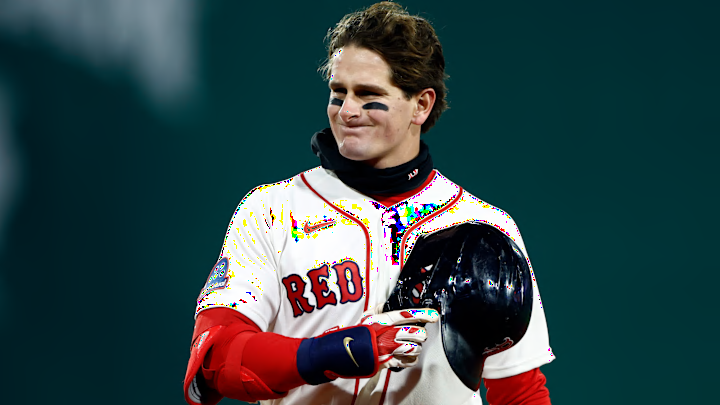
OF Roman Anthony, Boston Red Sox
I was a little bit wary of Anthony during draft season, mostly due to concerns about whether he could live up to his fourth-round ADP with such a high ground-ball rate (and a rookie slash line fueled by an unsustainably high .404 BABIP). Now, though, I'm worried that we're overcorrecting a bit: Yes, Anthony has been a massive disappointment to date, hitting .208 with just one homer and two steals, but much better days lie ahead.
Anthony still hits too many grounders, sure. But he also still hits the ball extremely hard, and he's been one of the unluckier hitters in baseball so far this year, with a 40-point gap between his xwOBA and wOBA. He's actually improved his launch angle slightly, and yet his barrel rate has plummeted. All of which suggests that he's just one or two tweaks away from looking more like the budding star we saw last season. His overall approach limits his fantasy upside, but we're in prime buy-low territory now.
1B Freddie Freeman, Los Angeles Dodgers

On the surface, it would appear that Father Time has finally caught up to the 36-year-old, who's currently posting his lowest OPS in nearly 15 years. Dig just a bit deeper, though, and it sure looks like Freeman is the same offensive force as always: He's slashed his K rate almost in half, and his barrel rate and average exit velocity are reaching career highs. I don't want to imply that this is as simple as pointing to his .273 BABIP — almost 70 points lower than his career mark — and call it a day, but, well, nothing in the profile suggests that Freeman is anywhere near a decline. His days of contributing 7-10 steals might be in the past, but he'll give you 20-25 homers with an elite batting average — and, most importantly, elite counting stats once both he and the rest of this Dodgers lineup hit top gear over the summer.
OF Fernando Tatis Jr., San Diego Padres

Much has been made of Tatis Jr.'s power outage so far this year: After going deep 25 times last year, he's yet to hit a single homer so far in 2026, in large part thanks to a career-high ground ball rate and a minuscule air-pull rate. With a batted-ball profile like that, it's no wonder he's underperforming his underlying metrics; grounders and opposite-field fly balls are about the least productive things a hitter can do.
I'm not a hitting expert, nor did I intern at Driveline. Whatever is wrong with Tatis Jr.'s swing right now is far above my pay grade to fix. But if I have to choose between a physical limitation and a technical one, I'll take the latter every time. This is less an argument rooted in reason than one rooted in faith: faith that Tatis Jr. is too physically gifted not to figure this out, and faith that even a small tweak or a minor regression to the norm will result in a very valuable player given his combination of exit velocity and foot speed. He's simply a better player than this, and there will be no better time to buy.
RHP Bubba Chandler, Pittsburgh Pirates

This one's pretty simple: Please, for the love of God, just throw strikes. There is no doubt about the electricity of Chandler's right arm; we saw it down the stretch of his rookie season last year, when he allowed just two runs on seven total hits with 19 strikeouts across his final three starts, and you see it every time you watch him pitch. But while drafters were hoping for a second-year breakout, Chandler has instead regressed, with an ugly 4.97 ERA and 1.48 WHIP largely fueled by a 15.4-percent walk rate that ranks him in the ninth percentile of all starters. He's walked three or more batters in four of his six starts so far in 2026, and he falls behind in counts even more frequently.
I don't want to pretend that this is an easy fix, or something that will get solved overnight. It's entirely possible that Chandler has more frustrating days to come this year. But given his prospect pedigree and the promise of his 2025 debut, the odds are good that he's going to figure it out eventually. And when that day comes, you're going to want to be the beneficiary. In the shallowest leagues, Chandler probably isn't worth a roster spot right now; if you're in a 12-teamer or deeper, though, his sky-high ceiling makes him worth the stash.
Avoid
2B Ozzie Albies, Atlanta Braves

I was in on Albies in drafts this spring, betting that a normal offseason and better injury luck would help a player still in his prime get back to his career norms offensively. So, now that he's tearing it up with a .908 OPS for the league-best Braves, why am I telling you to try and sell high?
Simply put, because Albies is getting very lucky right now. His exit velocities and barrel rate are all poor, and his wOBA is a full 80 points higher than his expected mark. Granted, the fact that Albies pulls the ball in the air as frequently as just about anybody means that he has a better shot of outperforming his underlying metrics than most hitters. But even by those standards, this has been pretty ridiculous. Add in the fact that Atlanta doesn't seem to be running very much as a team anymore (Albies has yet to steal a bag after swiping 14 last season) and I think now's the time to pull the plug.
C Hunter Goodman, Colorado Rockies

On first blush, Goodman would appear to be on track to be this season's Cal Raleigh, with a .257/.331/.560 slash line and nine homers across his first 29 games — a 45-homer pace if he can keep it up over a full season. I'm skeptical that he can, though, mostly because his approach at the plate feels unsustainably poor against big-league pitching.
Goodman swings at everything. His 55.5 percent swing rate is way above the MLB average of 47.3, and his chase rate is in the seventh percentile. Even when he does pick the right pitcy to pull the trigger on, he struggles to make contact, with an alarmingly low 73.8 percent zone contact rate. He's getting the most out of the times he does connect, but how much longer will that continue? And when pitchers adjust and start throwing him nothing but breaking stuff down and out of the zone, will his entire profile collapse? In a deep year for catchers, I'm not willing to take the risk, especially not if you can sell high on him now.
RHP Taj Bradley, Minnesota Twins

For those who waited years for the Bradley breakout, this is likely tough to hear. But as good as he's been in Minnesota, with a 2.85 ERA and 25.3 percent K rate in his first seven starts, I'm afraid that under the hood he remains the same maddeningly inconsistent arm that struggled to break through in Tampa Bay.
Command has always been the thing with Bradley, who possesses tantalizing stuff but runs into trouble when hitters can sit on the four-seamer that's been his bread and butter. When he's got everything working, the results make you think he can be an ace. But we know all too well at this point how ugly it can be when it doesn't, as a fly-ball pitcher who gives up a lot of hard contact in the air — and a lot of homers — if he misses his spots. He's also been pretty fortunate thus far, with a 4.04 expected ERA that feels closer to his true ability level. You're not dropping him, obviously; but if you can find another owner who believes in him, I'd get out now.
RHP Tyler Glasnow, Los Angeles Dodgers

Maybe this is my own inability to adjust my priors, as someone who's never been a big Glasnow fan. He's been awesome for the Dodgers so far this year, and even more interestingly, he's done it while expanding his repertoire beyond the usual fastball/slider/curve mix he became known for.
I'd still advocate selling high if you can flip him for a star bat, though. Health is the biggest reason why: At 38.2 innings, Glasnow is already almost halfway to his 2025 mark, and he's cleared 120 innings exactly one time in his 11-year MLB career. The talent has never really been in question; sustainability has, and given the Dodgers' pitching depth (and Glasnow's importance come October), there's no reason to push him in June and July.
 Add us as a preferred source on Google