
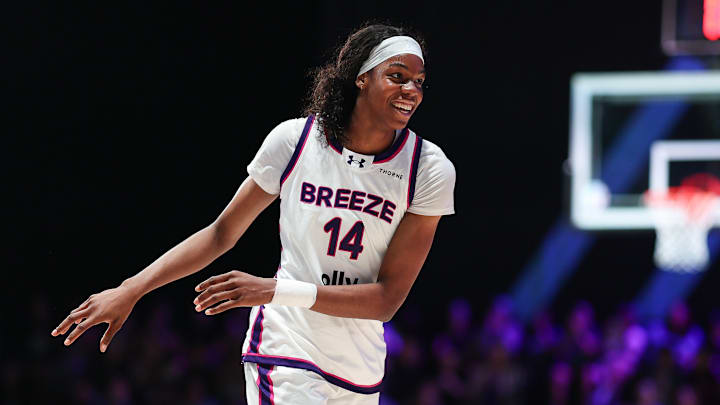
This past weekend, Dominique Malonga threw down the first dunk of Unrivaled’s second season, becoming just the second player in league history to dunk in a game after Brittney Griner. Malonga, a member of Unrivaled’s Breeze BC, also plays for WNBA’s Seattle Storm, and was selected second in the 2025 WNBA draft.
Despite hype surrounding her height and athleticism, the dunk marked a first for Malonga, who did not dunk in-game during her rookie season with the Storm.
“No, it feels really good. Really, I was practicing a lot. I was dunking all the time so I’m happy that I finally have one in game because I don’t want to be a practice (dunker). I want to do that in games. So I’m happy about that,” Malonga said postgame.
The dunk marks an exciting moment for Unrivaled and the women’s game at large while highlighting a deeper tension: whether Unrivaled will solidify itself as an innovation hub within the women’s basketball ecosystem or as a legitimate alternative to the WNBA.
Unrivaled could change the WNBA ... or it could replace it
From the onset, Unrivaled promised a different type of basketball: a 3-on-3 game played on a mini full court (49.2-by-72 feet) compared to the W’s regulation size (94-by-50 feet). The game is three seven minute quarters and a fourth quarter with “winning scoring” where 11 points are added to the leading team’s score and both teams play to reach that point value. The game is supposed to be more fast-paced, with one free throw awarded no matter the nature of the foul, alternating possession instead of jump balls, and an 18 second shot clock (compared to the WNBA’s 30 seconds). As Luke Cooper, the president of basketball operations at Unrivaled told ESPN, “The game is rooted in how you would play basketball as a kid on a black top.”
Unrivaled’s format could open the door for serious late-game experimentation. The league could pilot a 9.5 foot rim for the fourth quarter, or incrementally pull players off the court and end with a one-on-one matchup. Alternatively, the league could keep play as is but experiment during an All-Star game. If Unrivaled demonstrates that these structural changes are feasible, they can gradually be adopted by more established leagues without risk. As an innovation hub, Unrivaled’s value lies in its ability to experiment without destabilizing or delegitimizing women’s basketball at large.
Unrivaled has also modeled a new relationship between league ownership and labor by more or less merging the two. The league was founded by two of its star players, Breanna Stewart and Napheesa Collier, and gives athletes equity in the league. Unrivaled also set a high bar for player compensation: in its first season, the average Unrivaled salary was around $220,000. For reference, the average salary in the WNBA’s 2025 season was $102,249. In a typical year, Unrivaled’s governance and labor structure give players a reference for what is possible. This year, that reference point has been converted into leverage in WNBA CBA negotiations as players point to Unrivaled as evidence that leagues can afford to pay players higher salaries without sacrificing league sustainability.
If the ongoing labor conflict between the WNBA and its players escalates to a full scale work stoppage, Unrivaled would not need to declare itself a WNBA competitor— it would become one in the vacuum created by a strike or a lockout. Though extending broadcasting deals and covering operational costs might pose a challenge, Phantom player Natasha Cloud suggested that Unrivaled could feasibly extend the season into the summer months because the league owns the arena where games are played. The league could transition to a 5-on-5 format and expand rosters with untapped WNBA and international talent.
In the event of a WNBA work stoppage, Unrivaled could expand its season, rosters, and format and then return to its original structure once the WNBA resumes. Ultimately, Unrivaled does not have to choose between innovation and competition. It can do both.
More women's basketball news and analysis:
 Add us as a preferred source on Google