
Key Points
Bullet point summary by AI
- The Atlanta Braves are evaluating a young pitcher whose improved velocity and pitch selection have sparked early success.
- One breakout performer has transformed his command and pitch quality ahead of the regular season.
- While several players show promise, one name lacks underlying data to support the spring training surge.
Spring training numbers are almost always noise. Thin samples, uneven competition, veteran pitchers working on feel rather than going after hitters. Every March, someone posts a 1.400 OPS in 30 plate appearances and ends up in Triple-A by June. Some spring numbers are confirmation. The difference comes down to context, including what you already knew about the player, what changed, and whether the underlying data backs the box score.
The data we will look at includes FIP, which is the metric that scores what a pitcher's results are expected to be without the defense. Another important pitchers stat is Stuff+, a Statcast measure of the physical quality of pitches thrown. The last piece of data that becomes important is wRC+, an advanced statistic that measures a player's total offensive production that is adjusted for each park played in where 100 is league average.
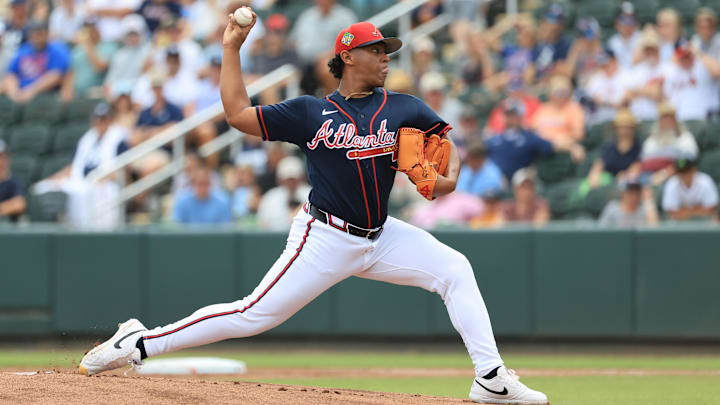
Didier Fuentes, RHP, Atlanta Braves: Buy
The 13.85 ERA from his 2025 MLB debut was always misleading. He was 20 years old, three days post-birthday, with fewer than 30 innings above High-A. His xERA was 7.73. His xFIP was 5.74. His BABIP sat at .395. The real problem was a sweeper at 83 mph that big league hitters ignored while timing his 96 mph fastball.
The sweeper is gone. In its place is a harder slider in the upper 80s. The fastball now averages 97.1, touching 98.7. Five spring innings, nine strikeouts, zero hits, zero walks. He has made Atlanta's Opening Day bullpen, the same entry point Spencer Strider used in 2022. The stuff is demonstrably better. Buy.
Mick Abel, RHP, Minnesota Twins: Buy

Abel's 2024 Triple-A season with Philadelphia looked bleak with a line of 6.46 ERA, 6.46 BB/9, 5.47 FIP in 108 innings. Minnesota traded for him with low expectations. Then his 2025 Triple-A line with the Twins appeared: 1.85 ERA, 12.21 K/9, 2.96 BB/9. The walk rate was cut in half, then cut in half again.
His Stuff+ score at the MLB level was 109. His 2025 xFIP was 4.34 against a 6.23 ERA, with a 1.85 HR/9 driving the gap. This spring: 1.35 ERA, 17 strikeouts, one walk in 13.1 innings. The command transformation preceded this spring by a full season. Buy.
Connelly Early, RHP, Boston Red Sox: Buy

His 2025 MLB debut: 2.33 ERA, 2.34 xERA, 0.91 FIP in 19.1 innings. Zero home runs. Fewer than two walks per nine. A 16.1% SwStr%. His Pitching+ was 107, Location+ was 108, and his changeup graded at 107 Stuff+, his best pitch by a wide margin.
His ERA went 3.99 in 2024 minors, 2.60 in 2025 minors, 2.33 in his MLB debut. This spring that number is 2.25 against an 8.1 out of 10 scale Opponent Quality schedule, the toughest opponent mark of any starter in the dataset with a sub-3.00 ERA. The trajectory is straight down. Buy.
Max Muncy, 3B/SS, Athletics: Sell

This is not Max Muncy who wears a Dodger jersey. This is Max Muncy who was drafted by the Athletics in 2021. Not only does he share the name with the Dodgers' thirdbasem they also share the same birthday, August 25.
So far, the differences end there. Muncy's 2026 spring 1.299 OPS in 49 plate appearances looks great. His actual 2025 MLB line does not: 72 wRC+, 30.9% strikeout rate, 4.5% walk rate in 220 plate appearances.
His minor league walk rates tell the story cleanly. At Double-A he walked 9.0% of the time. At Triple-A, 7.8%. Every level up, the walks disappeared, which means pitchers figured out they could attack him and he adjusted by swinging more, not less. For context, the league average walk rate in 2025 was 8.4%. Muncy was nearly half that.
That gap is where careers stall. Max has to learn the MLB version plate discipline and stop swinging at everything. The power is real. When he becomes more patient at the plate, he will get better pitches to hit. There is nothing in his numbers, at least through Spring Training, to suggest the plate discipline has been fixed. Sell.
Brady House, 3B, Washington Nationals: Buy, carefully

His 2025 MLB debut: .234/.252/.322, 56 wRC+, four home runs in 73 games. His ground ball rate was 47.3%. His average launch angle was 5.8 degrees. The bat speed is there at 72.4 mph. The trajectory was not. He showed that he had bat to ball contact skills, but he was mostly hitting the ball on the ground, which is a recipe for a lot of outs.
His development pattern is consistent: one rough exposure at each level, then a jump. This spring he has three home runs in 35 plate appearances against a 7.6 OppQual schedule, including a 415-foot shot off Sandy Alcantara on a 2-2 pitch after fouling off three consecutive offerings. The plate discipline still has to develop. But this fits a pattern. Buy.
Signal found. Noise identified
The names worth buying all have a specific reason why this spring is different. Fuentes has better stuff. Abel fixed his command before camp opened. Early was always this good. House fits a documented developmental arc. Muncy is the exception: nothing in his underlying numbers says the plate discipline problem is solved. Spring training is almost always noise.
Spring training is also a period of manufactured optimism. See what the prospects can do while the veterans get game-ready. It's less about the wins and losses and more about who can do the job when they need to. These numbers matter for clubs making decisions on who gets roster spots. Four of these five names have data behind the optimism. One does not. That is the whole exercise.
More MLB news and analysis:
 Add us as a preferred source on Google