
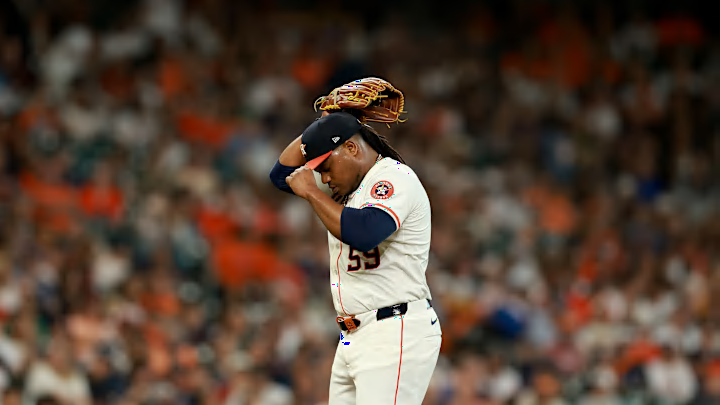
One by one, the biggest names remaining in MLB free agency came tumbling off the board this month. First came Kyle Tucker to the Los Angeles Dodgers, which was soon followed by Bo Bichette spurning the Philadelphia Phillies for the New York Mets and Cody Bellinger returning to the New York Yankees.
By the time the dust settled, the market had been just about picked clean. With one very notable exception, that is: left-hander Framber Valdez, still unsigned despite a 3.21 ERA, three top-10 finishes in AL Cy Young voting and nearly 200 innings a year over the last four seasons. On paper, that sort of consistency and production would be exactly what would-be contenders are looking for, especially given the sky-high demand for starting pitching.
And yet, as February approaches, Valdez remains a free agent — without even a hint of momentum toward a deal. What gives? How and where will this saga eventually end, and will some team be getting a potentially pennant-swinging bargain?
Red flags for Framber Valdez in MLB free agency
Clubhouse concerns

It's impossible to talk about Valdez's free agency without addressing the elephant in the room. His 2025 season took a turn for the ugly in early September, when he responded to giving up a grand slam by ... appearing to cross up his catcher, Cesar Salazar, on purpose, in the process drilling him with a 93-mph sinker.
There’s speculation that Astros pitcher Framber Valdez purposely crossed up his catcher Cesar Salazar and hit him with this pitch after Salazar told him to step off before allowing a grand slam pic.twitter.com/ds3c9MzQV6
— Jomboy Media (@JomboyMedia) September 3, 2025
Valdez's explanation afterward didn't do much to help his case. “We went down to the dugout, and I excused myself with him, and I said sorry to him, and I take full responsibility for that," he later told reporters. “It’s just stuff that happens in baseball. But yeah, we talked through it and we’re good.”
Baseball isn't played on spreadsheets. It involves real, flesh-and-blood human beings, and how those human beings get along is a crucial part of whether a team has success. Any front office weighing a significant long-term commitment to Valdez needs to know that he's someone who won't cause rifts in the clubhouse, and he hasn't done a great job of allaying those concerns.
His age
That isn't the only red flag here, though. There's also the matter of his age: Valdez turned 32 in November, a bit older than most free agents when they hit the market. He's coming off yet another solid season and shows no real signs of slowing down, but Father Time remains undefeated, and players only stave off regression until suddenly they don't.
Given that Ranger Suarez, another starter in his 30s with a less substantial track record, just got five years from the Boston Red Sox, you can bet that Valdez is using that as a baseline in talks with teams. But that would require paying him $25-30 million not just for 2026 but through his age-36 season, and there's no way to know for sure just how many prime years you're going to get on that contract.
He doesn't miss a ton of bats

Valdez is also a bit of a tricky evaluation on the mound, in a way that his shiny top-line numbers wouldn't necessarily suggest. Unlike most frontline arms of his ilk, Valdez is not a premier bat-misser — he ranked in the 59th percentile in whiff rate and the 55th percentile in K rate last season. Allowing contact introduces a host of potentially negative outcomes for a pitcher, and Valdez allows much more than you'd like from your No. 1 or No. 2.
Of course, Valdez gets away with it because most of the contact he allows comes on the ground: His sinker is his bread-and-butter pitch, and he consistently runs ground-ball rates north of 60 percent (well above the MLB average of 44.2). This raises a couple of concerns, though: Valdez relies on defense and batted-ball luck to turn his batted balls into outs, and what happens when his stuff begins to deteriorate and those batted balls become a bit louder? He's not as set-it-and-forget-it as previous top-flight starters to hit the market. There would seem to be less margin for error here, and teams without great infield defenses wouldn't appear to be a very good fit.
What kind of contract can Framber Valdez expect in MLB free agency?
I had Valdez pegged for a six-year, $156 million deal back in October, something similar to the contract fellow lefty Carlos Rodon signed with the Yankees a few years ago. Now, though, it seems like that may have been a tad aggressive: It's clear that teams aren't comfortable with the idea of crossing (or maybe even approaching) the $30 million a year threshold for Valdez, whether that's due to off-field concerns or about his specific profile.
Lefties with this sort of track record don't grow on trees, and in a market where Suarez is making north of $25 million over five years, you'd expect Valdez to get at least something similar. The money and the landing spots are beginning to dry up now, though. And if Valdez can't get the sort of deal he expects, could he go the shorter-term route we've already seen from the likes of Tucker and Bichette — sacrificing long-term security for a higher AAV and plenty of opt-outs to allow him to reenter the market as soon as next year?
I'm a bit skeptical. For starters, Valdez is significantly older than either Tucker or Bichette, and the thought of hitting free agency again at age 33 doesn't carry the same promise as it does for, say, Bichette at age 28. He also comes with a particular set of circumstances that might make a short-term deal unpalatable.
The qualifying offer conundrum

Valdez was one of 13 pending free agents to be extended the qualifying offer by their previous teams at the start of the offseason. Valdez, to no one's surprised, turned it down, hoping to do much better than a one-year, $22.05 million deal on the open market. As a consequence of that decision, though, whichever team signs Valdez now have to forfeit one or potentially multiple draft picks (plus international bonus pool money) for the privilege.
That's a not-insignificant commitment for a team to make, and while most front offices are happy to do it in order to secure several years of an elite player, the calculus shifts when we're talking about just a season or two. Valdez can try to pivot to a short-term deal with a higher AAV, but what team is going to be willing to pay the required penalty just to watch him potentially bolt next winter? It's a tricky market to parse, to say the least, and one that leaves only a handful of possibilities.
Most likely landing spots for Framber Valdez
The favorite: Baltimore Orioles

The O's have already taken the qualifying offer plunge after signing Pete Alonso back in December, and the increase in punishments for adding a second QO player pale in comparison to going from zero to one. Plus, Baltimore could very much use Valdez: The Shane Baz trade helps, but there's still precious little in the way of known quantities in this rotation, and Valdez's ability to eat up quality innings would go a long way to settling things and getting this team back toward contention in the AL East. It would be a shock if the Orioles didn't add another notable arm before Spring Training arrives.
Don't rule them out: Atlanta Braves, Philadelphia Phillies, San Francisco Giants

Baltimore would have to be the leader in the clubhouse, a team that clearly has contention on its mind and a glaring hole at the top of its starting staff. If I had to choose someone for second place, though, it would be the Giants: San Francisco has been curiously quiet this offseason for a team that we know is desperate to get back to October, and Buster Posey can't afford not to find a reliable third option behind Logan Webb and Robbie Ray. Plus, having arguably the best defensive infield in baseball will only help ease his transition.
From there, the picture gets considerably muddier. The Braves have a ton of injury risk and uncertainty of their own to navigate, and we know they were sniffing around the likes of Freddy Peralta in trade talks in recent weeks. Valdez is a bit overqualified for their needs, but if his market falls far enough, why not take the swing? The Phillies, on the other hand, just need something: They can't afford to simply run back last year's squad minus Suarez, and after missing out on Bichette, Valdez is the next best available player regardless of position. Plus, less Taijuan Walker is always a welcome thing.
Dark horses: Arizona Diamondbacks, Athletics, Detroit Tigers

When a player remains on the market for this long, of course, you can't rule out a mystery team or two getting involved. The D-backs are too good to rebuild, but need to add significant pitching upgrades if they want any chance of staying afloat in the NL West. The A's have the offense to contend but not the rotation, and Valdez's ground-ball tendencies would be a great fit for an extreme hitter's park like Sacramento.
That brings us to Detroit. It's not very likely, I admit, but the Tigers could use another starter even if they hold on to Tarik Skubal for at least 2026. Valdez would do wonders as their No. 2, while also providing a succession plan once Skubal inevitably moves on in free agency next winter.
 Add us as a preferred source on Google