
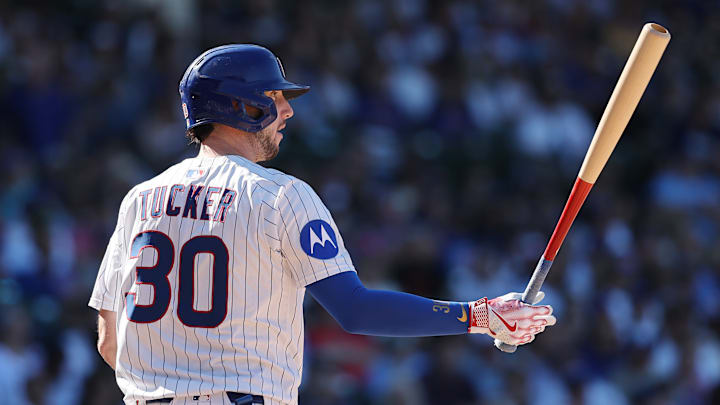
MLB's big bad did it again this week, as the Los Angeles Dodgers swooped in and plucked Kyle Tucker in free agent on a deal that might just break baseball math for good. Tucker is signing a four-year, $240 million with L.A., with $30 million of that money deferred and opt-outs after 2027 and 2028.
Almost immediately, the wailing began. What was already the richest team in the league decided to throw one more historic wad of money onto the pile — and add another All-Star talent to a roster full of it thanks to nothing but cold, hard cash. How can anyone compete with these Dodgers? How can they keep spending like this? And with the current collective bargaining agreement set to expire at the end of the 2026 season, was this the thing that would finally push baseball into a work stoppage?
Some of those questions are more valid than others. But what's inarguably true is that Tucker's deal is jaw-dropping in its scale.
The real cost of Kyle Tucker's historic Dodgers deal
On paper, the math would appear to be simple: $240 million over four years is $60 million per season. It's a staggering number on its face, beating Juan Soto's previous AAV record by a full $9 million. And yet, somehow, that's just scratching the surface of what this deal is actually going to cost the Dodgers. Because while fans around the league are screaming for the league office to curb L.A.'s spending, the reality is that the system is already designed to do just that — Andrew Friedman (and his ownership group) simply aren't taking the hint.
To get the full financial picture of Tucker's new contract, we need to factor in the luxury tax, the system MLB put in place in its most recent CBA as an attempt to institute parity without an actual salary cap. The relevant portion here is pretty straight-forward: Because the Dodgers have gone over the CBT threshold (which began at $230 million and has climbed steadily to $244 million for the 2026 season) for at least three consecutive years, they're subject to a 50 percent penalty for every dollar they spend beyond that threshold. But that's not all, as Los Angeles is also subject to an additional 60 percent tax for exceeding the threshold by $60 million or more, which the Dodgers have done with ease in recent years.
The upshot is that any free agent the Dodgers sign comes with a 110 percent tax penalty. Doing some quick math, that makes the real cost of Tucker's deal a whopping $120,078,000 — per season.
How Kyle Tucker's annual salary compares to the payrolls of MLB teams
If that sounds like a lot, well, yeah, no kidding. But to put into context just how outrageous that number is to spend on a single player, consider that just the total cost of Tucker's new contract is more than the total current payrolls of 11 different MLB teams.
Team | Current cash payroll for 2026 (MLB rank) |
|---|---|
Cincinnati Reds | $126,637,500 (19) |
Kyle Tucker's 2026 salary, including CBT penalty | $120,078,000 |
St. Louis Cardinals | $117,005,000 (20) |
Washington Nationals | $112,341,429 (21) |
Milwaukee Brewers | $106,640,000 (22) |
Minnesota Twins | $105,235,000 (23) |
Colorado Rockies | $100,721,666 (24) |
Chicago White Sox | $99,530,000 (25) |
Athletics | $96,485,000 (26) |
Pittsburgh Pirates | $90,700,000 (27) |
Cleveland Guardians | $87,795,000 (28) |
Tampa Bay Rays | $87,720,000 (29) |
Miami Marlins | $85,715,000 (30) |
Of course, not all of that is on the Dodgers. All of these teams could afford to spend significantly more than they are right now, and all of them would be forced to do so in the event of a salary cap (which would necessitate a salary floor to go with it). There's no reason for any Major League franchise in the year 2026 to be spending less than $100 million on salary in any given season.
Still, you can start to understand why fans are crying foul right now. The Dodgers already had a record payroll, and they just decided to add an entire other payroll's worth of money on top of it — seemingly without breaking a sweat. Their TV deal is among the envies of the league, and the presence of Shohei Ohtani allows L.A. to print money internationally. They can spend in a way that many other teams simply cannot access.
That's the problem that the league and the MLBPA are tasked with solving once the current CBA expires next winter. Even for those of us who think that a salary cap isn't necessary to fix what's broken with baseball's economic model, it's clear that something isn't working, and that small-market fans aren't wrong for throwing up their hands and wondering what the point of all this really is. Sure, teams like the Milwaukee Brewers show what can be possible on a budget, but at a certain point, money talks pretty loudly. And if the Dodgers polish off their threepeat come October, it won't be hard to figure out why.
 Add us as a preferred source on Google