
Key Points
Bullet point summary by AI
- The New York Mets entered the 2026 season with high hopes after a strategic offseason overhaul aimed at playoff contention.
- A series of high-risk, high-reward moves has backfired catastrophically, leaving the team with the worst record in baseball through 28 games.
- Critical failures in both offensive production and late-inning reliability have left the Mets 10.5 games out of the NL East lead before Memorial Day.
The New York Mets might've lost franchise icons like Brandon Nimmo, Pete Alonso and Edwin Diaz in the offseason, but they appeared to have rebounded from those losses to put together a team that, at the very least, appeared capable of getting to the postseason. If April is any indication, anyone who thought this team would be somewhat competitive couldn't have been more wrong.
After getting swept by the Colorado Rockies, of all teams, at home, the Mets are now 9-19, sitting with a share of MLB's worst record. They are 10.5 games back of the first-place Atlanta Braves. They've scored the fewest runs and have the lowest OPS in the sport. Injuries haven't helped, but this team is clearly fundamentally flawed. The offseason isn't entirely to blame for what's unfolding, but it's clear that the work David Stearns did wasn't nearly good enough. Here are some areas where he went wrong.
Bo Bichette is the exact opposite of the player he was expected to be

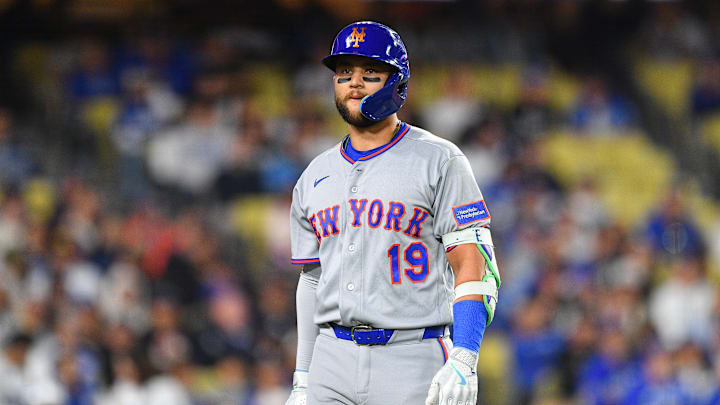
When the Mets signed Bo Bichette, the thought was that his defense at a new position, third base, would be an adventure, but his bat would make up for whatever shortcomings presented themselves in the field. Well, Bichette has actually been fine in the field, but his performance at the plate has been worse than anyone could've expected.
Bichette is slashing .233/.268/.302 with one home run and 12 RBI in 28 games. He has just six extra-base hits in 123 plate appearances, and after leading the majors with a .381 average with runners in scoring position in 2025, he's hitting .185 in such situations this season.
Season | Average with RISP |
|---|---|
2026 | .185 |
2025 | .381 |
Career | .325 |
Sure, it's nice to see that Bichette can handle the hot corner, but the Mets would surely trade a hit defensively in exchange for the Bichette they expected offensively. It's really hard to score runs when your star players don't produce, and Bichette, a player whose 62 wRC+ is tied for 160th out of 180 qualified players, is the biggest culprit.
The Brandon Nimmo trade is hurting even more than expected

The Brandon Nimmo trade was always made with the future in mind. The Mets were eager to trade him because he was a player in decline under contract through the 2030 campaign, and they didn't want him locking up a corner outfield spot knowing Juan Soto has the other one long-term. While they were always taking a downgrade for 2026, it's been larger than expected.
On one hand, Nimmo has been rock-solid for the Texas Rangers, posting a .816 OPS thus far despite slumping recently. For reference, the Mets only have one qualified hitter with an OPS above .670, and that's Francisco Alvarez, whose OPS is still more than 50 points lower than Nimmo's. On the other hand, Semien has been a disaster.
In addition to not being as good a defender as expected to this point, Semien's bat has been a complete zero. He's slashing .220/.275/.300 with one home run and eight RBI on the season. His 65 wRC+ is just three points higher than Bichette's.
The Mets traded the player who'd be their best hitter right now in exchange for an older player in a steeper decline who happens to still be under contract for another two years after this one. Yes, the Mets got out of paying Nimmo in 2029 and 2030, but was that really worth it for this version of Semien? Perhaps he'll find his home run stroke when the weather warms up, but for now, this trade is looking like a disaster.
The Mets made one too many offseason risks

The Mets made a slew of gambles this offseason in an effort to find value deals, and most of them have not paid off. For example, the Semien trade was a risk. The Mets gambled on Nimmo continuing to decline while hoping Semien would bounce back following a down year in 2025. Neither of those things has happened.
The Luis Robert Jr. trade was another gamble. Sure, they didn't have to give up much of anything, making it a worthwhile gamble, but the Mets hoped to see the MVP-caliber version of Robert by changing his scenery instead of the subpar version we saw in 2024 and 2025. Well, after a hot start, Robert has a .364 OPS in his last 10 games and hasn't homered in almost 50 at-bats. He looks a whole lot like the version of the player the White Sox couldn't wait to get rid of.
Perhaps the biggest risk the Mets took was hoping to see Jorge Polanco repeat his breakout 2025 campaign despite knowing that he's a 32-year-old with a lengthy injury history and knowing that 2024 was a brutal year for him. Well, Polanco had a 53 wRC+ when healthy and is on the Injured List right now.
The Mets expected guys like Semien, Robert and Polanco to play major roles on the team despite clear red flags, and all of them have done more harm than good. Maybe it'll turn around, but for now, this is a big reason why the Mets are in the position they're in.
Devin Williams is proving 2025 wasn't a complete fluke

The Mets haven't been in a position to win many games over the past several weeks, but the reason their recent losing skid reached 12 games has a lot to do with Devin Williams. Not only did the right-hander blow a save against the Chicago Cubs, but he also allowed the Minnesota Twins to take the lead in the ninth inning of what was a tie game by not retiring a single one of the five batters he faced, and earlier, allowed the Los Angeles Dodgers to pull away in a game thanks to a Dalton Rushing grand slam.
Williams has now allowed eight runs and six walks in just eight innings of work, and he hasn't recorded a save since April 5. So far, he's looked a lot like the pitcher that New York Yankees fans were fed up with in 2025, which makes the fact that Stearrns signed him look even more questionable.
Many thought Williams' 2025 disaster could be attributed to bad luck, and objectively, his numbers under the hood looked awfully similar to those from his Milwaukee Brewers days. However, the way his Mets career has begun proves that 2025 might've been more than just bad luck.
Ultimately, it's hard enough to win games when you can't score. It's a lot harder to win games when you can't get outs in the ninth inning of close games. Even if the Mets figure out a way to score more runs, they're going nowhere if Williams is unreliable late in games. The Williams we've seen thus far is hard to trust, and that might not change anytime soon.
Relying on 2025 failures to rebound was a recipe for disaster

What seemed most backwards about this past offseason is that the Mets let good players (Nimmo, Diaz, Alonso) leave, and held onto several players who struggled mightily in 2025, hoping they'd rebound. Say what you want about the external players they've brought in, but the internal players Stearns hoped would have better years have not shown up at all.
Mark Vientos was one of the most disappointing Mets in 2025, going from a potential future building block to a bench player. This season, Vientos has been even worse, posting a .637 OPS thus far and going just 7-for-49 (.147 BA) after a hot start to the year. Sean Manaea struggled mightily down the stretch in 2025 despite being an ace for the team in 2024, and after failing to make the Mets' Opening Day rotation, has been nothing but inconsistent in a long relief role.
Kodai Senga was the Mets' best pitcher in the first half of the 2025 season and their worst pitcher in the second half after he returned from an injury. After two good starts to begin the year, Senga has looked like his second half version his last three times out, and is probably going to lose his spot in the rotation, if not the team as a whole, because of it. David Peterson was an All-Star in 2025 before, like the others, faltering in the second half. Those second half struggles have bled into this season, as Peterson has already lost his rotation spot.
It's one thing not to want to commit to good players for too long, but why was Stearns so hellbent on bringing back players who looked awful for much of 2025? Most, if not all of those guys, have been just as bad, if not worse, this season.
More New York Mets news and analysis:
 Add us as a preferred source on Google