
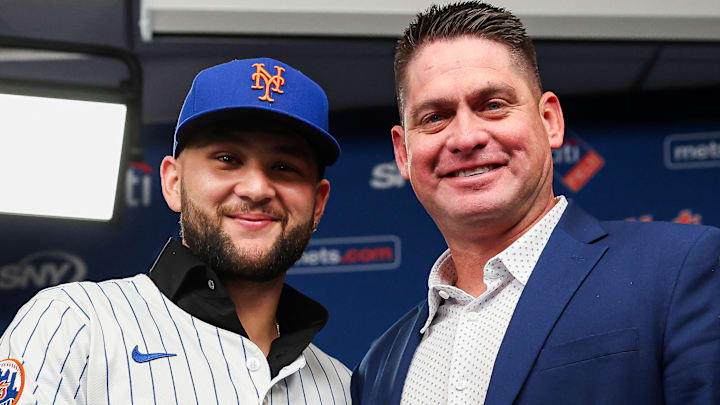
Somehow, the start to the 2025 offseason felt even worse than the New York Mets' stunning collapse to finish the 2025 campaign. It had gotten off to such a bad start in Queens that Mets fans wanted David Stearns fired and were even fed up with owner Steve Cohen. Now, just a couple of months later, it feels as if the Mets have had one of the best winters in the sport. FanSided's Robert Murray declared them one of his biggest offseason winners.
A lot went down to get to this point. Let's dive in, starting from the very beginning.
David Stearns was willing to make unpopular decisions

As if collapsing their way out of the playoffs wasn't bad enough, the Mets let several fan favorites walk this offseason. They traded Brandon Nimmo, the longest-tenured Met at the time. They let Pete Alonso, the franchise's all-time home run leader, walk in free agency. They let Edwin Diaz, a lockdown closer whose entrance song helped make him a beloved figure in Queens, walk in free agency. They traded Jeff McNeil, a two-time All-Star who, once Nimmo was traded, became the longest-tenured Met.
Letting all of these players go in one offseason, especially after how last season ended, is something few executives would have the stomach to do. It would've been very easy for Stearns to stick with the declining Nimmo in left field or spend more of Steve Cohen's money on Alonso than he deemed worthwhile, but Stearns stuck to his guns and got rewarded for it.
The Mets have built a team that aligns with Stearns' vision on multiple fronts.
Mets prioritized improving their team defense

Something David Stearns values a ton is defense. He made it clear after the season that the Mets had to improve defensively after a rough year in the field in 2025, and he's delivered, particularly up the middle.
Luis Robert Jr.'s bat has clear question marks, but he ranked in the 93rd percentile in OAA in 2025 and has been an elite defensive center fielder for much of his career. Marcus Semien was a Gold Glover at second base in 2025 and has been an outstanding defender at the keystone for much of his career. Pairing those two with Francisco Lindor, a perennial Gold Glove candidate, up the middle gives the Mets one of the best defenses up the middle in the sport.
To be fair, the Mets are taking clear defensive risks by handing the keys to their corner infield spots to Bo Bichette and Jorge Polanco, players who have combined to play at the positions they're being asked to for a total of one plate appearance. With that being said, traditionally, when moving middle infielders to the corners, the transition isn't all that difficult. There are reasons to believe both players will be fine at their respective new positions, and their bats should more than make up for any defensive downfalls.
Mets finally acquired ace they needed

One of the many downfalls to last year's team that hurt them even more than their defense was their lack of a starter they could turn to when they needed to break a losing streak or even get some innings. Freddy Peralta isn't the biggest innings eater in the world, but rarely do players who just finished fifth in the NL Cy Young award voting, like Peralta just did, become available for trade. The Mets got him.
Now, the Mets don't have to put nearly as much pressure on Nolan McLean to shoulder the load in his first full season. The Mets don't have to rely on guys like Kodai Senga and Sean Manaea to pitch like the aces the Mets hoped they'd be in 2024.
All of a sudden, with Peralta leading the way, the Mets' rotation ceiling and floor increase exponentially. Other guys will have to pitch well, obviously, but having someone you know can lead the way helps a ton.
Mets kept the door open for young players to play

Another priority on Stearns' checklist was ensuring that members of one of the best farm systems in the sport would have paths to consistent playing time in the majors. The moves they've made this winter accomplish that goal.
The lack of a left fielder on the roster keeps the door open for Carson Benge, their best position player prospect, to make the team. If the Mets choose to play a guy like Brett Baty in left field, Benge can play center field knowing that Luis Robert Jr.'s contract only guarantees him one year. Robert's contract also ensures that A.J. Ewing should have a shot to make the team sometime this season or next. On the pitching front, young arms like Jonah Tong and Jack Wenninger could be the next men up in the event of an injury to a starter in their projected rotation.
Homegrown players will have to factor in if the Mets want to build a consistent contender, and Stearns is keeping the door open for them to play a role right when they're ready.
Mets kept their financial flexibility

The last main priority Stearns seemed to have was to avoid any albatross contracts. The Nimmo deal, which still has five more years remaining, was looking more like one, so Stearns traded him away for a better fit. Alonso is a player the Mets certainly would've liked to bring back under their terms, but five years for an older first baseman who is one of the worst defenders at that position is two or three too many. I personally would've given Edwin Diaz a four-year deal to ensure he'd remain with the team, but I can understand why Stearns didn't want to give an older reliever that kind of contract.
Instead of locking a player in long-term, the Mets flexed their financial muscles by making expensive short-term gambles. Bo Bichette's AAV is over $40 million, but he signed a three-year deal with opt-outs. Luis Robert Jr. is making $20 million, but he's only guaranteed money this season. Marcus Semien is on an expensive three-year deal, but when factoring in the fact that he was traded for a player on a five-year deal, again, the Mets prioritized short-term commitments.
This ensures they won't be stuck with players well beyond their primes, and gives them a path to shake things up again if things go awry in the near future.
Mets addressed weaknesses and proved that patience is a virtue

I understand why Mets fans were irate with Stearns. I am a Mets fan. I, too, was not thrilled with how the offseason was progressing. I, too, wanted the additions to come before the heartbreaking subtractions. Now, though, it's hard to have any complaints.
The Mets greatly improved their defense and rotation, the team's biggest weaknesses from 2025. They added some much-needed lineup balance by adding right-handed bats in Bichette, Robert and Semien. They avoided any sort of albatross contracts by trading Nimmo and letting Alonso walk. They're younger, more athletic, and deeper than they were in 2025.
Perhaps most importantly, though, Stearns was unwilling to run back what wasn't working. Their core, consisting of the likes of Alonso, Nimmo, Diaz and McNeil, had won a total of two playoff series together in over half a decade. At some point, enough had to be enough, and Stearns breaking up what wasn't working is objectively a good thing.
Is this team better than the Dodgers? Only time will tell. Stearns having a vision and sticking to it, even though it took until late January to fully form, is something he deserves so much credit for, though. The Mets figure to be a lot better than they were in 2025, and the changes Stearns made have everything to do with that.
 Add us as a preferred source on Google