
Key Points
Bullet point summary by AI
- The Pittsburgh Pirates sold out PNC Park for Konnor Griffin’s highly anticipated major league debut at age 19.
- Griffin showcased elite tools in his first game, including blazing speed and powerful contact despite a shaky Spring Training performance.
- This debut marks the culmination of extensive adjustments to his swing mechanics and approach that transformed his minor league numbers.
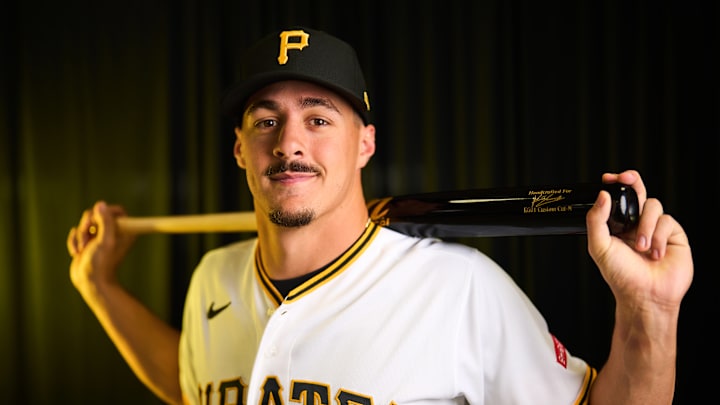
PNC Park sold out; 38,986 Pittsburgh Pirates fans showed up to watch a 19-year-old shortstop take his first major league at-bat, and he delivered. The first pitch Konnor Griffin saw from Kyle Bradish was an 85 mph curveball on the outside corner. Griffin took it the other way, 105.8 mph off the bat, 369 feet to center field. Ryan O'Hearn scored standing up. Pittsburgh went sideways.
The Pirates won 5-4. Griffin scored twice, reached base twice, and flashed 29.4 feet per second sprint speed on a heads-first slide into second in his next at-bat. In one game, he showed everything the hype promised.
The headline writes itself. What it doesn't tell you is how we got here, and that story is worth understanding.
Why did the Pirates send Konnor Griffin to Triple-A after Spring Training
Griffin hit .171 in 16 Grapefruit League games. Four home runs, yes, but a .282 K rate and enough swing-and-miss that the Pirates sent him to Triple-A on March 21. The coverage framed it as a stumble, a humbling, a prospect pressing under the lights. Some of that was true. The rest of it is in the batted ball data.
His BABIP in spring training was .125. For context, a league-average BABIP runs around .300. Griffin's hard contact was not turning into hits. His ground ball rate spiked to 55.6 percent, the highest it had been at any level since he turned pro. His ISO was .317, meaning when he did get the ball in the air, it traveled. His HR/FB rate in the spring was 50 percent. Half of every fly ball he hit left the yard. The bat was not the problem.
What the numbers show is a player who had altered his swing mechanics under big-league camp pressure, was generating elite contact quality when he squared it up and was pulling everything into the ground at an unsustainable rate. Nothing was falling in. The .171 was real. The reason for it was not what it looked like.
What Konnor Griffin's Spring Training stats actually showed

Griffin was drafted ninth overall in June 2024 out of Jackson Preparatory School in Mississippi. He was 18 years old. He'd reclassified from the 2025 class to make himself eligible, passed on a commitment to LSU, signed for $6.53 million, and reported to the Bradenton Marauders with swing questions that had scared several teams off his board.
In his first eight professional at-bats, he struck out six times.
Then he made adjustments, specifically to his hand placement and swing path, and the numbers shifted in a direction that scouts do not typically see from teenagers in their debut professional season.
At Low-A Bradenton, across 231 plate appearances, Griffin hit .338 with a .932 OPS and a 156 wRC+. His ground ball rate was 51.0 percent and his fly ball rate was just 22.5 percent, meaning he was still pulling the ball down too often. His SwStr% was 11.7 percent and his K rate was 22.9 percent. Solid production for a teenager. Not yet special.
Then he moved to High-A Greensboro. Same age, different player on the contact charts.
Griffin's ground ball rate dropped 13 points to 37.7 percent. His fly ball rate climbed to 28.8 percent. His line drive rate jumped from 26.5 percent to 33.6 percent. All three batted ball metrics moved in the right direction simultaneously, which does not happen by accident. His walk rate nearly doubled, from 6.5 percent at A-ball to 12.0 percent at High-A, and his K rate fell to 19.7 percent. He was seeing more pitches, making better decisions, and lifting the ball more consistently. He posted a 170 wRC+ across 234 plate appearances.
He finished the year at Double-A Altoona at 19 years old, playing a level where the average hitter is 23. In 98 plate appearances, he hit .337 with a .961 OPS and a 175 wRC+. The production did not dip when the competition got harder. It went up.
His full season across all three levels: .333 average, 21 home runs, 65 stolen bases in 78 attempts, 563 plate appearances, a 168 career minor league wRC+ that ranks seventh all time among hitters with at least 500 minor league plate appearances since 2006. Juan Soto is first on that list. Kyle Schwarber is second.
What Konnor Griffin's bat speed and exit velocity mean at Age 19

Griffin's bat speed is 76 mph. The MLB professional range runs from roughly 66 to 78 mph. Griffin is 19 years old and sitting near the top of that window. That number does not reflect his ceiling. It reflects where he is right now, in April, in his first week of professional baseball at the highest level.
His 90th-percentile exit velocity in the minors was 107.6 mph. His max exit velocity was 115.7 mph. Among teenagers tracked in the Florida State League since 2021, those grades are 80-grade on the scouting scale, which is the top of the scale, full stop.
The debut double came off the bat at 105.8 mph. That is not a lucky number from a nervous teenager swinging early in a count. That is what happens when 76 mph bat speed makes clean contact.
Konnor Griffin, Bill Mazeroski and what his Pirates connection means

When Konnor Griffin walked through PNC Park on Friday for the first time as a major league player, he entered from Mazeroski Way. Darren Mazeroski, the Pirates' southeast area scout for two decades and the son of Hall of Famer Bill Mazeroski, was the scout who signed Griffin with the ninth overall pick in 2024. Darren and his brother David were already traveling to Pittsburgh for a ceremony honoring their father, who passed away in February at 89 years old, when Griffin's call-up was announced. The scout who identified him, evaluated him, and signed him was in the building for his first game, in a city that was already gathering to remember the name on the street Griffin walked in on.
The baseball is just starting. What happened on Friday was the introduction. The work that made it possible started in a dugout in Bradenton with six strikeouts in eight at-bats and a swing that had to be rebuilt from scratch.
He rebuilt it. The numbers confirm every step.
More MLB news and analysis:
 Add us as a preferred source on Google