
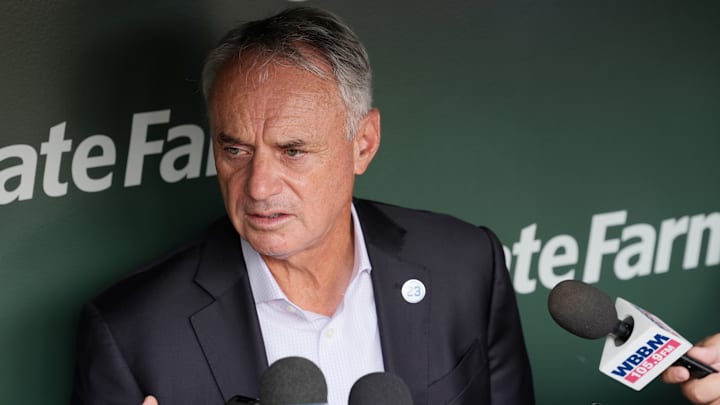
As the 2025 MLB Winter Meetings began in Orlando, Fla., baseball fans were hit with an unfortunate dose of reality. Less than a year remains until the current collective bargaining agreement expires on Dec. 1, 2026, and the possibility of a lockout — and the potential of games, or even the 2027 season itself, being canceled — becomes more realistic every day.
If you’re curious about what a lockout entails, you’re in luck. We’re here to walk you through every aspect of a potential MLB lockout, including why Major League Baseball and the players’ association are trending towards another work stoppage. But before we go any further, we suggest taking a deep breath, because you’ll quickly understand why we’re prepared for a lockout — and an ugly one, at that.
How can Major League Baseball avoid a lockout during the 2025 Winter Meetings?
This part is easier said than done. Manfred and Clark, along with other representatives on both sides, would need to sit down at the Winter Meetings and, likely, find some common ground on a salary cap. Considering that Philadelphia Phillies veteran Bryce Harper allegedly told Manfred to “get the ‘[expletive] out of our clubhouse” this past summer when the salary cap topic came up, we’re skeptical that there will be any real movement anytime soon.
That’s not to say that we believe a lockout is guaranteed. What we are saying is that there have been no credible reports regarding a potential compromise, which we feel would be needed for something as serious and league-changing as a salary cap. Such a move would have massive ramifications on baseball for years, even decades, to come, and it’s hard to see either side easily budging even if it results in canceled games.
We here at FanSided have long been the proponents of a salary floor. This would help some of the game's lesser-known professionals receiver their fair share in contract talks, all the while forcing owners to spend. With that would need to be either a cap (seems unlikely) or a far more strict luxury tax system. This isn't to say MLB doesn't punish teams that disregard its spending rules – they do – but simply taxing the likes of the Mets and Dodgers an extra amount isn't going to make much of a dent. Owners are billionaires. It's important to remember that as they cry poor.
What is an MLB lockout?
Before we go any further, we need to explain the difference between a strike and a lockout. An MLB lockout occurs when there is no collective bargaining agreement between the league and the players’ association. As a result, baseball enters a work stoppage, and all business pauses. Teams cannot make trades or sign free agents, and players are prohibited from using team facilities.
Perhaps most importantly, players do not receive their regular salaries during a lockout. However, players are paid bonuses, deferred money, and option buyouts.
Because a lockout traditionally happens in the offseason, games are not immediately impacted. However, an in-season players’ strike, which most recently occurred in 1994, mandates the league to cancel games as soon as possible. The 1994 strike even forced the cancellation of the World Series, the first time since 1904 that no World Series was held.
Why could there be an MLB lockout after the 2026 season?

As of December 2025, the most significant point of contention between the league and the MLBPA is the idea of a salary cap. Major League Baseball believes that the league needs a salary cap, and potentially even a salary floor. However, the MLBPA disagrees, believing that a salary cap is unfair to its players. It is worth noting that the NFL, NBA, and NHL all have salary caps.
If you’re unfamiliar with why the league wants a salary cap, keep in mind what we have previously discussed ad nauseam. The Los Angeles Dodgers, New York Yankees, and New York Mets are among the teams that happily and frequently spend as much as they want.
Conversely, organizations like the Pittsburgh Pirates, Tampa Bay Rays, Chicago White Sox, and Miami Marlins have reputations for being content to hand out smaller contracts and, often, trade their best players before they hit free agency. The Pirates haven’t signed a free agent to a multi-year deal since awarding starting pitcher Ivan Nova a three-year contract following the 2016 season.
Complete list of MLB lockouts: Will history repeat itself?
Major League Baseball previously had a lockout in 1973, 1976, 1990, and 2021. The 1973 lockout lasted from Feb. 8 through Feb. 25, and no regular-season games were canceled. Three years later, the lockout occurred from March 1 through March 17, and things were again resolved before any games were canceled.
Although the 1990 lockout pushed Opening Day back one week, no games were canceled. Instead, the league extended the regular season by three days to ensure that all teams played 162 games. A similar instance happened during the 2021-22 lockout, when the work stoppage forced the postponement of the regular season’s first two series.
Could an MLB lockout cost baseball the entire 2027 season?

Yes, and this is why baseball fans should be especially concerned. Those old enough to remember the 2004-05 NHL lockout know full well that an entire season being canceled because of a lockout, not a strike, is entirely possible if the two sides cannot compromise and agree to a new CBA.
The 2004-05 NHL lockout lasted from Sept. 16, 2004, through July 22, 2005. If a similar timeframe occurred with a potential 2026-27 MLB lockout, it would mean the sides didn’t reach terms on a new CBA until October or November of 2027.
 Add us as a preferred source on Google