
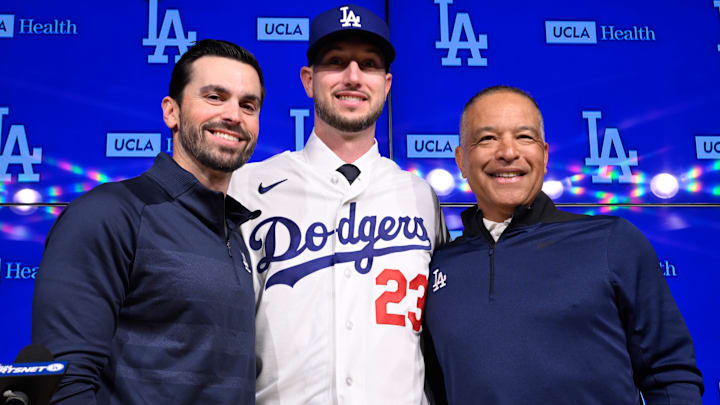
An MLB offseason that should have lent itself to utter chaos has instead wound up dominated by two words: salary cap. The call has been building for a while now, and the Los Angeles Dodgers following a second straight World Series title by signing the best free agent on the market in Kyle Tucker just sent it into overdrive.
But identifying that baseball has been split into the haves and have-nots is the easy part. Actually figuring out a way forward? Well, that's much tougher. So, as the league and its players union get ready to go to war over the subject as they attempt to hammer out a new collective bargaining agreement next winter, let's take a deep dive into the details. Just how do MLB's economics currently work? What do owners want to change, and will it actually solve the problem? And will players go for any of this anyway, or are we doomed for a lockout in 12 months' time?
What is a salary cap in professional sports?
At the most basic level, a salary cap is what it sounds like: a cap placed on the amount each team can spend on player salary in a given year. Every major pro sports league in North America has one, with the goal of keeping costs (relatively) contained in an effort to ensure that every team is on something like even financial footing. Bigger markets might have an advantage in attracting and retaining top talent, the argument goes, but if you put a cap on what they can spend, you force at least some of that talent to spread out elsewhere — and create parity around the league.
Of course, while every league has some version of a cap, how it looks and how it's implemented can vary pretty widely.
Hard salary caps (NFL, NHL)

There are two categories of cap: hard and soft. Under a hard cap system, teams are forbidden from going over a certain salary threshold under any circumstances. Soft cap systems allow teams to go over that threshold, but at a cost — whether that cost comes in the form of luxury tax payments, revenue sharing, or free agency and trade restrictions.
Two of the four major North American professional leagues, the NFL and NHL, have hard cap systems; teams cannot go over a maximum salary amount in a given year. For the NFL, that number was $279.2 million for the 2025 season. For the NHL, it was $95.5 million.
Soft salary caps (MLB, NBA)

Contrary to popular belief, MLB actually does have a salary cap system in place already. It's just a soft cap: Any team that exceeds a given salary threshold is subject to financial penalties known as a luxury tax. The NBA operates in the same way, although there's far less leeway to go over the cap now in the world of first and second aprons.
How MLB's current financial system works
Baseball attempts to keep team spending in check through a mechanism called the Competitive Balance Tax. This is basically a luxury tax by another name: Each team is technically allowed to spend whatever they want on salary each year, but there will be escalating penalties as they cross certain dollar thresholds.
Entering the 2026 season, the CBT threshold is set at $244 million. Cross that line, and you'll have to pay extra — with how much extra depending on how many years in a row you've gone over.
Number of violations | Tax penalty |
|---|---|
First year over threshold | 20 percent on every dollar over the threshold |
Second consecutive year over threshold | 30 percent |
Third or more consecutive year over threshold | 50 percent |
If a team goes over the tax threshold for two straight years, then dips back under it for one year, the clock (and the penalties) reset. But those aren't the only penalties to worry about: Teams will also be charged more depending on just how much they go over the tax threshold by.
Amount over CBT threshold | Tax penalty |
|---|---|
$20 million to $40 million | 12 percent on every dollar |
$40 million to $60 million | 42.5 percent on every dollar in first year; 45 percent in each consecutive year after |
$60 million or more | 60 percent on every dollar |
Let's use everyone's favorite boogeyman, the Los Angeles Dodgers, as an example. In 2025, the Dodgers' total payroll for tax purposes — calculated by adding up the average annual value of each contract on the 40-man roster — came out to just north of $417 million. That's some $176 million over the CBT threshold of $241 million for the 2025 season, and once taxes are factored in L.A.'s total bill comes out to a whopping $586,717,377.
And that's not the only way that MLB attempts to keep its biggest markets in check. There's also revenue sharing: Introduced in 1996 after years of heated debate, it's essentially a system in which a set percentage of every team's revenue (gate, TV, concessions, etc) is pooled together and distributed out equally. Certain teams obviously contribute much more revenue than others, and so the upshot is that the league's richets teams subsidize its poorest.
The case for a salary cap in MLB

As we've just laid out, there are several ways in which MLB tries to enforce a degree of economic parity — including a soft cap system. And yet, the sport's haves and have-nots have hardly ever been further apart; some $330 million separated the Dodgers' total after-tax salary expenditures this season from the Miami Marlins. It's certainly not impossible for small-market teams to compete with shrewd management and player development — just ask the 96-win Milwaukee Brewers and their 22nd-ranked payroll — but there's a reason that Los Angeles is looking for a third straight World Series title this season.
Something has to be done, the argument goes, and if a soft cap isn't getting the job done, then a hard cap is the only option left. Teams like the Dodgers clearly view the CBT as at most a minor inconvenience, and there's no way cities like Cleveland, Pittsburgh and Tampa Bay can avoid getting left in the dust. Force everyone into a narrow financial band, and suddenly you've got more player movement, a more even dispersal of talent, an increased emphasis on player development (finding diamonds in the rough on rookie deals will be more important than ever) and, ideally, enthusiasm from all 30 fan bases who feel like contention is just some smart management away.
It's also worth noting that a hard cap system more directly rewards good decisions and punishes bad ones. The Dodgers didn't just sign Edwin Diaz and Kyle Tucker this winter because they could; they did it because they also had to, after previous bullpen and outfield acquisitions like Tanner Scott and Michael Conforto failed to pan out. Under a hard cap, those failures would hamstring the team rather than offering an escape hatch for those who can afford it.
The case against a salary cap in MLB

The first argument against a salary cap is a labor one. By artificially limiting what teams are allowed to spend, you're suppressing salary and prohibiting players from earning whatever the market will bear for their services. There's a reason why the MLBPA has treated the institution of a hard cap as a third rail for decades now: They know that it reduces their leverage and coerces them into below-market deals, as teams only have a limited amount to spend.
And really, why do the players need to bear the burden of what is fundamentally an ownership problem? The high end of MLB's payroll spectrum gets all the attention, but let's not lose sight of the low end as well: a full third of the league spent less than $150 million in tax payroll last season, and five teams spent less than $125 million. Hard cap systems in the NFL and NHL also come with salary floors, minimum amounts that each team needs to spend on a yearly basis. If MLB were to implement a similar system, it would require a lot of small-market teams to spend substantially more than they do right now.
No one expects Milwaukee's spending to match the Dodgers in a fully free market. But instituting a hard salary cap is, in effect, letting teams like the Brewers off the hook for not doing more simply because they don't want to. The lack of spending in the bottom half of the league is simply unacceptable, and while the mega-contracts that the soft cap system produces plays a part there, so do ownership groups that are either undercapitalized or flat-out cheap.
How a salary cap could be introduced in MLB
Let's say that owners get their way in next winter's negotiations, and the players agree to some sort of hard cap system. What would that actually look like? And how would it be phased in?
The likeliest scenario is a hybrid between a soft and hard cap, with a luxury tax threshold and a hard salary ceiling above it. Actually adopting a system on the fly, in real time, in a sport with active contracts negotiated under different conditions, would be difficult to say the least. It would require a multiple steps over multiple years, with the cap ceiling slowly lowering to allow teams to come gradually into compliance.
Year of implementation | Hard cap ceiling | Luxury tax threshold | Salary floor | Penalty structure |
|---|---|---|---|---|
2027 | $210 million | $190 million | $142.5 million | Graduated fines, draft penalties |
2028 | $200 million | $180 million | $144 million | Stricter repeat offender penalties |
It's also worth mentioning that adopting a hard cap would change much more than just the bottom line. So much of MLB's player compensation is tied to the current economic landscape. In a more owner-friendly world, would rookies still need a full six years of service time before hitting free agency — or would they be able to hit the market quicker, as they are in the NFL and NBA? How would arbitration, the process by which salaries are determined over the final three years of that service time, change?
And while the top end of the free agency market would no doubt be curbed, what about the middle class? The Hot Stove would figure to get cranking much sooner each winter, with teams knowing exactly how much they have to spend in a given offseason. Rather than, say, spending $765 million on Juan Soto, would it be wiser to spread that wealth around a bit in order to maintain a more balanced and cost-effective roster?
We're getting ahead of ourselves here, no doubt. The stuff won't hit the fan for another 11 months or so, and there's still an uphill battle to a cap given just how adamantly opposed the MLBPA remains to the idea. Both players and owners have every reason to avoid a lengthy work stoppage, after all. That said, MLB's way of doing business does feel increasingly outdated in 2026, and it might only be a matter of time before big change comes.
 Add us as a preferred source on Google