
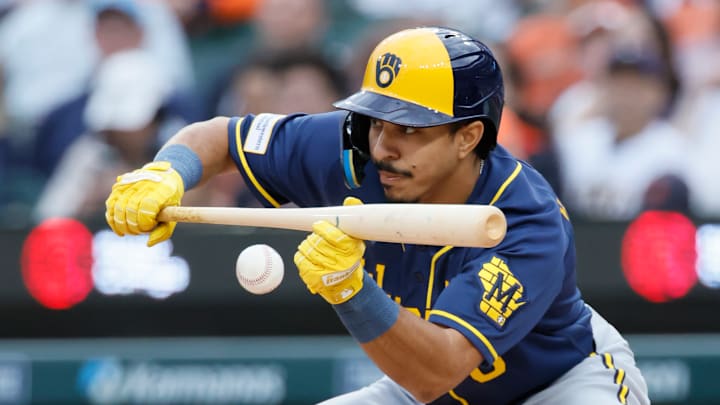
The standard frame for MLB's bunting resurgence in 2026 has been a poverty story. Small-budget teams manufacturing runs because they cannot afford the big bats that make manufacturing unnecessary. There is truth in that. The teams leading in sacrifice bunt attempts are the Rays, Brewers, White Sox, Athletics and Cardinals, and they are certainly not competing for Dodgers-level payrolls.
But the actual run-scoring data from 2026 complicates the poverty narrative significantly, and the complication is worth tracking.
Why MLB’s best contact teams are suddenly outscoring everyone
The Milwaukee Brewers lead the majors in both bunt hits and sacrifice attempts. They are scoring just over 5 runs per game, ahead of the Phillies, Mets and Giants. The Cardinals, second in sacrifice attempts, are scoring just over 4 runs per game. Meanwhile, the Yankees rank dead last in sacrifice attempts and are scoring more than 5 per game. The Cubs, second to last, are at the same production rate as the Yankees.
Team | Sac Attempts | Bunt Hits | Sac % | Runs/Game |
|---|---|---|---|---|
Brewers | 21 | 13 | 57.1% | 5.17 |
Rays | 19 | 8 | 73.7% | 4.42 |
White Sox | 19 | 11 | 52.6% | 4.19 |
Cardinals | 15 | 4 | 53.3% | 4.83 |
Diamondbacks | 15 | 10 | 53.3% | 4.54 |
Rangers | 11 | 4 | 36.4 | 3.81 |
Yankees | 4 | 5 | 0% | 5.41 |
Cubs | 6 | 5 | 50% | 5.41 |
None of that proves bunting causes run scoring. The causality almost certainly runs the other direction: contact-heavy lineups bunt more because their hit profile produces more situations where the bunt makes sense, and those same lineups happen to score at higher rates than strikeout-heavy ones in a year when pitching velocity has pushed whiff rates up across the board.
But that distinction is exactly the point the conventional anti-bunt argument has been missing. The bunt is not a replacement for production. It is a symptom of the same offensive profile that is quietly outscoring traditional power lineups in 2026.
The bunt only works when teams are built for it

If you want to understand why some teams are generating real value from the bunt and others are wasting outs, the sacrifice success rate data is where to start.
The Athletics have converted 10 of 13 sacrifice attempts, a 76.9 percent success rate. The Rays are at 73.7 percent (14 of 19). The Brewers at 57.1 percent, the Cardinals at 53.3 percent. Now look at the Texas Rangers. Eleven attempts, 4 successes, 36.4 percent. The Rangers are also scoring just 3.81 R/G, worst among the high-bunt teams.
Team | Attempts | Success | Succ Rate | Runs/Game |
|---|---|---|---|---|
Athletics | 13 | 10 | 76.9% | 4.25 |
Rays | 19 | 14 | 73.7% | 4.42 |
Brewers | 21 | 12 | 57.1% | 5.17 |
Cardinals | 15 | 8 | 53.3% | 4.83 |
Rangers | 11 | 4 | 36.4% | 3.81 |
A sacrifice bunt that fails does not just fail to advance the runner. It is often a wasted plate appearance against an already-dominant pitcher, which means the Rangers' approach is costing them twice: bad execution and the opportunity cost of a better at-bat.
The separation between the Rays and Rangers tells you the bunt is not a binary strategic choice. It is a skill-dependent play that requires the right personnel and the right preparation. Teams that bunt because they have fast, disciplined contact hitters are doing something analytically sound. Teams that bunt without that foundation are likely helping the other team.
Contact-heavy offenses are exploiting a gap in modern pitching

There is no better single argument for the 2026 bunt than Chandler Simpson.
Through the first month of the season, Simpson has 43 hits. Fifteen of those are infield hits. Four more are bunt hits. That means nearly half of his total hit production is arriving through a combination of elite speed, exceptional bat control and precise reads on third base positioning. He has also laid down 5 sacrifice attempts, succeeding on 3.
In a traditional analytical frame, a player generating that kind of contact profile is seen as a limitation. He is not driving the ball. He is not posting the kind of expected stats that make front offices comfortable. But Simpson's production is real and it is repeatable, because it is not dependent on barrel rate or launch angle. It is dependent on speed and discipline, two things that do not have bad days the way exit velocity does.

David Hamilton of the Brewers is running a similar profile: 21 hits, 11 of them infield hits, 7 bunt hits, a player who is essentially beating the shift ban by rendering all defensive positioning irrelevant. If the third baseman plays back, he drops a bunt. If the third baseman charges, he has an open hole on the left side. The defense has no good answer because Hamilton is making the right read before the pitch rather than trying to barrel a 97 mph fastball after it.
Victor Scott II of the Cardinals represents the extreme end of this approach. He has put down 11 sacrifice attempts in 106 plate appearances, a usage rate that has not existed in the major leagues outside of pitchers in decades. Seven of those 11 have been successful. The Cardinals are scoring 4.83 R/G. Scott is not dragging the lineup down. He is contributing to one of the more functional run environments in the National League.
The anti-bunt argument was built for a different era of baseball
The anti-bunt argument, rooted in run expectancy matrices built across the 2000s and 2010s, priced an out based on what a league-average at-bat looked like at the time. League-average contact rates were higher. Strikeouts were lower. The offense behind a bunted baserunner was more likely to eventually drive that runner in through conventional means.
The teams scoring the most runs in 2026 through conventional power approaches — the Yankees, Cubs, Dodgers, Braves — are doing it with elite personnel that most organizations cannot replicate. The Yankees are posting 5.41 R/G with Aaron Judge leading a lineup that does not need to manufacture runs because it can simply hit the ball out of the park.
But look at what happens when teams without that kind of lineup try to play power-first, strikeout-accepting baseball. The Phillies are at 3.97 R/G. The Giants are at 3.11, last in the majors. The Mets are at 3.67. These are not small-market teams, but they are scoring at the bottom of the league while approaching offense through a framework built for a different era of contact rates.

The Brewers are scoring more runs than the Phillies. The Cardinals are scoring more than the Mets. The Rays, with a payroll a fraction of New York's, are nearly matching the Mets on a per-game basis. The contact-first, high-bunt teams are not underperforming the model. They are outperforming the teams that abandoned contact without having the payroll to replace it with elite power.
Do teams that bunt more score more runs?

Beyond bunt hits and sacrifice counts, the situational data reveals something even more telling. The Brewers are advancing baserunners from second to third on scoring opportunities at a 60.7 percent rate, best in the National League. The Rays are at 65.5 percent. The Cardinals are at 55.4 percent.
Baserunner advance rate is a broader metric than bunt tracking. It captures the totality of a team's ability to move runners in conventional situations, whether through hit-and-run, aggressive baserunning, or situational contact. But the teams posting the best advance rates in 2026 are largely the same teams deploying the most aggressive bunt strategies.
That is not a coincidence. The same players who are disciplined enough to execute a bunt at 70 percent success rates are disciplined enough to take the extra base when the outfielder is slow to the ball. Contact-first offensive identities generate better situational outcomes across the board, not just in the narrow category of bunt hits.
The Yankees, for context, are advancing from second to third in scoring opportunities at 55.0 percent. Their baserunner advance rate overall is actually below several of the contact-heavy teams they are supposed to be outperforming offensively.
MLB’s smartest offenses are generating runs without chasing power
The popular version of the bunt resurgence story is romantic. Small teams fighting back against the analytics machine with old-school baseball. That framing is wrong and the data says so.
The teams executing the bunt well are not nostalgia acts. They are organizations that correctly identified a gap in how the league's dominant pitching environment interacts with contact-first lineup construction, built rosters around players fast enough and disciplined enough to exploit that gap, and are now generating runs at rates that compare favorably to lineups costing twice as much.
The teams executing the bunt poorly, like the Rangers at 36.4% sacrifice success, are proving the other half of the argument: the bunt is not a universal answer. It is a tool that works when the personnel and preparation are right and costs you when they are not.
The run expectancy models that buried the bunt two decades ago were not wrong. They were right for the environment that produced them. The environment has changed. The models need to catch up.
 Add us as a preferred source on Google