
Key Points
Bullet point summary by AI
- Major League Baseball's new automated ball-strike system is gaining praise from fans and players despite pushback from umpires.
- Retired and active umpires have expressed strong opposition, citing potential public embarrassment from overturned calls.
- The technology promises precise, instant decisions, addressing longstanding accuracy issues in pitch calls across the league.
Major League Baseball’s new automated ball-strike challenge system is an early hit among fans, social media users, and the players benefiting from the sport’s latest change. Who would be against a technological advancement that determines whether or not umpires made the right call?
Unsurprisingly, the answer is the umpires themselves. Numerous retired umpires have called out the ABS system in recent weeks. Longtime MLB umpire Richie Garcia blasted the implementation of robot umpires as “embarrassing,” while Ted Barrett, a full-time MLB umpire from 1999 through 2022, bemoaned the impact that ABS could have on active umps.
Why umpires are against ABS – and on the wrong side of MLB history

“Nobody wants to fail at your job, but then there’s also the, hey, thank God I didn’t cost that team a game or a run or a pennant,” Barrett told the Associated Press. “No one wants to live with that. And so we take the positive of that. The negative is sometimes it’s like: ‘What am I doing over there? I got overturned twice at first base.’”
We’re not sure why Garcia and Barrett are so against the ABS system, seeing as it would have made their jobs extremely easier.
Allow me to understand: The umpires don’t like being embarrassed, and we agree that social media accounts like Umpire Scorecards and Umpire Auditor have only highlighted just how poorly some umpires fare behind the plate. Yet, the retired umpires disagree with using technology that arguably prevents them from being humiliated?
Barrett and Garcia both cited the feeling of shame that could come with having a call overturned in front of tens of thousands of fans. It’s interesting how the umpires complain about that, yet we seemingly never hear a player blasting instant replay when it’s determined that they didn’t have both feet in bounds (in football) or that they were late getting to first base. Sure, we might see a coach dispute the call with a first-base umpire, but often when there is indisputable evidence about whether the runner was safe or not.
In fact, part of why the ABS system exists is because of umpires like Dan Iassogna. The Umpire Scorecards X account found that Iassogna only accurately called 88% of pitches in Boston’s 3–0 victory over Cincinnati on Thursday afternoon. Iassogna missed 16 of the game’s 132 taken pitches. Even if you back Iassogna by pointing out that he’s only missing two pitchers per inning, that’s not exactly the best defense.
Umpire: Dan Iassogna
— Umpire Scorecards (@UmpScorecards) March 27, 2026
Final: Red Sox 3, Reds 0#DirtyWater // #ATOBTTR#BOSvsCIN // #CINvsBOS
More stats for this ump 👇https://t.co/l2AuSZDz75 pic.twitter.com/tQyfV4VAqh
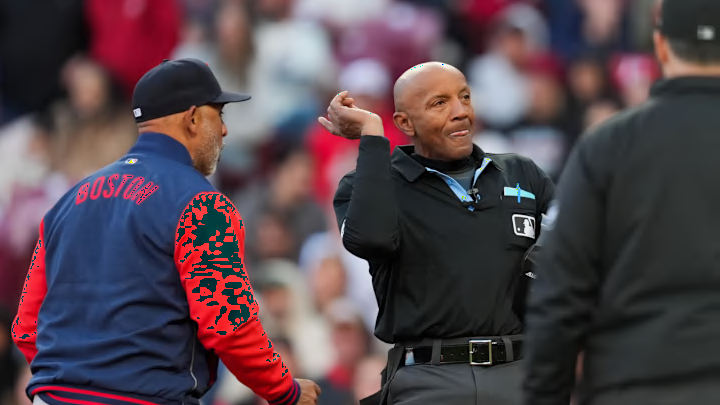
CB Bucknor, who has a reputation as one of the league’s worst umpires, proved on Saturday exactly why the ABS system is needed. Cincinnati challenged five calls against Bucknor and triumphed each time, and designated hitter Eugenio Suárez even won challenges on consecutive pitches in the sixth inning. Bucknor later ejected Red Sox manager Alex Cora for arguing balls and strikes, but the damage was done.
Major League Baseball must use ABS as the sole way to call balls and strikes
When he spoke with the Associated Press, Garcia used the tired defense that “some computer geek that knows nothing about baseball” is the one determining what is or is not a ball or strike. There’s only one problem: Major League Baseball spent the spring properly getting players’ measurements to determine the strike zone it would use this year.

The ABS system is not Moneyball, and it’s not the concerning trend of teams playing things way too cautiously with their starting pitchers. If you watched any baseball this weekend, you noticed that an ABS challenge takes no time at all. When Suárez disputed one of Bucknor’s incorrect calls, I counted 12 seconds between Bucknor telling the crowd that the pitch was under review and announcing that the call was overturned. This wasn’t a prolonged, five-minute analysis in which they used 10 different angles.
If I’m CB Bucknor, I would much rather have the ABS system tell me if a pitch is a ball or a strike than make my own determination and have teams go 6-for-8 in challenges. The accuracy rate for every umpire should be 100% if the technology is there to prevent those simple mistakes.
Bucknor had a game last summer where he missed 28 pitches, with Umpire Scorecards and Umpire Auditor publicly sharing his performance. If Garcia and Barrett are so concerned about umpires being humiliated, they should instead advocate for Major League Baseball to have ABS determine all balls and strikes moving forward.
More MLB news and analysis:
 Add us as a preferred source on Google