
Every MLB team has made a trade in its history that fans will never forget for the best of reasons. The Boston Red Sox stealing Chris Sale in the middle of his prime for practically nothing will never be forgotten by Red Sox fans. The same can be said about them getting practically nothing for him and watching him win a Cy Young with the Atlanta Braves. Those are two trades Red Sox fans will remember forever involving the same star pitcher, but for entirely different reasons.
With that in mind, as fun as it is to focus on the best of the best, here's a look at the one offseason trade each MLB franchise would like to take back, as the trade market in the 2025 offseason heats up.
One offseason trade each MLB team wants to take back
- Worst offseason trades in AL East history
- Worst offseason trades in AL Central history
- Worst offseason trades in AL West history
- Worst offseason trades in NL East history
- Worst offseason trades in NL Central history
- Worst offseason trades in NL West history
Worst offseason trades in AL East history
Baltimore Orioles: (Jan. 10, 1991)
The Baltimore Orioles acquired Glenn Davis, a two-time All-Star, in exchange for three unproven youngsters. Most often, the team that acquires the proven All-Star wins trades involving nothing but prospects. Unfortunately, Davis looked nothing like his All-Star self in parts of three seasons with the O's, and all three players they traded away proved to be valuable big leaguers.
Schilling is the biggest loss here, as he had a borderline Hall of Fame career, even if he was only in Houston for a year. Steve Finley became one of the best defensive center fielders ever, made two All-Star teams and was a key piece on the 2001 World Series-winning Arizona Diamondbacks. Even Pete Harnisch made an All-Star team in Houston and had a very nice 14-year career.
Boston Red Sox: (Jan. 5, 1920)

Trading a superstar for cash might be in Bob Nutting's wheelhouse, but it's the worst thing a franchise can do. Babe Ruth was a two-way phenom at the time of the deal. The Boston Red Sox trading him to begin with is bad, but not even getting a single player in return, while sending him to that team is all-time bad.
The Red Sox, as we all know, went nearly 100 years without winning a World Series title after making this trade, falling short every year until 2004. As for the Yankees, they won four World Series titles with Ruth, one of the greatest players ever, and had incomparable success even after he retired.
New York Yankees: (Dec. 9, 1982)
The New York Yankees drafted Fred McGriff in the ninth round of the 1981 MLB Draft. Getting a future Hall of Famer that late is beyond impressive, but all Yankees fans can do is wonder "what if." McGriff wound up never playing a single game with the Yankees before being traded alongside two other players to the Toronto Blue Jays.
The return was lackluster. Dale Murray struggled in parts of three seasons with the Yankees and Tom Dodd never played a big league inning with the team. As for the Blue Jays, McGriff began his Hall of Fame career with a bang, receiving MVP votes in three of his four full seasons in Toronto before being traded for future Hall of Famer Roberto Alomar and future World Series hero Joe Carter. Even Dave Collins had a couple of decent years in Toronto, too.
Tampa Bay Rays: Oct. 28, 2002

Managers are vital to team success, but so are talented players. There's only so much a manager, even one as great as Lou Pinella, can do if the Tampa Bay Rays are willing to trade a player of Randy Winn's caliber for him. They learned this the hard way.
Unsurprisingly, the Rays never won more than 70 games in a season in the three years Piniella was in town. Meanwhile, Winn, an All-Star with the Rays, had parts of three strong seasons with the Mariners before being traded to the San Francisco Giants at the 2005 trade deadline.
Toronto Blue Jays: Dec. 16, 2009
The issue isn't that the Toronto Blue Jays traded Roy Halladay, it's what they got in return. Halladay, an owner of a full no-trade clause a year away from free agency, wanted to be traded and he wanted the Phillies. The return, though, did not age well. At the time, this deal was celebrated. Kyle Drabek was one of the top pitching prospects in the game, Travis d'Arnaud was on his way to becoming one of the best catching prospects in the game, and Michael Taylor was soon flipped for Brett Wallace. Unfortunately, none of the players in this deal amounted to anything in Toronto.
Drabek never came close to living up to the hype, as his 5.27 ERA in parts of five seasons with the Blue Jays would indicate. d'Arnaud was traded to the New York Mets alongside Noah Syndergaard in the deal that brought Cy Young award winner R.A. Dickey north of the border before he even played a game with the Jays, and that deal greatly favored the New York Mets. Again, Taylor never played a game in the Jays' organization, and neither did the player he was traded for. Meanwhile, Halladay picked up where he left off in Philadelphia, winning a Cy Young, nearly winning another, and throwing a postseason no-hitter.
Worst offseason trades in AL Central history
Chicago White Sox: Dec. 9, 2014

In an effort to win now, the Chicago White Sox traded decent prospects for a rental, Jeff Samardzija. Unfortunately, Samardzija had an ERA a tick below 5.00 in 2015 and led the American League in earned runs and hits allowed while the White Sox won just 76 games. That was bad enough. Giving up what they did in hindsight, though, makes the deal even worse.
Rangel Ravelo never made it to the majors with the Athletics and Josh Phegley was never a starting catcher, but both Marcus Semien and Chris Bassitt wound up really panning out for the A's. It took a little while for Semien to find his footing, but he'd eventually become one of the best middle infielders in the American League and was even an MVP finalist in 2019. He also signed a massive contract in free agency with the Texas Rangers and won a World Series there. Chris Bassitt isn't quite as decorated, but he's been a rock-solid mid-rotation arm for the better part of a decade now.
Cleveland Guardians: Nov. 19, 2021
The Cleveland Guardians thought they were getting a steal by acquiring Tobias Myers, a pitcher the Rays didn't want to protect from the Rule-5 Draft. As it turns out, this deal was an utter disaster. Yes, Junior Caminero, the 22-year-old phenom who just hit 45 home runs in his first full season, was once in the Guardians' minor league system. The Guardians, a team devoid of power around Jose Ramirez, traded him for Myers, a decent big league pitcher. As if that isn't bad enough, Myers isn't even in the Guardians' organization anymore and never pitched an inning in the majors for them.
The Guardians DFA'd the right-hander less than a year after he was acquired. He eventually caught on with the Brewers and is a decent starter for that team. So, yes, the Guardians traded Caminero essentially for nothing. Perhaps I'm jumping the gun when labeling this as the worst trade in Guardians history, but knowing Caminero's MVP-level upside, there's a chance this will be one of the most lopsided deals in MLB history.
Detroit Tigers: Dec. 11, 2014

The Detroit Tigers, eager to remain at the top of the AL Central, desperately needed a starting pitcher, so they acquired Alfredo Simon from the Reds. Well, he ended up having the worst season of his career, posting a 5.05 ERA in 31 starts for a Tigers team that surprisingly missed the playoffs after winning four straight division titles. 2015 was Simon's only season in Detroit. To make matters worse, the Tigers wound up parting with one of the better power hitters of this era.
That's not an understatement. Suarez's 321 home runs since being traded to the Reds rank fifth in the majors, ahead of guys like Bryce Harper, Mike Trout and Giancarlo Stanton. He hit as many as 49 home runs in a single season for Cincinnati. Jonathan Crawford never made it past High-A, but getting seven years of Suarez for one lackluster year of Simon was a huge win for the Reds, and a deal that Dave Dombrowski and the Tigers certainly regret.
Kansas City Royals: Mar. 27, 1987
I'm cheating a bit by picking a deal that went down in spring training, but this is too lopsided to ignore. The Kansas City Royals traded David Cone, a top prospect who happened to be from Kansas City, to the New York Mets in exchange for three players, headlined by catcher Ed Hearn. To be fair, the Royals had a ton of pitching, had a need at catcher, and Cone was coming off an incredibly rough 1986 campaign both in the minors and in his brief stint with the Royals. Still, Cone was oozing with potential, and he quickly realized it, making his first of five All-Star appearances in 1988.
To make matters worse, none of the players acquired by the Royals did much in Kansas City. Hearn appeared in 13 games across two seasons as he battled injury, Rick Anderson had a 6.89 ERA in 13 appearances for the Royals, and Mauro Gozzo never appeared in a game for Kansas City. Yes, Cone did eventually get traded back to the Royals and even won a Cy Young in Kansas City, but they missed out on several great years by trading him.
Minnesota Twins: Feb. 2, 2008

As was the case with Halladay, the Minnesota Twins had reason to trade Johan Santana. He wanted to get paid, and the Twins wouldn't pay him. The issue is the return they got from the New York Mets. They got four prospects, none of whom made an impact in Minnesota. Carlos Gomez eventually became one of the best center fielders in the game, but that was in a Milwaukee Brewers uniform. Phillip Humber threw a no-hitter, but that was with the Chicago White Sox. Deolis Guerra never pitched for the Twins, and Kevin Mulvey made two appearances.
Santana never won a Cy Young award with the Mets, but he lived up to the billing for the first three years of his deal before encountering injuries. Not paying Santana proved to be a defensible decision, but the Twins had to get more than they did. I mean, they would've been better settling for a draft pick in free agency, as sad as that is.
Worst offseason trades in AL West history
Athletics: Nov. 10, 2008
The Athletics trading for Matt Holliday was a bit strange, since he was a high-priced rental and they weren't a team that was expected to compete in 2009. Holliday wasn't bad with the A's, but the team was expecting a bit more than a 120 OPS+, and they expected him to play in more than 93 games in the green and gold. Holliday only played in 93 games for the Athletics because the team traded him at the deadline for prospects. The prospects they got, headlined by Brett Wallace, did not pan out. The Holliday side of the deal was a complete bust, and to make matters worse, the A's gave up a ton to the Colorado Rockies.
Carlos Gonzalez was a three-time All-Star, three-time Gold Glover, and two-time Silver Slugger winner with the Rockies. Huston Street was one of MLB's best closers for a while after the trade. Greg Smith didn't wind up amounting to much, but losing Gonzalez and Street, two bonafide stars, for not even 100 games of Holliday, who wasn't even at his best for the A's, is such a brutal turn of events.
Houston Astros: Nov. 29, 1971

The Houston Astros acquired a pair of two-time All-Stars, Lee May and Tommy Helms, as well as an incredibly useful bench player, Jimmy Stewart, in an effort to win now. Unfortunately, while May was his usual productive self for most of his three-year tenure in Houston, both Helms and Stewart were fairly disappointing. To make matters worse, they sent five players to Cincinnati in the deal, three of whom proved to be excellent additions for the Reds.
Jack Billingham was an All-Star for the Reds a couple of years after this deal and finished in the top six of the NL Cy Young balloting twice in a mostly productive six-year tenure with the Reds while winning a pair of World Series titles. Cesar Geronimo was another two-time World Series winner and won four Gold Glove awards in nine seasons with the Reds. The real prize, of course, was Joe Morgan, a future Hall of Famer who won two MVPs with the Reds. Trading Morgan was a controversial decision for the Astros to have made, and it couldn't have aged worse.
Los Angeles Angels: Mar. 14, 1991
Trading for Parker, a 39-year-old on the cusp of retirement, obviously came with some risk, but still - this was Dave Parker we were talking about, and he was coming off a strong season. Unfortunately, he just didn't have it anymore during his lone season with the Los Angeles Angels, as he had a .638 in 119 games before the team released him. Taking a chance on Parker, knowing how historically great he had been, isn't the worst thing ever on its own, but trading Dante Bichette, a promising outfielder itching for an opportunity, proved to be a huge mistake.
Bichette didn't exactly turn it on in Milwaukee, but eventually became one of the best hitters in the National League with the Colorado Rockies, making four All-Star teams and even finishing as the NL MVP runner-up in 1995. Had the Angels stuck it out with him a bit longer, there's no reason to believe Bichette couldn't have been a really good player for them.
Seattle Mariners: Feb. 8, 2008

It was a lot to give up for the Seattle Mariners, but hey, Erik Bedard had a legitimate Cy Young ceiling and could anchor their rotation long-term, right? Well, not exactly. Bedard was rock solid in parts of three seasons with the Mariners when he was able to take the mound, but his inability to stay healthy was a major issue. Bedard never made more than 16 starts in a season with the Mariners, and never surpassed 100 innings with Seattle either, before the Mariners ultimately traded him at the 2011 trade deadline.
Taking a shot on a talented arm like Bedard is always understandable, but what the Mariners gave up to get him cannot be overlooked. Adam Jones, a five-time All-Star and four-time Gold Glover in 11 years with the Orioles, was the headliner, but even beyond him, Baltimore got tremendous value. George Sherrill was an All-Star closer for a year and a half before getting flipped at the 2009 trade deadline. Chris Tillman even made an All-Star team with Baltimore and was a productive starter for the better part of a decade. The Mariners didn't get much from Bedard and sent three All-Stars the other way. Not great.
Texas Rangers: Feb. 16, 2004
I give the Texas Rangers a bit of a pass here because Alex Rodriguez wanted out and would only waive his no-trade clause for a short list of teams. They had to take what they could get. Still, for a player of Rodriguez's caliber, this return just wasn't good enough. Sure, Alfonso Soriano was a star, but he wasn't close to Rodriguez's level, and was only in Texas for two years. The worst part of the deal is that Joaquin Arias was the second player.
The Rangers famously chose Arias, a utility infielder who didn't play much in four years with the Rangers, over Robinson Cano, a future superstar, as the player to be named later in the deal. Say what you want about the Rangers being backed into a corner, but they could have and should have done better for one of the best players in the game at the time. Rodriguez wound up having a mostly successful Yankees tenure and has Rangers fans wondering "what if?"
Worst offseason trades in NL East history
Atlanta Braves: Dec. 13, 2003

In an effort to get over the World Series hump, the Atlanta Braves traded promising pitchers headlined by top prospect Adam Wainwright and right-hander Jason Marquis, in a deal that brought J.D. Drew, a rental, to Atlanta. Drew had a memorable 2004 campaign and even finished sixth in the NL MVP balloting, but the Braves lost in the NLDS for a third straight year and then watched Drew sign a lucrative deal with the Los Angeles Dodgers.
As if getting only one year of Drew that didn't end in a World Series title wasn't bad enough, Wainwright would become one of the best pitchers of his generation in St. Louis. The Georgia native spent all 18 of his seasons with the Cardinals, made three All-Star teams, and had many memorable postseason moments. Even Marquis was a solid mid-rotation arm in St. Louis, and Ray King pitched well out of the bullpen for the Cardinals. The Braves didn't get any further with Drew than they did without him, and wound up giving up a haul in hindsight. This is a bigger blunder than it's given credit for.
Miami Marlins: Dec. 4, 2007
One of the most lopsided deals in recent history went down at the 2007 Winter Meetings. The Miami Marlins traded Miguel Cabrera and Dontrelle Willis in an effort to shed payroll and rebuild, and received an enormous haul of prospects. Andrew Miller and Cameron Maybin were two of the top 10 or 15 prospects in the sport, so getting them along with four other pieces felt like decent enough consolation. That didn't wind up being the case.
Cabrera, a budding superstar, was always going to do great things in Detroit, but the Marlins thought their return was good enough. Miller was at his best as a reliever with Cleveland. Maybin never came close to living up to expectations and had two other stints with the Tigers. Burke Badenhop, a decent middle reliever, was arguably the best player the Marlins received. The trade was that bad.
New York Mets: Dec. 10, 1971

The New York Mets needed an infielder entering the 1972 season, and wound up acquiring Jim Fregosi, a six-time All-Star, to play third base for them. Trading Nolan Ryan, a talented, yet erratic pitcher who never fully put it together in five seasons with the team, made a lot of sense with a player like Fregosi being the return.
Well, Fregosi hit a total of five home runs and had an 85 OPS+ in parts of two seasons with the Mets before getting traded to the Texas Rangers in 1973 for a player to be named later. As for Nolan Ryan, he still struggled to throw strikes, but that didn't really matter when he routinely struck out 300+ batters per year and dominated the American League with the California Angels. The Angels got eight outstanding years of a future Hall of Famer and even got some solid years out of Leroy Stanton, while the Mets got a year and a half of Fregosi, whose best years were way behind him.
Philadelphia Phillies: Jan. 27, 1982
The two worst trades the Philadelphia Phillies have made have been with the Chicago Cubs, and either would be great fits for this list, but only one of them went down in the offseason. Ahead of the 1982 season, the Phillies traded an unhappy Larry Bowa to the Chicago Cubs with top prospect Ryne Sandberg in exchange for the guy they thought would be Bowa's long-term replacement at shortstop, Ivan De Jesus.
Well, the light-hitting De Jesus was not all that productive in three seasons with the Phillies, and while the same could be said about Bowa, Sandberg became a Hall of Famer in the Friendly Confines. Sandberg was a 10-time All-Star, a nine-time Gold Glove winner, won seven Silver Sluggers, and won the 1984 MVP award as well. The Phillies traded a future Hall of Famer (and a popular player in Bowa) for three years of underwhelming shortstop play.
Washington Nationals: Nov. 18, 1997

The Washington Nationals were once the Montreal Expos before relocating to Washington, so it's fair game to use a deal the Expos made to represent the Nationals franchise, especially when the deal is this bad. The Expos parted with Pedro Martinez, arguably the best pitcher on the planet, because he was free to test free agency the next offseason, and they wanted to make sure they got appropriate value in return. In hindsight, this was not that.
Carl Pavano was a top pitching prospect who fans were excited about, but he had an ERA a shade below 5.00 in parts of five injury-riddled seasons in Montreal before having more success elsewhere. Tony Armas, the player to be named later in the deal, was a decent back-end starter for the better part of a decade in Montreal, but that's it. The Expos didn't get anything of tremendous value, and wound up trading one of the greatest pitchers ever. Even if they were set on trading Martinez, the return had to be stronger.
Worst offseason trades in NL Central history
Chicago Cubs: Dec. 8, 1987
For whatever reason, the Chicago Cubs refused to adjust Lee Smith's contract when he asked, and the result was this monstrosity of a trade. The Cubs traded arguably the best reliever in the team's history to the Boston Red Sox in exchange for starters Al Nipper and Calvin Schiraldi. Nipper and Schiraldi combined to pitch for parts of three seasons with Chicago before moving on to other teams, while Smith bolstered his Hall of Fame case in Boston.
Smith played a huge role in the Red Sox's division title in 1989 and was rock solid in the back end of their bullpen during his entire tenure there. He'd only get better after leaving Boston and peaked with the St. Louis Cardinals in the early 1990s. Had the Cubs extended him, they would've gotten Smith's best years.
Cincinnati Reds: Dec. 9, 1965

The Cincinnati Reds needed pitching entering the 1966 season, and were willing to stop at nothing to land just that. They were even willing to trade Frank Robinson, a six-time All-Star at the time and one of the best players in the National League who hadn't yet turned 30, to get it. The Baltimore Orioles were the beneficiaries, and the rest is history.
Milt Pappas, the centerpiece of Cincinnati's return, wasn't nearly as good with the Reds as he was with the Orioles, and lasted less than three full seasons with the team. Jack Baldschun, a solid reliever at the time, really struggled with the Reds. Dick Simpson was worth -0.4 bWAR in parts of two seasons with the Reds. Cincinnati didn't get much out of this, and had to watch Frank Robinson win the Triple Crown and an MVP award the year after trading him while leading the Orioles to a World Series victory. Robinson remained a superstar for the better part of a decade after the Reds traded him, and Cincinnati failed to cash in accordingly for that kind of value.
Milwaukee Brewers: Nov. 17, 1992
The Milwaukee Brewers acquired Dante Bichette, a future superstar, for only 39-year-old Dave Parker. Unfortunately, that trade can't be celebrated as the win it should have because Milwaukee flipped Bichette for Kevin Reimer just two years later. Sure, Bichette hadn't done much with the Brewers yet, but had a pretty solid 1992 season and was still young. Trading him for Kevin Reimer, a player Colorado selected in its Expansion Draft.
Reimer played just one season in Milwaukee and was worth -0.4 bWAR, while Bichette blossomed into a four-time All-Star and one of the best offensive players in the National League in the 1990s. I don't know whether Bichette would've been quite as dominant in Milwaukee as he was in Colorado with altitude on his side, but he certainly would've been a substantial upgrade over Reimer.
Pittsburgh Pirates: Dec. 11, 1975

The Pittsburgh Pirates trading for Doc Medich, a young starting pitcher who had three outstanding seasons with the New York Yankees and was a hometown kid, made a lot of sense. Unfortunately, Medich played just one year in Pittsburgh before getting flipped the following season. Medich wasn't bad in that one year, but the fact that it was only one year isn't ideal when considering what Pittsburgh gave up.
Willie Randolph is the centerpiece who went back to New York. Randolph was never much of a slugger but was an on-base machine who made five All-Star teams in 13 years with the Yankees and helped New York win the 1977 World Series. Even Dock Ellis had a better run in New York than Medich did in Pittsburgh, and he only made 35 appearances with the Yankees. This was a deal that looked great at the time and wound up being anything but.
St. Louis Cardinals: Feb. 25, 1972
Both Steve Carlton and Rick Wise wanted more money from their respective teams, so it only made sense that the St. Louis Cardinals and Philadelphia Phillies traded them for each other. Unfortunately, the deal couldn't have been more lopsided. That's not Wise's fault - he made an All-Star team with St. Louis and pitched well in his two years there, but Carlton became an all-time great in Philadelphia.
The southpaw immediately won his first of four Cy Young awards in his first season with the Phillies and never looked back. He was a seven-time All-Star with the Phillies and accomplished just about everything he could have except winning a World Series title.
Worst offseason trades in NL West history
Arizona Diamondbacks: Dec. 8, 2009

It's hard to get fleeced in a three-team trade since there are so many moving parts, yet the Arizona Diamondbacks got fleeced to the point where this is the worst deal in team history. It's not as if they received nothing, as Ian Kennedy had some good years with Arizona, but Edwin Jackson was abysmal in his lone season in the desert, and what the Diamondbacks parted with is really hard to come back from.
The Diamondbacks traded Max Scherzer, a future first-ballot Hall of Famer, in this deal, and couldn't even get the second-best player in return. Trading Scherzer for Curtis Granderson would've been bad, but maybe not the worst deal ever. Trading him for Ian Kennedy and a rough couple of months from Edwin Jackson makes this deal such a disaster. Scherzer, of course, really emerged in Detroit and never looked back.
Colorado Rockies: Feb. 1, 2021
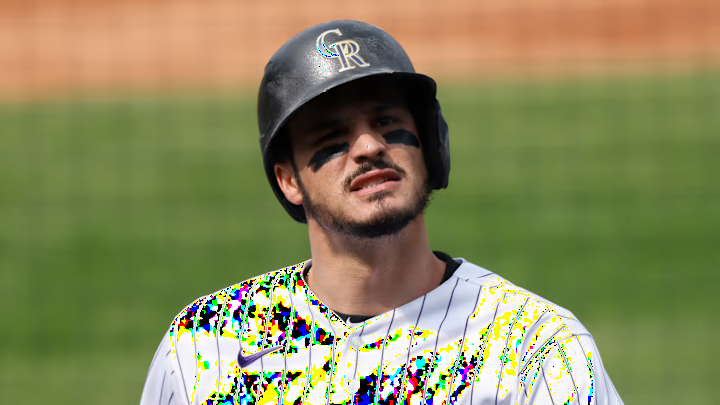
Nolan Arenado signed a massive eight-year extension with the Colorado Rockies ahead of the 2019 season, making it clear he was willing to remain with the franchise long-term. Just two years later, the Rockies traded him for reasons that are still hard to comprehend. Sure, the relationship between the two sides wasn't as strong as it once was, and Arenado's hefty contract made it tough for the low-budget Rockies to build around him, but was this the trade they had to make?
Only two of the five players they received, Austin Gomber and Elehuris Montero, appeared in a game for Colorado. Montero was worth -1.7 bWAR in parts of three seasons with Colorado, and Gomber had a 5.31 ERA in parts of five seasons in the Rockies' rotation before being DFA'd this past season. That's what they got for Arenado, a player who'd perform at an MVP level for several years in St. Louis. To make matters worse, it's not as if the Rockies even saved money, as they sent the Cardinals over $50 million in cash to cover some of the Arenado deal, and they later signed Kris Bryant to one of the worst free agency deals in recent memory to replace Arenado. Even with Arenado struggling in the latter years of his Cardinals career, this was still such an inexplicably bad trade made by Colorado.
Los Angeles Dodgers: Nov. 19, 1993

The Los Angeles Dodgers needed a second baseman, so they traded a reliever (albeit a young one with a lot of promise) named Pedro Martinez in exchange for Delino DeShields, a young infielder himself who had received MVP votes a couple of years before the deal went down. Not only did DeShield's production take a turn for the worse with the Dodgers, but Martinez broke out in a huge way with the Montreal Expos.
The Expos immediately converted Martinez into a starter and reaped the rewards. He was an All-Star in two of his three seasons in Montreal and even won a Cy Young award in 1997. Of course, flipping Martinez after his Cy Young win didn't age well at all, but the Expos trading for him to begin with was great, and a decision the Dodgers will always regret.
San Diego Padres: Dec. 10, 1981
This trade featured two shortstops, Ozzie Smith and Garry Templeton, both of whom were frustrated in their current organizations. Templeton was more known for his offense, while Smith was an outstanding defender. Admittedly, Templeton had a strong career with the San Diego Padres, making an All-Star team and winning a Silver Slugger in a decade in San Diego, but nothing he did came close to matching what Smith did with the St. Louis Cardinals.
His bat was never anything special, but Smith was a lot closer to league average as a hitter in St. Louis than it was in San Diego, and his glove was as good as anyone's in MLB history. He made highlight after highlight, leading to Gold Gloves in each of his first 11 years with the Cardinals. Oh yeah, he also helped the Cardinals win a World Series in his first year with the club. The Cardinals got everything they could've hoped for out of this, even if Templeton was a solid player.
San Francisco Giants: Nov. 29, 1971

It made some sense that the San Francisco Giants would be willing to trade Gaylord Perry, a pitcher on the wrong side of 30 with a lot of innings under his belt, especially when Sam McDowell was the return, but clearly, that wasn't wise. Perry proved he still had a lot of baseball in his right arm, as he won the Cy Young award in his first year with Cleveland and won another one eight years later with the Padres.
As if that wasn't bad enough, the Giants didn't get what they thought they were with McDowell. After capping off a strong 11-year career with Cleveland with four straight All-Star seasons, McDowell struggled with the Giants, posting a 4.36 ERA in parts of two seasons before moving on to the New York Yankees. Frank Duffy also had some solid years with Cleveland, even if he didn't hit much.
More MLB offseason news and analysis:
 Add us as a preferred source on Google