
Gambling has taken over sports, for better or for worse. Right now, at least 38 states offer some form of legalized sports gambling, with most allowing betting from the comfort of your couch or on your phone. More and more states are looking for ways to profit from sports gambling, so there will be more options and more money going into the system.
With this level of money going in and the option to make even more, there will be attempts at corruption. Betting on sports, and people trying to ruin the game to win said bets, is a century-old tale that continues to be told today. The controversies might be the most salacious in sports.
Many of these stories are basically out of a mob movie. Someone with an insane nickname would contact an athlete directly or an athlete’s representative to make a deal to shave points, throw games, or even connect with referees or coaches to impact the results of a game that way. Let’s take a trip down criminal memory lane to see the most impactful controversies that knocked the sports world topsy-turvy.
1. 1919 Black Sox Scandal
Possibly the most famous gambling controversy is one of the first. Obviously, there was gambling before this, but there was nothing like a team throwing the World Series. To this day, Shoeless Joe Jackson is still not in the Baseball Hall of Fame despite being one of the best players in the history of baseball. This is what happens when a player is caught up with the muck of illegal gambling.
Eight members of the Chicago White Sox were accused of intentionally losing the 1919 World Series against the Cincinnati Reds. They were allegedly paid by New York City mob kingpin Arnold Rothstein. While the mob involvement into the scandal isn’t confirmed, many believe that the White Sox players were paid off with mob intent.
It started with animosity against White Sox owner Charles Comiskey. He had one of the top teams in the league, but he was known for underpaying his players and fighting labor unions. He already won the 1917 World Series, but the players didn’t seem keen on winning him another one despite him being a former player himself.
The fix really took off when ace starter Red Faber got sick and couldn’t pitch. This opened the door for a fix, and players met with a Boston bookmaker in a New York hotel. They were paid thousands of dollars to throw the series against the Cincinnati Reds. They ended up losing the series in eight games (the World Series was a nine-game series that year), and a year later, a grand jury investigated and ultimately chose to lay charges on eight players and five gamblers in the scandal.
2. 1946 NFL Championship Game
This one isn’t nearly as well-known as some of the other scandals on this list, but it deserves its own entry. Two players on the New York Giants tried to fix the NFL Championship Game. There were a lot of denials here, but Merle Hapes and Frank Filchock were accused of trying to fix the game. Since they played quarterback and running back, they had a pretty big impact on the game's outcome.
Word got out before the game of the gambling scandal, and there was a scramble in the 24 hours leading up to the championship to see what happened. New York City Mayor William O’Dwyer, who ironically had to step down due to corruption allegations in 1950, interviewed both Hapes and Filchock.
During those interviews, Hapes admitted that a bookmaker attempted to pay him to throw the game. Filchock never admitted to any wrongdoing. The Giants suspended Hapes for the championship game, but Filchock was allowed to play. Weeks later, when under oath, Filchock also admitted to taking the bribe.
The Chicago Bears ended up winning the game after the Giants failed to score a point in the fourth quarter. Because of the loss, every Giants player lost out on $700 based on the pay scale at the time, which is about 40% of the championship payout. Both Merle Hapes and Frank Filchock were suspended indefinitely by the league.
3. 1951 College Basketball Point-Shaving Scandal
The 1951 scandal that basically ruined the integrity of an entire decade of college basketball started small and ended up exploding, eventually impacting one of the blue blood programs and put their National Championship in question. This scandal started in New York City and centered on Madison Square Garden. However, as the investigation continued, it was clear that point shaving was happening across the country.
In the end, 35 players were accused of taking bribes for game fixing. On top of that, a referee and multiple members of the mob were charged. Corruption eventually made its way into the NYC Police Department, leading to the resignation of Mayor O’Dwyer, the same guy who had been trying to address the NFL Championship Game fixing a few years prior.
Ralph Beard is one of the greatest players in the history of Kentucky basketball, but his legacy is forever marred by the 1951 point-shaving scandal that destroyed college basketball. The 1947 National Champions were embroiled in the scandal, but it was a 1949 NIT game that was in question. Still, Beard and two of his teammates were arrested, and the Kentucky name was hurt in the process.
Beyond that, City College of New York never recovered in their basketball program, and Long Island University is not a major program today for a similar reason. The University of Toledo was involved in this, as well.
4. 1963 Paul Hornung and Alex Karras bet on games
Unlike some of the previous controversies, this next NFL controversy didn’t come from seedy people asking players to fix games. This was actually the players themselves acting as the bettors. Two football legends, Paul Hornung of the Green Bay Packers and Alex Karras of the Detroit Lions, were caught up in the scandal. These weren’t just anyone in the league, it was two of the biggest stars, as Hornung won the 1961 league MVP.
After it came to light that both men were not only betting on games but associating with the people putting in the bets, then-NFL commissioner Pete Rozelle suspended them both indefinitely. Karras missed the entire 1963 season, as did Hornung. They were reinstated about a year later.
At the time, there was no proof that either player bet on their own teams, but the reputation of the league was on the line. It was important enough for two league stars to watch the sport from their own homes. This was a pivotal time for the league, just a few years away from the famous NFL-AFL merger. Sending a future Hall of Famer home is not an easy decision.
5. 1978-79 Boston College mob connection
Much of these point shaving scandals are meant to only take a few points off the totals of the winning team. The conversation usually surrounds falling under the point spread and still winning. Of course, that still ruins the integrity of the game and could lead to the wrong team winning or another team not putting their all into a victory or a loss. We saw that during the Boston College basketball scandal during the 1978-79 season.
During this scheme, alleged members of the mob would find games on BC’s schedule with a significant points spread. There, they found there was room for the players to win the game comfortably but still allow bettors to get a payout. Senior Rick Kuhn agreed to the plan, and brought in teammates to help with the scheme.
The scheme unraveled when one of the conspirators was arrested on unrelated charges and gave up the goose to avoid a further prison sentence. While looking at the evidence around the Lufthansa heist at JFK International Airport, they found this suspect was making frequent trips to Boston, which caused him to admit that the point shaving was part of his criminal profile.
Ernie Cobb, Jim Sweeney, and Kuhn were all permanently suspended from the NBA once the scandal came to light. They were the last players who were suspended from professional basketball due to their conduct in college.
6. 1989 Pete Rose is banned from baseball
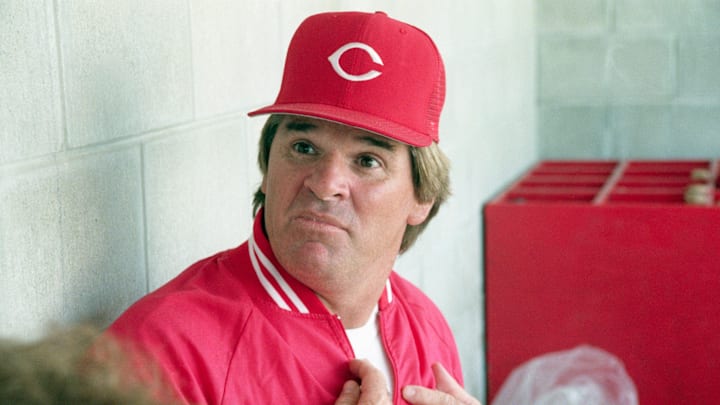
Fast forward a few years, and we have the most impactful gambling scandal since the Black Sox. Baseball was knocked on its behind when Pete Rose, the all-time hit leader and then manager of the Cincinnati Reds, was suspended by baseball for his alleged gambling habits.
Not only was this a huge story, but it happened in the middle of the 1989 season. It was August, so teams were in the home stretch, trying to make a run to the playoffs. This got ugly quickly, with allegations in the “Dowd Report” claiming there was conclusive evidence that Rose bet heavily on baseball games, including Reds games. This violates a rule enacted after the 1919 World Series that says anyone involved in games cannot place bets on baseball, especially their own.
Rose sued MLB after the allegations, but upon seeing the report, Rose agreed to accept a lifetime ban from baseball to end the investigation before more became public. He immediately stepped down as manager, and he now had to live with the fact that he would never become a Hall of Famer. Despite push from leaders at different times, Rose never made it to Cooperstown.
Current MLB commissioner Rob Manfred removed Rose’s ban recently, but it didn’t come before his death. If Rose does make the Hall of Fame now, it will be done posthumously.
7. 2007 Tim Donoghy gets caught
There’s a prevailing thought in sports that if we know the name of a referee, it’s always for bad reasons. Usually, that means that the referee made a bad call against our favorite team, and we never trust them again. There’s also the way some fans joke (mostly) about how referees must be paid off to make such a call. In basketball, we learned the name Tim Donaghy because he was paid off, and it became the biggest scandal in NBA history.
It’s one thing to have a player throw a game or attempt to shave points, but a referee feels different. He’s in charge of the rules and integrity of the game. When the person meant to instill the rules comes in with a clear bias, it can have more of an impact on the game than any player or coach could possibly hope to.
The controversy started in summer 2007 when the New York Post reported that an NBA referee was being investigated for betting on games. We later learned that Donaghy made bets across four seasons, almost exclusively on games where he was officiating. David Stern, then NBA commissioner, said that this showcased a blindspot for the league that needed to be addressed.
Donaghy made it seem like he was working with the mob on this, but that was quickly dispatched as false. He was realistically just making bets with his high school friends, but it did amount to tens of thousands of dollars.
8. 2010 Cricket World Cup
Many of the readers may not know about the 2007 scandal that rocked the world of cricket, but this might be the most well-known scandal worldwide. The Super Bowl this season, between the Patriots and Seahawks, had about 125 million viewers. The Cricket World Cup Final usually gets around 300 million. You can see the popularity of this sport.
When Pakistan faced England in cricket during a game in 2010, many eyes were going to be on the match. Pakistan is one of the world’s elite in cricket. However, there were rumblings of gambling happening before the match, and journalists in England caught Mohammad Amir and Mohammad Asif allegedly taking bribes. Salman Butt was also caught up in the scandal.
This wasn’t about who won or lost. This was specifically about when the three would throw a “no ball.” In cricket, a no-ball is an illegal delivery that results in an extra run being added to the score of the other team. The bettors would place live bets on the no-ball and win from that one play.
All three men were banned by the International Cricket Council for five years after the scandal broke, but this type of live betting would come up again.
9. 2025 NBA wide-spread gambling scandal erupts
The gambling microscope moved back to the NBA in the past few years. With the explosion of gambling and the relative ease in making bets, leagues are trying to find where they might have blind spots. This isn’t players meeting with mobsters in secret hotel rooms to formulate a plan using all cash. This is an app on your phone or your friend’s phone that can make bets in real time. The scandals began with Jontay Porter, but he wasn’t a household name.
In October 2025, household names became a part of the gambling conversation. The U.S. Department of Justice announced arrests across the nation involving different types of gambling rings involving current and former NBA players. One of those former players, now-Portland Trail Blazers head coach Chauncey Billups, was apparently in a scheme that involved high-end poker games.
Terry Rozier, who was in his first season with the Miami Heat, was actually involved in a sports betting scheme. He would allegedly share non-public information with bettors about his own team and his opponents to give bettors an edge. This includes injury information and player removals. They are even investigating whether players intentionally removed themselves for the bettors’ interest.
This situation is still ongoing, as we have league investigations and criminal investigations under review.
10. 2026 MLB players accused of fixing pitches
The biggest gambling scandal playing out right now is the one involving tipped pitches. Not tipped to the batter, like the Houston Astros scandal that brought shame to that organization. This one is talking about tipping pitches to bettors, throwing a ball to start an at-bat, then reaping the rewards.
The biggest name involved is Cleveland Guardians closer Emmanuel Clase. He was placed on paid leave last year after reports came out that he was involved in sports betting somehow. The more the details came out, the more people found evidence of insane pitches Clase has thrown to start at-bats. These weren’t missing the plate by a few inches. These were pitches in the dirt or missing the plate by a few feet.
He was eventually arrested for the scheme in November, and he’s currently going through the court process. We don’t know yet if and how much Clase was paid for this, but he lost millions of dollars in salary to make it happen. He was on pace to get a record-setting contract for a relief pitcher. Now, his career is likely over.
It’s been more than 100 years since the first big betting controversy, and we’re still not learning the lessons from those previous scandals. People still make mistakes when it comes to money, and with gambling being more and more accessible, we don’t see these controversies going anywhere anytime soon.
More MLB news and analysis:
 Add us as a preferred source on Google