
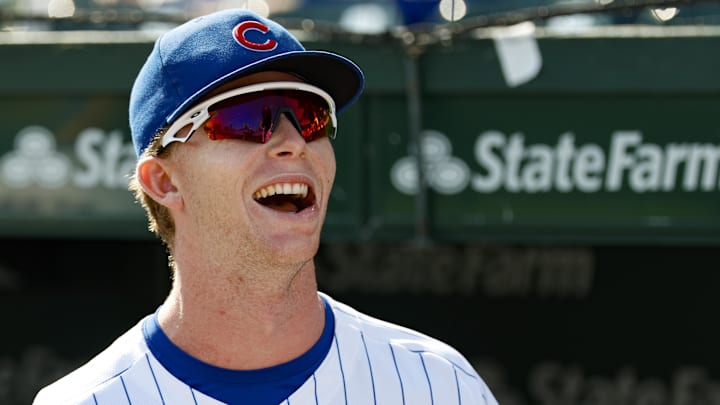
Spring Training is well underway, but there's just as much attention being paid to what's happening off the field as to what's happening on it. Because this is officially extension season: Teams have a clear picture of their finances after the offseason dust has settled, and players have yet to seal themselves in the regular-season bubble, leaving a window of just a few weeks to lock up premium talent before Opening Day.
It's become more and more of a tradition in recent years, as young stars want to make big money more quickly than MLB's current economic model (three years at the league minimum followed by three years of arbitration before you can even think about making market value) allows and front offices are eager to gain as much team control over their best players as possible. And it's only going to become more common moving forward, given how much more quickly baseball's best prospects move through the Minors and start setting the league on fire.
Take Chicago Cubs outfielder Pete-Crow Armstrong, for example: He was a legitimate MVP candidate for much of last season, and he won't even turn 24 until next month. PCA has no reason to wait several more years to start being paid commensurate with his production — and he's far from alone. Here's what it might take to lock up Crow-Armstrong, Gunnar Henderson and more of the brightest stars in baseball.
OF Pete Crow-Armstrong, Chicago Cubs
“I’ve made it clear I want to be here for as long as they want me,” Crow-Armstrong told Chicago Magazine at Spring Training. “I want what’s best for the team. I’m cool with being under team control and being here. League minimum ain’t too f***ing bad.”
Of course, while the league minimum ain't bad, making eight figures a year is even better. Crow-Armstrong turned down something between $75 million and $90 million from Chicago last offseason, and there will be no hometown discounts forthcoming.
"I would like to get a fair deal so I don’t f*** the market up," Crow-Armstrong said. "I want to look out for the other center fielders who have to go through the same process. Which is why I’m glad [Cubs management] and my agents are figuring out how to do this."
So what exactly does a fair deal look like? Finding a good comp is a bit tricky. Corbin Carroll signed an eight-year, $111 million extension with Arizona before the 2023 season, but he'd played just 32 MLB games at that point. Jackson Merrill had played just one full season before the Padres locked him up for nine years and $135 million (with a team option for year 10 that would bring it north of $150 million). PCA, by contrast, has played 280 games over the last two years. Something in between those two numbers seems right: Crow-Armstrong's defense gives him a high floor, but he also wasn't the prospect that Carroll was and comes with some question marks about his bat. The below deal buys out two or three free agency years while still allowing him to hit the market before he's too old to cash in.
Projected extension: Seven years, $125 million (with a club option for year eight)
SS Gunnar Henderson, Baltimore Orioles

Of all the extension candidates on this list, Henderson will be the hardest to lock up. Part of that is due to proximity to free agency: He has just three years of team control remaining, despite the fact that he won't turn 25 until this summer. And part of that is the fact that his agent is Scott Boras, a man who will always recommend taking his clients to free agency rather than forgoing the market.
So if the O's are serious about keeping Henderson in Baltimore for the long haul, they're going to have to treat this less like extension talks and more like free agency. Bobby Witt Jr. signed an 11-year, $288 million deal with the Royals two years into his MLB career, with an opt-out after year seven and three team options attached. That's instructive from a structure perspective, with big money up front and flexibility on the back end.
But Henderson has been nearly Witt's equal, and he's closer to hitting the market and breaking the bank as an MVP candidate at a premium position entering his age-29 season. If you want to buy out free agency years, it's going to cost you something like $40 million a season to do it — the sort of money he can reasonably expect to make if he keeps playing like this.
Projected extension: 11 years, $450 million (with club options beyond)
3B Junior Caminero, Tampa Bay Rays

The thought of the Rays splashing this kind of cash might engender some laughter, but don't be shocked: Tampa has done this sort of thing before (they shelled out $182 million over 11 years for Wander Franco, money that they're still trying to claw back), and paying foundational players before they have the chance to make market value is the only way that small-market teams can hang on to star-level talent.
Caminero certainly qualifies after launching 45 homers in his first full season in his age-21 campaign. That youth is working for him: With five years left until free agency, he'll hit the market at the ripe young age of 27. His agent, Rafa Nieves, mentioned last year that he'd be targeting something in the realm of $150-200 million in guaranteed money in any potential extension, which seems about right considering his ceiling — the Merrill extension feels like the absolute floor here.
Projected extension: Nine years, $162 million (with a team option for year 10)
RHP Bryan Woo, Seattle Mariners

The Mariners have been weighing potential extensions with a number of their homegrown pitchers, but while Logan Gilbert (two years away from free agency) and George Kirby (three) are close enough to testing the market to make it potentially prohibitive, Woo is the youngest of the trio — and he might have the highest ceiling to boot.
Of course, he'll have to stay healthy to realize it. He's already undergone Tommy John once, and he battled a pec issue down the stretch of 2025. That could make him more willing to sign away at least a couple of his free agency years in order to gain some more short-term security.
Tanner Bibee signed a five-year, $48 million deal with the Guardians last spring, when he had numbers that compared to Woo's and was at the same level of service time. That feels like a good model here: Seattle won't want to tie themselves to such a volatile asset for a ton of years, but this is an exciting young pitcher (2.92 ERA over the last two years) worth investing in — especially if/when Gilbert or Kirby move on.
Projected extension: Five years, $60 million (with a team option for year six)
C Drake Baldwin, Atlanta Braves

From Ozzie Albies to Austin Riley to Michael Harris II to Spencer Strider to Ronald Acuña Jr., no team has been more aggressive in locking up its young, homegrown talent than the Atlanta Braves. And it sure looks like Baldwin's next in line, after a season in which he posted a 126 OPS+ en route to NL Rookie of the Year honors.
Catcher is also a volatile and grueling position, which should make Baldwin amenable to forfeiting at least a couple of free agency years in order to start getting paid right away. Atlanta will jump at the chance to hand him an extension despite already having another backstop under a long-term deal in Sean Murphy; lefty-hitting catchers with middle-of-the-order potential simply don't come around very often. From there, it's just a matter of finding the right number: The last catcher who signed a deal five years away from free agency was Keibert Ruiz, who agreed to an eight-year, $50 million contract with the Washington Nationals, but Baldwin is already a much better player.
Projected extension: Eight years, $80 million
SS Zach Neto, Los Angeles Angels

I mean, the Angels have to build around somebody, right? Unlike other bottom-feeders like the White Sox and Rockies, they refuse to truly lean into a rebuild, which means that paying up for Neto as an infield cornerstone makes some sense. He's a very good offensive player, with legit 30-30 upside on a yearly basis, and while his defense is rough at shortstop, that still hasn't stopped him from posting back-to-back seasons of at least 5 bWAR.
Luckily, we've got ourselves a handy comp here: The Royals signed Maikel Garcia (a player with nearly identical service time) to a five-year, $57.5 million extension that includes a team option for a sixth earlier this offseason, and while he's not the threat Neto is with the bat, their overall value is about the same. Neto would probably ask for a bit more given that he plays shortstop, his pop at the position is rare and the Angels are, well, a mess. But it's a good baseline nonetheless.
Projected extension: Five years, $70 million (with a team option for year six)
INF Kevin McGonigle, Detroit Tigers

There are a handful of players who are potential candidates to follow the path laid out by Jackson Chourio, who signed an eight-year, $82 million extension with the Brewers before he'd even played an inning at the Major League level. But the rebuilding Cardinals are in no rush to shell out for JJ Wetherholt, while the Pirates ... well, let's just say I'll believe that they'll hand $90-100 million to super-prospect Konnor Griffin when I see it.
Which leaves McGonigle, who might be the best non-Griffin prospect in the sport and who figures to step right into a meaningful role for a contending Tigers team as a rookie (whether that role begins on Opening Day or not). Detroit is no stranger to this kind of move: They locked up Colt Keith before his MLB debut a couple of years ago. McGonigle is in a different neighborhood as a player, and his contract will be too, but a deal here could make sense for both sides.
Projected extension: Eight years, $88 million (with a team option in year nine)
OF Wyatt Langford, Texas Rangers

We talked about a couple of other big outfield extensions in Carroll and Merrill above, but that won't quite work here. For starters, Langford is a year ahead of them in terms of service time, which means he's closer to free agency and thus more expensive to lock up. He's also probably a better player than you think: According to Evan Grant of the Dallas Morning News, the only under-25 outfielder to accrue more bWAR than Langford over the last two years is Mariners star Julio Rodriguez.
Rodriguez, of course, has a long-term deal of his own, and it's a doozy: 12 years and $209 million. Julio is a truly special player, and no one's arguing that Langford should realistically set his sights that high. But something between that number and Merrill's would likely get the job done, which would be a smart move for a Rangers team that's still trying to figure out what it has in Evan Carter.
Projected extension: 10 years, $175 million
 Add us as a preferred source on Google