
In the late 19th century, just about every MLB team — there were only 16 at the time — hailed from the northern part of the country, making training over the offseason difficult. Sick of keeping his players cooped up in a gymnasium, Albert Spalding, the-president of the Chicago White Stockings, decided a change of scenery was in order. So, in 1886, he picked up stakes and moved his team down to Hot Springs, Ark., to get ready for the season to come — and just like that, Spring Training as we know it was born.
Of course, a lot has changed since then. What began as a group of semi-pros playing catch in the woods has now become a multimillion-dollar industry, with all 30 teams heading to Florida or Arizona for the spring and taking legions of fans with them. If you'd like to be one of them this year, or if you've ever just wanted to know how MLB Spring Training came to be and where each club calls home, we've got you covered.
What is the Grapefruit League?

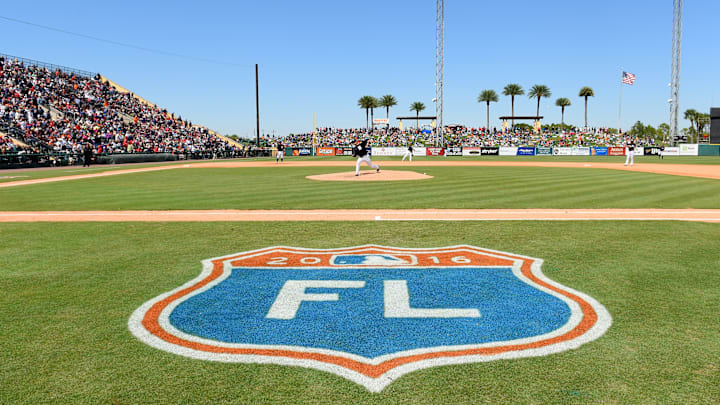
The Grapefruit League refers to the collection of teams that play their spring ball in Florida — 15 in all, exactly half the league, comprised mostly (but not entirely) of franchises located east of the Mississippi River. Spring Training in Florida dates back to the 19th century, but things really took off in 1913, when the mayor of Tampa managed to lure the Cubs to his city by offering to cover their expenses up to $100 per player. Other teams soon struck up similar deals around the state, and it turned out that being in close proximity to the rest of the league made exhibition games a lot easier and more convenient.
(As for why it goes by the Grapefruit League, that's a pretty spectacular story. In 1915, an aviator by named Ruth Law had begun dropping golf balls onto a course below as a publicity stunt. The Brooklyn Dodgers, located in nearby Daytona Beach, thought it might be fun if she tried the same trick with a baseball. Except, when the time came, Law forgot to bring a baseball up with her — so she used a grapefruit instead. It splattered all over Dodgers manager Wilbert Robinson, and the name stuck.)
Here are all the teams that currently call the Grapefruit League home, as well as their locations in Florida. (Note: the Astros and Nationals, as well as the Marlins and Cardinals, share Spring Training complexes in West Palm Beach and Jupiter, respectively.)
- Atlanta Braves: North Port
- Baltimore Orioles: Sarasota
- Boston Red Sox/Minnesota Twins: Fort Myers
- Detroit Tigers: Lakeland
- Houston Astros/Washington Nationals: West Palm Beach
- Miami Marlins/St. Louis Cardinals: Jupiter
- New York Mets: Port St. Lucie
- New York Yankees: Tampa
- Philadelphia Phillies: Clearwater
- Pittsburgh Pirates: Bradenton
- Tampa Bay Rays: Port Charlotte
- Toronto Blue Jays: Dunedin
CoolToday Park, Atlanta Braves (North Port)
CoolToday Park is one of the newest Spring Training stadiums anywhere, having opened in 2019. (The Braves had previously spent the spring in Orlando, much further north than most other spring locales and a further drive for road games.) The stadium is located in a planned community in North Port, just north of Fort Myers.
Ed Smith Stadium, Baltimore Orioles (Sarasota)

Built in the late 80s, Ed Smith Stadium initially served as the spring home of the White Sox and the Reds before both eventually moved to the Cactus League in Arizona. The Orioles made it their home in 2010 and immediately set about renovating the place, including refurbished seats from Camden Yards in Baltimore. Located in downtown Sarasota, it's an ideal basecamp if you're looking to tour spring sites on the Gulf Coast of Florida.
JetBlue Park, Boston Red Sox (Fort Myers)
You might also hear the Red Sox' Spring Training facility referred to as Fenway South. And that's more than just branding: JetBlue Park was made in Fenway's image, complete with a replica of the Green Monster in left and identical outfield dimensions. Roof covering means that most seats are in the shade even in the afternoon, and it also happens to be located right across the street from Southwest Florida International Airport for maximum convenience.
Publix Field at Joker Marchant Stadium, Detroit Tigers (Lakeland)

It's hard to imagine the Tigers anywhere but Lakeland, where they've played spring ball since 1966. But Joker Marchant Stadium is hardly gathering dust: On the contrary, it was renovated in 2016, and is still one of the nicer Spring Training complexes around. The entrance is iconic, and yes, there is an inflatable tiger hanging out beyond the outfield fence. The only downside, if there is one, is that Lakeland isn't the most convenient location if you're trying to hit multiple parks on one trip.
Ballpark of the Palm Beaches, Houston Astros/Washington Nationals (West Palm Beach)
The Ballpark of the Palm Beaches opened in 2017, a joint effort from the Astros and Nats as the two teams decided that sharing a stadium would be more cost-effective. (While there's only one ballpark, there are two separate Spring Training complexes.) And don't worry, Washington fans: You can still catch the racing presidents with Coolidge, Hoover and Taft "retiring to Florida" and taking up residence.
Roger Dean Chevrolet Stadium, Miami Marlins/St. Louis Cardinals (Jupiter)

For decades, the Cardinals called St. Petersburg home in the spring. But in 1998, with the expansion Rays coming to town, St. Louis decided to pull up stakes and move across the state to Jupiter, where they shared a complex with the Montreal Expos. The Cardinals have been there ever since, though the Marlins replaced the Expos upon their sale to former Montral owner Jeffrey Loria in 2003.
Hammond Stadium at Lee County Sports Complex, Minnesota Twins
The Twins first moved into Hammond Stadium in 1991. Just a few months later, they won the World Series. It's no wonder that Minnesota has stayed put in Fort Myers ever since, one of the longest-standing relationships between a team and a Spring Training complex anywhere in the league. Hammond Stadium also happens to be right down the road from Fenway South, meaning you can catch games at both on the same day if the schedule shakes out right.
Clover Park, New York Mets (Port St. Lucie)

Opinion seems to be a bit divided among Mets fans when it comes to Clover Park. On the one hand, it's been the team's spring home since the 1980s, and many of the greatest players in franchise history have come through its doors. On the other, Port St. Lucie is among the sleeper Grapefruit League destinations, well north of the glitzier Atlantic Coast ballparks, and the attempt to mimic Shea Stadium mostly just results in a lot of ugly concrete.
George M. Steinbrenner Field, New York Yankees (Tampa)
The Yankees spent more than three decades in Fort Lauderdale, but when George Steinbrenner regained control of the Yankees in 1993 after a two-year suspension, he was determined to make a splash. And boy did he ever: George M. Steinbrenner Field (known as Legends Field when it first opened) is still the largest Spring Training park in Florida, complete with a mockup of monument park and a facade based on the one at Yankee Stadium. It even served as the Major League home of the Rays in 2025, after Hurricane Milton caused extensive damage to Tropicana Field.
BayCare Ballpark, Philadelphia Phillies (Clearwater)

The Phillies were the first big-league team to ever train in Florida, although they wouldn't move to Clearwater until the 1940s. They've been there ever since, including nearly 50 years at nearby Jack Russell Stadium. Baycare was built in 2004, and while it's far from the most glamorous spring destination, it holds up pretty well — it was the first Grapefruit League park to use a berm in the outfield, and that's still one of the more enjoyable places to catch a game in February or March.
LECOM Park, Pittsburgh Pirates (Bradenton)
Thanks to its huge Spanish Mission facade, LECOM Park is one of the most visually distinctive in the Grapefruit League. It also feels like passing through a portal into a past age of spring baseball: It's the oldest active Spring Training stadium, built in 1923, and it was also the last Spring Training stadium in Florida to install lights, only doing so in 2008.
Charlotte Sports Park, Tampa Bay Rays (Port Charlotte)

Few spring parks have experienced a glow-up quite like Charlotte Sports Park. Once the laughingstock of the league — the Rangers had to hold Alex Rodriguez's introductory press conference on the dugout roof because there wasn't enough room indoors — several renovations have completely flipped the script, including a 360-degree boardwalk concourse that runs all the way around the stadium.
TD Ballpark, Toronto Blue Jays (Dunedin)
The only Spring Training home the Blue Jays have ever known, TD Ballpark had fallen behind the times as ballpark renovations swept the Grapefruit League in the early 21st century. With the Blue Jays forced to play the first two months of the 2021 regular season in Dunedin amid the COVID-19 pandemic, though, this stadium got a serious makeover, and the result is one of the most pleasant spring experiences anywhere. Dunedin isn't the most convenient location, way off the interstate north of Clearwater, but this is well worth the trip.
What is the Cactus League?
While spring baseball in Florida goes back over a century, it didn't come to Arizona until 1947, when notorious MLB carnival-barker Bill Veeck protested the inequities of the Jim Crow South by moving Cleveland — the franchise he'd purchased just a few months prior — from Florida to Mesa. Slowly but surely, other teams started to follow, from the Giants to the Cubs to the Orioles. As MLB expanded westward in the middle of the 20th century, Arizona became a second spring hub, with now half the league located largely around the Phoenix metro area.
(Unfortunately, there's no similarly colorful story around how the Cactus League got its name. There are just a lot of cacti in Arizona, I guess.)
- Arizona Diamondbacks/Colorado Rockies: Salt River Pima–Maricopa Indian Community
- Athletics/Chicago Cubs: Mesa
- Chicago White Sox/Los Angeles Dodgers: Glendale
- Cincinnati Reds/Cleveland Guardians: Goodyear
- Kansas City Royals/Texas Rangers: Surprise
- Los Angeles Angels: Tempe
- Milwaukee Brewers: Phoenix
- San Diego Padres/Seattle Mariners: Peoria
- San Francisco Giants: Scottsdale
Salt River Fields at Talking Stick, Diamondbacks/Rockies (Salt River Pima–Maricopa Indian Community)
The first MLB park built on Native American land, Salt River at times feels more like a resort than a Spring Training stadium, putting all of that extra funding to good use. Before you even arrive at the field, you take a stroll through landscaping that incorporates the surrounding area, from cacti to fountains and wells. No wonder it's been winning awards since pretty much the day it opened in 2011.
Hohokam Stadium, Athletics (Mesa)

Originally built in 1997 to be the new home of the Cubs — who spent 35 years in Mesa from 1979-2014 — Hohokam Stadium has served as the home of the A's ever since Chicago moved out. It still shows its age in spots, but with the biggest scoreboard in the Cactus League, plenty of shade, an outfield berm and a whole lot of food trucks, what could be bad?
Sloan Park, Chicago Cubs (Mesa)
Was it strictly necessary for the citizens of Mesa to approve a ballot measure funding a new stadium for the Cubs? Absolutely not. But it's hard to argue with the results, especially considering how effectively Sloan Park manages to capture the quaint Wrigley vibe all the way out in the desert. It's also a massive stadium for a massive fan base: Chicago set a Cactus League record with over 250,000 fans in attendance in 2019, and set the single-game mark as well with over 16,000 taking in a game against the Giants in 2023.
Camelback Ranch, White Sox/Dodgers (Glendale)

For decades the Dodgers were synonymous with Vero Beach, Florida, in an old Navy base that then-owner Branch Rickey turned into a Spring Training complex. Eventually, though, the cross-country travel from L.A. became hard to justify, and the Dodgers made the move to the Cactus League back in 2009 (with the White Sox as co-tenants). Camelback Ranch does its best to recreate the vibe of Dodger Stadium, with a sunken field surrounded by those iconic golden seats.
Goodyear Ballpark, Reds/Guardians (Goodyear)
Goodyear is a bit far-flung, way out on the western edge of the valley, and the grand mixed-use plans that developers had for the site when it opened in 2009 never quite materialized. That open space does have its upsides, though, like a Wiffle Ball field out beyond the first-base line.
Surprise Stadium, Royals/Rangers (Surprise)

Surprise is also out there, a full 40-minute drive from downtown Phoenix and even furthered removed from other sites like Mesa, Tempe and Scottsdale. It was built in the early 00s, in a joint agreement between Texas and Kansas City as both looked to make their move west to the Cactus League.
Tempe Diablo Stadium, Angels (Tempe)
Amid all the new construction that's taken place in the Cactus League in the 21st century, Tempe Diablo stands out as a throwback. Not only is it the oldest park in Arizona, initially serving as the spring home of the then-Seattle Pilots in 1969, but it's the smallest as well with a capacity of 9,558. Of course, several rounds of renovations have taken place since then, and it's hard to beat the view of a small butte out beyond left field.
American Family Fields of Phoenix, Brewers (Phoenix)

"No-frills" feels like a fair way to describe American Family Fields, and I don't mean that derogatorily. With a wide-open entry plaza and a 360-degree concourse, it's an assuming stadium that you can just stroll right on up to and catch a game. It is a bit further away from Phoenix proper than the name would suggest, though.
Peoria Sports Complex, Padres/Mariners (Peoria)
When Peoria Sports Complex first went up in 1994, there was hardly anything around it, but now it's in the midst of a bustling mixed-use development that makes it worth the 30-minute drive from Phoenix. There isn't a ton of flair to the design here, just a solid, spacious ballpark that keeps on doing the job some 30 years later.
Scottsdale Stadium, Giants (Scottsdale)

Scottsdale Stadium was ahead of its time in 1992, the first Cactus League stadium with a five-figure capacity and modern amenities, foreseeing the growth of spring ball in Arizona still to come. While the ballpark itself was rebuilt in 1991, the site has been around since the mid-1950s, serving as the home of the Giants since the mid-1980s. It's built right into the heart of Scottsdale proper, too.
 Add us as a preferred source on Google