
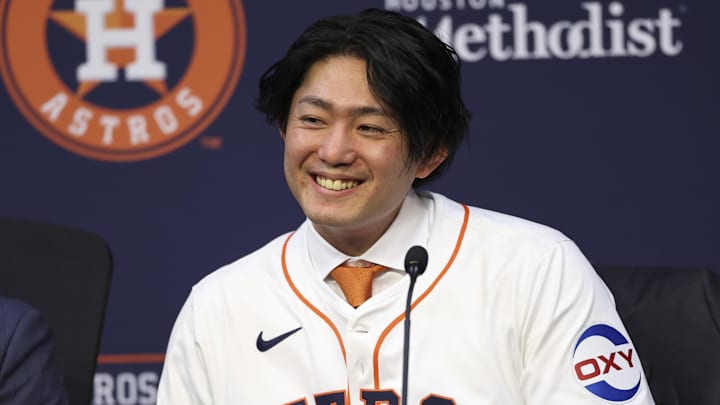
Time was ticking on the Houston Astros to make an impactful free agency move — and not solely because other teams were pursuing Japanese baseball ace Tatsuya Imai. Unlike most free agents, Imai was on a deadline; teams had until Jan. 2 to sign the three-time NPB All-Star before his posting window expired.
Luckily for the Astros, they locked up Imai on a three-year, $54 million deal — with up to $63 million in incentives — on Friday, shortly before he would have returned to NPB for another season. Imai joins an Astros team fresh off missing the postseason for the first time since 2016 and one seeking a final championship in the Jose Altuve era.
Free agency deadlines are strange to consider, especially with premier players such as Alex Bregman, Cody Bellinger, and Kyle Tucker all remaining unsigned as of Jan. 6. They’ve been on the open market for two months, yet there are no indications that they’ll sign anytime soon. Bregman made it all the way to mid-February last year before signing a three-year, $120 million deal with the Boston Red Sox, which included an opt-out clause allowing him to re-enter free agency this cycle.
Would baseball benefit from putting Bregman, Tucker, and other free agents on the clock the way it did with Imai and new Chicago White Sox third baseman Munetaka Murakami? As intriguing as the concept sounds, things wouldn’t be so simple.
MLB free agency deadlines are a brilliant idea — at least on paper
For those unfamiliar with the posting system that NPB players such as Imai and Murakami navigate, they were given a 45-day window to sign with an MLB team. For context, that six-week period is up from the 21-day window Shohei Ohtani had under the previous collective bargaining agreement.
Compare that to Major League Baseball’s standard free agency system. It’s not unrealistic to think that Bellinger, Bregman, and Tucker could all remain unsigned on Feb. 1. In fact, I’ll even predict that one of those three is still available when pitchers and catchers begin reporting in mid-February. Bo Bichette, Framber Valdez, and Ranger Suárez all woke up Jan. 6 without contracts. Even longtime Philadelphia Phillies catcher J.T. Realmuto remains a free agent.

As I’ve argued elsewhere, that’s not the sign of a slow offseason. We’ve already seen Kyle Schwarber (five years, $150 million with the Phillies), Dylan Cease (seven years, $210 million with the Blue Jays), and Pete Alonso (five years, $150 million with the Orioles) all cash in. Edwin Díaz inked a three-year, $69 million deal with the Dodgers, and we’re confident they’re not done spending.
Still, we acknowledge that the offseason isn’t moving as quickly as many would like. We’re just not convinced that free agency deadlines are the answer.
What could MLB free agency deadlines look like?
For the sake of experimentation, let’s imagine how MLB free agency deadlines could work. To be clear, this is just us thinking out loud. There are no indications that Major League Baseball is considering a system like this.
- Teams have until the second Thursday of November to exclusively negotiate with their own free agents. Why the second Thursday? It gives teams nearly two weeks to take care of internal business.
- Players are divided into categories. Those with All-Star selections and/or major awards within the last five years — such as Cody Bellinger or Devin Williams — are Category A free agents. Players with at least six years of service time but without those accolades (think Luke Weaver) fall into Category B. Gary Sánchez, a two-time All-Star who last made an All-Star Game in 2019, would also be Category B because he hasn’t made an All-Star Game, won an award, or been a finalist for an award within the last five seasons. Everyone else, including fringe major leaguers and career minor leaguers, is Category C.
- Teams can begin negotiating with outside free agents at 6 p.m. ET on that Thursday. In this scenario, that would be Nov. 13, 2025.
- Teams must submit their first offer to a Category A or Category B player by 11:59 p.m. ET on Nov. 30. This does not require the player to sign. However, using Kyle Tucker as an example, if the Blue Jays, Dodgers, and Yankees all wanted Tucker, they would have needed to submit an initial offer by Dec. 1. Otherwise, they would be barred from bidding.
- Category A players must sign by 11:59 p.m. ET on Dec. 31. Category B players have until 11:59 p.m. ET on Jan. 14. Exceptions could be granted for players rehabbing significant injuries or undecided about playing the following season.
- Any Category A or B player unsigned at midnight on Jan. 15 may sign at any time thereafter — but contracts would be limited to two years in length.
Well, that’s certainly an idea.
So, how feasible is an MLB free agency deadline?

This is where I have no problem being honest with myself. The idea I just outlined is unrealistic, nonsensical, and could ultimately do more harm than good.
For starters, it’s difficult to imagine either the union or ownership signing off on rigid deadlines. Why should teams feel pressured to sign players by an arbitrary date? And if you’re Tucker or Bregman, there may be advantages to waiting out the market.
But then, why wouldn’t players simply wait until Jan. 15? That’s a fair question. Some Category A or B players would likely accept two-year deals with opt-outs after the first season. But if Bellinger is adamant about securing a long-term contract, he shouldn’t feel forced into settling for a short-term arrangement.
There’s also the question of how much players could earn on post-deadline contracts. In theory, nothing would prevent the Yankees from giving Bellinger a one-year, $40 million deal. But that money would almost certainly be paid within a single season — and that’s $40 million unavailable at the trade deadline.
If you have ideas on how an MLB free agency deadline could actually work, we’d love to hear them. Otherwise, it’s probably best to prepare for the status quo.
 Add us as a preferred source on Google