
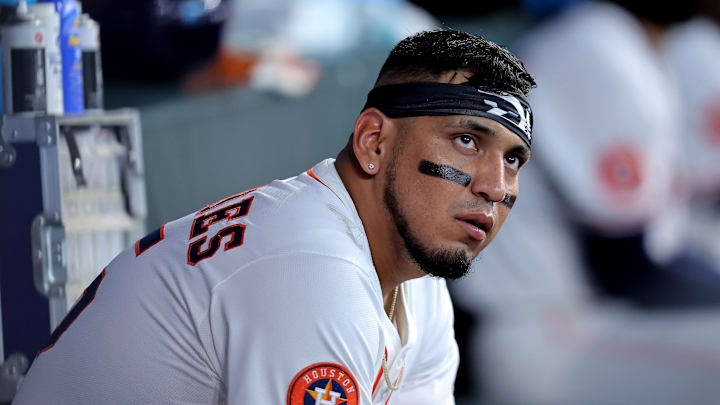
The Houston Astros' panic trade for Carlos Correa has left the front office in a pickle just seven months later. While we all love a reunion narrative, acquiring Correa was painfully short-sighted. It gave Houston temporary relief amid injuries, but now the 2026 season has arrived and Houston just does not have enough infield spots to go around.
WIth Correa at third base, Jeremy Peña at shortstop, Jose Altuve at second base and Christian Walker at first base (not to mention DH regular Yordan Álvarez), it's difficult to see how All-Star Isaac Paredes fits into the equation. He's much too valuable to sit on the bench. Thus, Houston has taken to exploring potential trades, with the ambitious Pittsburgh Pirates reportedly expressing interest in the 26-year-old righty.
Potential Astros-Pirates trade package for Isaac Paredes
Paredes has two years of arbitration eligibility left, which gives Houston some leverage despite the corner they've backed themselves into. While Paredes was limited to 102 games last season because of injury, he still earned his second All-Star appearance at 26 years old, hitting .254 with 20 home runs and an .809 OPS. Pittsburgh could use an offensive upgrade at the hot corner. Houston would love to squeeze a few prospect out of a talent-rich pipeline.
Why the Astros do this trade

Houston has made smart additions to the pitching staff already, signing Tatsuya Imai to an incredibly cheap deal and acquiring Mike Burrows from Pittsburgh, ironically, in an earlier three-team trade. Still, the rotation behind Hunter Brown lacks a sense of certainty. There is plenty of talent, plenty of potentially effective mid- or back-end starters, but few who have actually made their bones at the MLB level. Cristian Javier and Lance McCullers are both coming off of nightmare seasons. Ryan Weiss put together an impressive 2025 campaign in Korea, but he's 29 years old and never reached the Majors in his prior stateside career.
Hunter Barco, 25, is knocking on the Major League door. He put up a 3.79 ERA in 21 Triple-A appearances (17 starts) last season, notching 82 strikeouts in 73.2 innings. He pitched 25.2 scoreless innings in Double-A beforehand, and finished the campaign with three scoreless MLB innings out of the Pirates bullpen.
He will need to ramp up his innings and prove his durability in Houston, but Barco sets the table with a mid-90s fastball and really attacks hitters with his slider and splitter, two spin-heavy offerings that encourage chases outside the zone.
In addition to a potential day-one starter or swingman in Barco, the Astros take a couple positional fliers.
Nick Yorke, 23, was a first-round pick to the Red Sox in 2020. Once considered a premium asset in Boston, complications with his swing set his stock plummeting. Yorke has struggled to translate his swing to the Majors in scant opportunities, but he finished the season with a .754 OPS at Triple-A Indiana (a year removed from posting a .938 OPS in Indiana post-trade). He needs to settle into a more stable mechanical zone at the plate, but Yorke can drive it to all fields and steal some bags with his speed. The defense is suspect, but he offers flexibility between second, third and corner outfield. He could be a helpful utility bat off the Astros bench, at least.
Easton Carmichael, 22, is a bit further out — still in High-A as of last season. He's a catcher with a solid hit tool and unique speed on the bases, though, which makes for a worthwhile development project as Houston waits out the remainder of Yanier Díaz's contract.
If Barco can elevate into a consistent MLB role within the next year, and if Yorke becomes a semi-useful fifth infielder, with Carmichael on the back-burner, the Astros can feel somewhat good about how this all played out.
Why the Pirates do this trade

Pittsburgh has meaningfully increased its spending this offseason in an attempt to support Paul Skenes and their rotation with actual production offensively. Pittsburgh was a scrappy group over the second half of last season. New manager Don Kelly really unlocked something. Now, he might have the talent to guide Pittsburgh into the division race — especially with an addition of Paredes' caliber.
Paredes would join Brandon Lowe, Ryan O'Hearn, Marcell Ozuna and Jhostynxon García as new arrivals in a revamped Pirates lineup. Though not without his limitations, primarily as a base-runner and defender, Paredes would immediately profile as Pittsburgh's most dangerous bat. He can crack 30 home runs in a healthy season, with significant pull-side power and impressive plate discipline: 74th percentile in strikeouts and 83rd percentile in walks, per Baseball Savant.
Here's how Pittsburgh's lineup could shape up, in theory:
Order | Name | Position |
|---|---|---|
1 | Konnor Griffin | SS |
2 | Spencer Horwitz | 1B |
3 | Isaac Paredes | 3B |
4 | Brandon Lowe | 2B |
5 | Marcell Ozuna | DH |
6 | Ryan O'Hearn | LF |
7 | Bryan Reynolds | RF |
8 | Oniel Cruz | CF |
9 | Joey Bart | C |
That's a damn good lineup, folks. Pittsburgh suddenly has the means to really push Milwaukee and Chicago in the division, especially if the rotation can stay healthy and blossom under Paul Skenes. Pittsburgh has two potential Rookie of the Year frontrunners — Konnor Griffin at short, Bubba Chandler on the mound — and several talented prospects knocking on the door. There would be genuine excitement about Pirates baseball for the first time in, well, a while.
 Add us as a preferred source on Google