
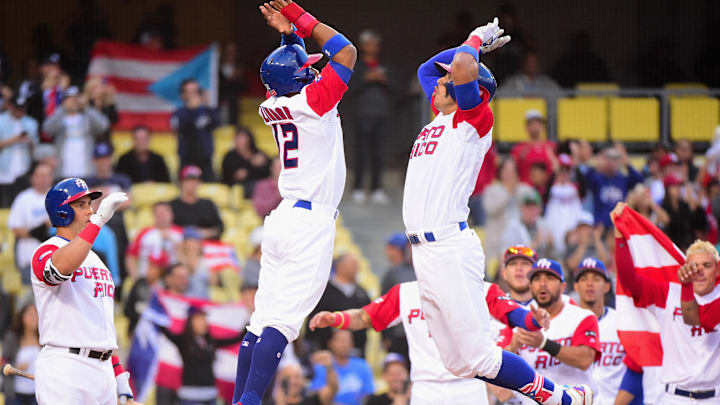
After a thrilling tournament in 2023, anticipation is high for the 2026 edition of the World Baseball Classic this coming March. What was once something of an afterthought on the sport's calendar has slowly but surely become a marquee event, promising to bring the best players on planet Earth together to play for national pride.
But unfortunately, that promise has been broken a bit in recent days, as one by one some of the biggest names in baseball have been deemed ineligible to compete. On Friday, it was New York Mets shortstop Francisco Lindor, who revealed he would not be able to join Team Puerto Rico in this year's WBC due to "insurance constraints".
"Due to the cleanup procedure that Francisco Lindor had on his right elbow earlier this offseason, he will not be participating for team Puerto Rico in the 2026 World Baseball Classic," the MLBPA said in a statement.
"Francisco is obviously disappointed that he will be unable to participate. However, because of WBC insurance constraints, he is ineligible to play in WBC games. He will participate fully in all spring training activities."
Wait, what? How can Lindor be healthy enough to be full-go for the start of Spring Training next month but not healthy enough to play for his country in the WBC? The answer is a complicated (not to mention unsatisfying) one, a situation that the powers that be would do well to address as soon as possible — before this turns into an epidemic that saps the event of its considerable momentum.
Full list of players not participating in the 2026 World Baseball Classic: Francisco Lindor is just the beginning

The Lindor news comes just days after his partner on the left side of the infield, Carlos Correa, announced he wouldn't be on Puerto Rico's roster due to similar concerns. And that announcement came just a day after Correa's Houston Astros teammate, Jose Altuve, revealed that insurance issues would prevent him from playing for his native Venezuela. Both Correa and Altuve, like Lindor, are expected to be 100-percent healthy in time for Spring Training, and both have expressed a desire to play for their respective countries.
Those are three huge names, All-Star-caliber players who have authored memorable WBC moments in the past, none of whom will be able to participate in the biggest edition to date. And they're just the tip of the iceberg: Puerto Rico's roster has been so decimated that federation president Jose Quiles has reportedly considered withdrawing his team from the tournament. Here's the full list of players who we know won't be taking part so far. (To date, no players that we know of have been prevented from joining Team USA because of an inability to acquire insurance.)
- SS Francisco Lindor (Puerto Rico)
- 3B Carlos Correa (Puerto Rico)
- RHP Jose Berrios (Puerto Rico)
- RHP Emilio Pagan (Puerto Rico)
- 2B Jose Altuve (Venezuela)
- INF Miguel Rojas (Venezuela)
- C Carlos Narvaez (Venezuela)
- INF Marcelo Mayer (Mexico)
Which players are eligible to participate in the 2026 World Basball Classic?
Unlike MLB's 26-man rosters, each team at the WBC gets 30 players, of which at least 14 must be pitchers and at least two must be catchers. The following is the criteria that determines which country (or countries) a player is eligible to play for:
- The player is a citizen of the country
- The player is qualified for citizenship or to hold a passport under the laws of that country but has not been granted citizenship or been issued a passport, in which case the player or team may file a petition with the WBC
- The player is a permanent legal resident of the country or territory the team represents
- The player was born in the country or territory the team represents
- The player has one parent who is (or was) a citizen of the country the team represents
- The player has one parent who was born in the country or territory the team represents
In the past, countries have been willing to meet players halfway if they seek citizenship with a country they want to compete for (whether due to family heritage or some other reason). This year, though, we're facing a different problem: Star players unable to compete due to a lack of insurance.
How do insurance policies for MLB players work?
This is a separate issue from any insurance policies players might have out in order to protect future earnings in MLB or elsewhere. The league requires that all players currently on a team's 40-man roster to take out an insurance policy that will protect themselves and their team should they miss regular-season games due to an injury suffered in the WBC. If an insured player is hurt during the tournament, the policy guarantees their salary for the year. If an uninsured player gets hurt, their MLB team is not required to pay them for the games they miss the next season.
This rule is hardly new; back in 2023, Clayton Kershaw was unable to pitch for Team USA because of chronic back issues that made it difficult for him to obtain an insurance policy. Players like Altuve and Edwin Diaz, meanwhile, were able to participate after receiving insurance, which came in handy when both suffered serious injuries in WBC competition. (Diaz missed the entire 2023 season after tearing his patellar tendon, while Altuve missed the first 43 games due to a broken thumb after being struck by a pitch; both were paid for the time they missed.)
This year, though, it seems that more red flags are being raised than we've seen in the past. Players like Altuve, Lindor and Correa, who will be healthy this spring but have suffered injuries in the recent past, are having a hard time finding policies. Of course, every insurance company will consider risk factors like age and medical history. But it's hard to figure out why someone like Lindor (who hasn't played fewer than 150 games in a season since 2021) would be flagged while someone like Tarik Skubal (who underwent major elbow surgery in 2022 and plays a far more perilous position) has no trouble.
“Unfortunately, a lot of players were hurt or for some reason went to the IL in the previous season and automatically, they’re getting into what they call ‘chronic’ injuries,” Team Venezuela manager Omar López, who is also the Astros' bench coach, told The Athletic.
What exactly the insurance process entails, or what makes a player insurable or uninsurable, remains a mystery. But for players who are unable to obtain an insurance policy, they have to choose between competing for their country and risking a year's salary or sitting out.
Can MLB teams prevent their players from taking part in the WBC?
Contrary to popular belief, players don't need permission from their MLB teams to participate in the World Baseball Classic. Of course, teams are free to make their feelings known, and plenty do: The Athletic reported earlier this month that Astros owner Jim Crane was involved in convincing both Altuve and Correa to stop pursuing a chance to play in this year's tournament. But ultimately, the decision belongs with the player.
- The player spent at least 60 days on the IL in the previous season, including at least 15 of the final 60 days of that season, or
- The player was on the IL on the final day of the previous August, or
- The player was physically unable to play in two of his team's final three games, or
- The player has had surgery since the previous Opening Day or is scheduled to have surgery in the future
Often times, a team's "request" acts as binding even though it really isn't; they're the ones signing the checks, after all, and a player's pro career will continue long after the WBC concludes. Still, unless a player meets certain requirements, they're free to take part if they choose.
 Add us as a preferred source on Google