
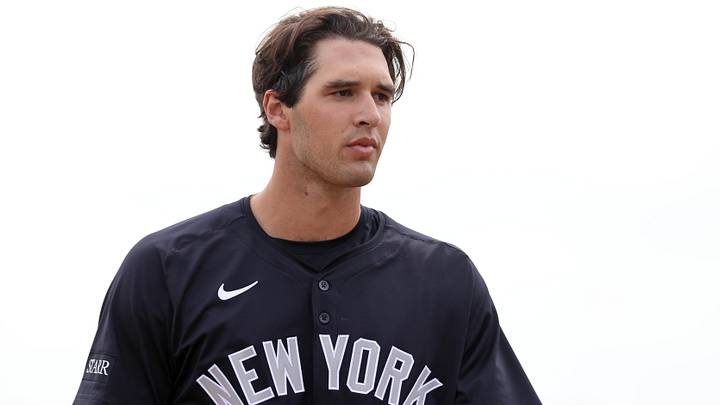
Key Points
Bullet point summary by AI
- The New York Yankees called up top prospect Spencer Jones to replace injured outfielder Jasson Domínguez. The 6-foot-7 lefty brings massive power to the Bronx.
- Jones boasts elite exit velocity and Triple-A home run production. However, his high strikeout rate and swing-and-miss tendencies pose risks against MLB arms.
- This move tests if Jones’ generational power can overcome his hit-tool flaws. His success could solidify the lineup for a 2026 World Series run.
New York Yankees outfielder Jasson Domínguez will head to the IL for a few weeks with a shoulder sprain after he crashed into the left field wall in Thursday's win over the Texas Rangers. With Giancarlo Stanton also hurt, the path is cleared for 24-year-old phenom Spencer Jones — New York's No. 6 prospect, per MLB Pipeline.
Jones was called up mere hours after the Domínguez injury. The 6-foot-7 lefty could see reps all over the outfield or at DH. Among the most polarizing and exciting prospects in recent memory, it's unclear how well Jones will fair in his first taste of Major League action.
The good and the bad with Spencer Jones

The good
Jones has arguably the best power tool in the minors. For a Yankees team accustomed to hitting the baseball very far, very often, Jones is another bullet in the chamber. He has 11 home runs and 41 RBI across 142 plate appearances in Triple-A this season, with a .958 OPS and 135 wRC+.
There is no doubting Jones' ability to connect with the heavy part of the bat and yank it deep over the wall. He also has 18 walks this season; minor league pitchers tend to stray outside the zone out of fear.
With seven stolen bases, Jones displays impressive speed for such a massive human. He accelerates quickly and can burn rubber on strong contact into the outfield gaps.
In short, Jones is a baseball spectacle. He looks the part — not unlike his new teammate Aaron Judge — of a middle-order slugger, towering over the plate with a gorgeous uppercut swing. He has the athleticism to contribute elsewhere, too. He came up as a centerfielder. The Yankees probably prefer him in the corners, but Jones will cover ground and supply average to above-average defense.
The bad
Jones' offensive profile features extreme contrast. He's in the 99th percentile among minor leaguers for exit velocity. He has legitimate 40-home run upside in New York. When Jones puts his barrel in the right spot, fireworks typically follow.
The problem is: Jones puts his barrel in the wrong spot way too often. He chases (32.4 O-Swing%). A lot. His 32.4 percent strikeout clip this season eclipses Ryan MacMahon's MLB-worst 32.3 percent strikeout rate from 2025 (h/t MLB Trade Rumors). And Jones is facing far less competitive pitching in the Minors. He has improved his approach compared to years past, but he's still the most volatile hitting prospect in recent memory.
Spencer Jones gets the call!
— Thomas Nestico (@TJStats) May 7, 2026
Jones is one of the most polarizing prospects in baseball, exhibiting jaw dropping power paired with one of the worst hit tools in MiLB. It will be interesting to see how his pro success translates to MLB as it is such an extreme profile
Congrats! https://t.co/GiguiGc8H0 pic.twitter.com/sFbygvlgcE
Jones struggles with upper-echelon velocity (which he'll see more of in the majors), and he gets antsy against strong breaking stuff. The Yankees won't be able to transform Jones' swing and mental makeup overnight. He can get away with loosy-goosy swing decisions in Triple-A, but the margin for error decreases substantially in the Bronx. Jones will need to prove that his power is such an overwhelming force that it washes away all other sins.
What can the Yankees expect from Spencer Jones?

Jasson Domínguez began the season in Triple-A because his path to the Majors was blocked by a veteran outfield of Cody Bellinger, Trent Grisham and of course, Aaron Judge. The same applied to Jones. With Giancarlo Stanton locked in the DH spot on a massive contract, there simply was zero flexibility.
The Yankees brought up Domínguez to split time between left field and DH with Stanton on the IL. Jones could see a similar diet, with Judge and Grisham also candidates to see more work in the DH spot if the Yankees want to see what Jones can offer in the outfield. Domínguez's glove has been a real point of concern for years. Jones is a more accomplished defender.
As for what Jones can accomplish production-wise, it's best to temper expectations a little bit. Yankees fans have been waiting on Jones for a long while. He was stuck in the Minors for much longer than most prospects with his pedigree.
There's clearly a reason for that, however. Jones' swing-and-miss rate is not sustainable in the majors. At least historically. Maybe he breaks the mold, able to settle into a similar vein of stardom as Munetaka Murakami or Nick Kurtz. There is certainly a higher tolerance for lofty strikeout rates nowadays. But unless Jones can take more pitches and calibrate his swing with more precision, he's in for a rude awakening and a steep MLB learning curve.
He's in the first of three option years, so New York is under zero pressure to keep Jones in the majors if he struggles. The talent, again, is immense, but this is a veteran roster with a ton of quality outfielders and more than enough power to sustain a World Series-caliber offense with or without Jones. He's the cherry on top of an obscenely large sundae, loaded with chocolate syrup, sprinkles and every manner of cookie crumble. It's nice to have, but you don't really need it.
This is not to say Jones won't succeed in the majors. He should eventually. But as for what happens over the next couple of weeks as New York's more senior bats recover, expect Jones to strike out a bunch, maybe hit a few dingers, and then end up back in Scranton for the meat of the season.
More MLB news and analysis:
 Add us as a preferred source on Google