
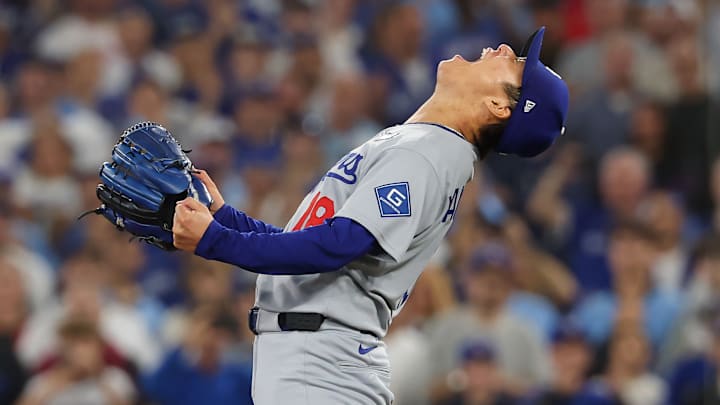
Major League Baseball's offseason is well underway, and as they seem to do every year around this time, the Los Angeles Dodgers are once again adding even more talent to their already stacked roster. Two years ago, the Dodgers signed Shohei Ohtani, then two weeks later added his Japanese countryman Yoshinobu Yamamoto. Shortly after New Year's, they also brought in Teoscar Hernandez.
This past offseason was an eventful one, too. L.A. buffed its rotation even further with two-time Cy Young winner Blake Snell and NPB sensation Roki Sasaki, and added to the bullpen by signing Kirby Yates and Tanner Scott. They're now joined by new arrival Edwin Diaz, one of the best closers in baseball. It shouldn't come as any surprise that the Dodgers addressed their biggest weakness.
Why the Dodgers are beatable
The Dodgers are by far the most talented team in the league, but they're not unbeatable. Baseball is funny that way. The Toronto Blue Jays had them up against the ropes in this past season's Fall Classic, taking a lead into the 9th inning of Game 7 before seeing it agonizingly slip away, and even though the boys in blue will enter next season as prohibitive favorites to three-peat, a few key injuries and a few bad bounces could be all it takes to knock them from off their perch.
There's no other roster in the league that can stack up to the collection of talent the Dodgers have amassed, so we thought we'd do a little thought experiment. The Dodgers are the best now, but where does their talent rank among the other teams that have won the World Series in back-to-back years? Baseball has been played a long time, so here is our attempt to see where they fit historically.
How many teams have won back-to-back World Series titles?
Though 15 teams have won at least two titles back-to-back, the feat has become more and more difficult in recent years. The Dodgers became the first team in 25 years to do it, and just the third since 1979. Interestingly, the Cardinals have never repeated as champs despite being in sole possession of second place all time with 11 World Series titles.
Team | Title years |
|---|---|
Chicago Cubs | 1907-08 |
Philadelphia Athletics | 1910-11 |
Boston Red Sox | 1915-16 |
New York Giants | 1921-22 |
New York Yankees | 1927-28 |
Philadelphia Athletics | 1929-30 |
New York Yankees | 1936-39 |
New York Yankees | 1949-53 |
New York Yankees | 1961-62 |
Oakland Athletics | 1972-74 |
Cincinnati Reds | 1975-76 |
New York Yankees | 1977-78 |
Toronto Blue Jays | 1992-93 |
New York Yankees | 1998-2000 |
Los Angeles Dodgers | 2024-25 |
Where the Dodgers rank among the most talented teams to go back-to-back
15. 1921-22 New York Giants
These Giants teams had talent, most notably Frankie Frisch. Known as "The Fordham Flash," he still holds the record for the highest batting average by a switch-hitter of anyone in the Hall of Fame. They beat the Yankees both years in what were the Yanks' first-ever World Series appearances, but then lost to them in 1923. That's the only time in Major League history that the same teams met three straight times for all the marbles.
The Giants were managed by the legendary John McGraw, and they had other talented players besides Frisch, but they finish 15th in our rankings here because Ross Youngs, Dave Bancroft and George Kelly were controversially selected to the Hall of Fame by the Veterans Committee, which was chaired by Frisch, their former teammate. Those three are generally acknowledged by baseball historians to be among the weaker Hall of Fame selections, while many more deserving players are still on the outside of Cooperstown looking in.
14. 1907-08 Chicago Cubs
Tinker to Evers to Chance. It's a testament to these three double play maestros — Joe Tinker, Johnny Evers and Frank Chance — that they're still famous well over 100 years after they plied their craft at West Side Park, the forerunner to Wrigley Field (which was actually named Wheegman Park for its first decade of existence).
The Cubs have had many greats pass through the franchise, from Ernie Banks, Billy Williams and Ron Santo to Ferguson Jenkins, Ryne Sandberg and Kerry Wood, but until a new group led by Kris Bryant and Anthony Rizzo, none of them managed to win the World Series. This group did it twice thanks to superior pitching and fielding.
Mordecai "Three Finger" Brown was the ace of the staff, and like the three infielders behind him was inducted into the Hall of Fame. It's nearly impossible to compare athletes from this long ago to more recent ones, but in their day, this team was dominant. The 1906 Cubs were upset in the World Series by the crosstown Cubs after winning 116 games and setting what is still the record for winning percentage in a season, and they followed that with seasons of 107 and 99 wins, plus two World Series titles.
13. 1910-11 Philadelphia Athletics
It's difficult to fully appreciate how different baseball was in the dead ball era. Folks back then would likely find today's game unrecognizable due to the proliferation of 100 mph pitching and home run hitting. Back then, the A's had a guy nicknamed Home Run Baker, and he only hit 96 long balls in his career.
Like the 1921-22 Giants, the A's were also managed by an all-time great in Connie Mack, and he made good use of a pitching staff that was virtually unhittable. Keeping in mind that this was a different time, it's still ridiculous that the A's had four starters with an ERA of 2.01 or lower, a rotation which included future Hall of Famers Eddie Plank and Chief Bender.
Second baseman Eddie Collins was one of the best players of his era, finishing his 25-year career with seven top-six MVP finishes (including a win in 1914), a .333 average, 741 stolen bases and the most sacrifices of any player in history.
12. 1915-16 Boston Red Sox
Any team that has Babe Ruth on it automatically gets bumped up a couple spots, that's just a rule I have. The Babe was only 21 years old by time his Red Sox won the second of two straight titles, and back then, he was known mch more for pitching than for his prodigious power at the plate. It wasn't until a couple years later that he began really belting homers, as he had just seven in these two seasons combined.
On the 1915 team, Ruth was joined by another all-time great in Tris Speaker, aka baseball's all-time doubles and outfield assist king. In an event that foreshadowed Ruth being sold to the Yankees in 1919, Speaker was traded before the 1916 season to the Cleveland Indians after refusing to take a pay cut.
These teams had outstanding pitching. Besides Ruth, who led the league in ERA and shutouts in 1916, Rube Foster (a different one than the future Negro Leagues star), Dutch Leonard, Ernie Shore, Carl Mays and Smoky Jo Wood were all extremely effective on the mound.
11. 1977-78 New York Yankees

Let's flash forward quite a bit. The 1977-78 Yankees featured Reggie Jackson, Thurman Munson, Graig Nettles, Mickey Rivers and Willie Randolph. Ron Guidry would put up one of the most dominant seasons ever by a starting pitcher in 1978, winning the Cy Young just one year after his teammate Sparky Lyle, a shutdown closer before such a thing even existed, did it.
The Yankees had gone 15 years since winning their last World Series in 1962, an unprecedented dry spell since they won their first title in 1923, but they won exactly 100 games in both '77 and '78, helped slightly by Bucky Dent's famous home run to win the AL pennant over the Red Sox.
This was peak Reggie Jackson time, as he earned his Mr. October nickname after crushing three home runs in Game 6 of the '77 World Series to lift the Yankees to the title over the Dodgers.
10. 1992-93 Toronto Blue Jays

It was nice seeing the Blue Jays make the World Series once again, because it stirred memories of their great teams from the early '90s. By this point, many people only know about Joe Carter's famous walk-off home run, but this was a stacked team from top to bottom.
Roberto Alomar is an all-time great second baseman, and he was really hitting his stride at this time as he won two Gold Gloves and his first Silver Slugger. John Olerud led the league with a .363 batting average in 1993, while Carter mashed 67 homers in these two seasons combined.
Other than the right side of the infield, this was a veteran team that got 26 homers and 108 RBI from 40-year-old Dave Winfield in '92, then replaced him a year later with the league-leading 211 hits from 36-year-old fellow future Hall-of-Famer Paul Molitor. In those two years, the Jays had six guys finish in the top six of A.L. MVP voting (Carter and Winfield in '92, Molitor and Olerud in '93, and Alomar both years). Oh yeah, they also had Rickey Henderson for the '93 stretch run.
Juan Guzman was a very good pitcher back in his day, and though none of them were at the peak of their powers at this time, the Jays boasted Jack Morris, David Cone, David Wells, Dave Stewart and Al Leiter, too.
9. 1929-30 Philadelphia Athletics
It takes a special team to dethrone Murderer's Row, and not only did the 1929 Philadelphia A's do that, they ran away with the pennant by recording 104 wins and finishing 18 games ahead of the the Yankees. Led by a 21-year-old Jimmie Foxx, who smashed 33 homers and got on base over 46 percent of the time, this team was a juggernaut. In 1929, Foxx wasn't even the most effective power hitter on the A's yet, as his teammate Al Simmons edged him by one homer and drove in 157 runs to lead the league. The next year, these two combined for 73 homers and 321 RBIs while each posting an OPS of 1.066 or better..
The rest of the lineup could rake, too. Catcher Mickey Cochrane batted .331, a number matched by Bing Miller, who also legged out 16 triples and stole 24 bases. Lefty Grove was one of the great pitchers of this or any generation, leading the league in strikeouts the first seven years of his career and winning 48 games in these two seasons combined. George Earnshaw didn't have Grove's career longevity, but he won 46 games of his own these two seasons.
8. 1998-2000 New York Yankees

We're getting into heady territory here, and until the Dodgers repeated as champs, no team had done it since the turn of the century Yankees. That squad actually won four World Series in five years, and during their three-peat from 1998-2000, they only lost a single World Series game.
Looking back, it's interesting that these Yankees were extremely deep, but not as stacked with future Hall-of-Famers as you would expect from a team that had such success. Derek Jeter and Mariano Rivera are the first two obvious names that need to be mentioned, and manager Joe Torre is the only other one that has made it to Cooperstown.
This was still a loaded team. Bernie Williams, Jorge Posada, Tino Martinez, Paul O'Neill and Scott Brosius were all dangerous hitters, while Andy Pettitte, Orlando "El Duque" Hernandez, David Cone, David Wells and Roger Clemens made for a formidable rotation.
7. 1949-53 New York Yankees
In baseball history, no team has had a stranglehold on winning like the mid-20th century Yankees. From 1947 through 1962, the Bronx Bombers raised 10 out of a possible 16 World Series banners, and in the three Fall Classics they lost, it took their opponents seven games to beat them. Since for the purpose of this exercise we're only looking at repeat champs, this era gets two entries, and we'll start with baseball's only ever five-peat.
This era of Yankee greatness has an embarrassment of riches. There's Yogi Berra, Phil Rizzuto, and a late-career Joe DiMaggio. Just as Joe Montana later passed the torch to Steve Young and Brett Favre was succeeded by Aaron Rodgers in the NFL, DiMaggio gave way in this run to a young Mickey Mantle, undoubtedly the greatest segue in baseball history.
Whitey Ford was one of the best pitchers of his era, and though he won titles in his rookie year in 1950 and again in 1953, one can only imagine how dominant the Yanks would have been if he didn't miss the '51 and '52 seasons after enlisting in the Army. Allie Reynolds, Vic Raschi and Eddie Lopat held it down in his absence, though, ensuring that what would become baseball's greatest uninterrupted dynasty stayed that way.
6. 1972-74 Oakland Athletics

You don't win three straight World Series without being loaded with talent, especially when you switch managers after the second one and don't skip a beat. These A's had stars in the lineup, such as Reggie Jackson, who won the first of his two MVPs in 1973, and on the mound, such as 1974 Cy Young winner Catfish Hunter.
Jackson and Hunter are far from the only Hall-of-Famers to be found. Vida Blue won his Cy Young the year before this dynasty began, and Rollie Fingers was the ultimate relief weapon at the back end of the bullpen. There are also names that have been a bit forgotten to time but who were nonetheless excellent players, guys like '72 A.L. MVP runner-up Joe Rudi, six-time All-Star Bert Campaneris and four-time All-Star Sal Bando. On top of that, every starter from the '72 team had an ERA under 3.00.
Known as the Mustache Gang, the A's had swagger and style. They knew how good they were, and they proved it on the field. There's never really been another team like them.
5. 2024-25 Los Angeles Dodgers

Every other team on this list played at least a quarter of a century ago, so in fairness, we're going to need some time to pass before we can confidently say where this Dodgers team ranks. Already, though, it has to be pretty high. Shohei Ohtani is the second coming of Babe Ruth and could go down as the greatest player of all time before it's all said and done. Clayton Kershaw went out on top as not only one of the most revered starters of modern times, but as a three-time champion.
Mookie Betts and Freddie Freeman will one day be joining Kershaw in the Hall. Catcher Will Smith has a long way to go, but he's on his way, too. Even the "mid-tier" guys in this lineup would be one of the best players on any other team in the league. Teoscar Hernandez has averaged over 30 homers for the past five years. Max Muncy has hit 35 homers or more five times. Even less heralded guys like Kiké Hernandez and Tommy Edman turn into absolute demons in the playoffs.
In addition to Kershaw, L.A. has a bevy of arms that stack up to just about anyone else on this list. Blake Snell has two Cy Youngs to his name, and he's one of only seven to win it in both A.L. and N.L. Tyler Glasnow is an ace, and Yoshinobu Yamamoto just finished doing his best Madison Bumgarner impression. Up until this past year, Blake Treinen has been a lights-out closer, but when he declined, the Dodgers were able to pivot to Japanese wunderkind Roki Sasaki. Next year, they'll hand the ball to Edwin Diaz.
4. 1975-76 Cincinnati Reds

With one of the most fearsome lineups in history, the Big Red Machine more than earned their famous nickname. This team had hit king Pete Rose, Ken Griffey Sr., George Foster and Dave Concepcion, and those are just the ones not in the Hall of Fame. Joe Morgan is on the shortlist for greatest second basemen of all time, and Johnny Bench is still considered by many to be the best hitting catcher to ever live. Tony Perez was a seven-time All-Star and finished top-10 in N.L. MVP voting four times.
The Reds were known more for being able to outscore their opponents, but their pitching was underrated. Don Gullett had nine great seasons before his career was cut short due to injury, and he formed a superb 1-2 punch with Gary Nolan. The bullpen, led by closer Rawly Eastwick and setup men Pedro Borbon and Clay Carroll, was also quite good.
3. 1961-62 New York Yankees

This team was so talented, they made a movie about it, but while 61 focused almost exclusively on Roger Maris and Mickey Mantle, it took more than just those two sluggers to get to 109 wins in 1961. Elston Howard hit .348 with a .936 OPS. He would go on to win A.L. MVP in 1963. Moose Skowron reached his fifth straight All-Star Game. Yogi Berra was still productive at 36. In 1962, Tom Tresh won the Rookie of the Year and Bobby Richardson was MVP runner-up to Mantle. Clete Boyer was great, too!
The Yankees' pitching was every bit as good as their lineup. Whitey Ford went 25-4 and won the 1961 A.L. Cy Young. Closer Luis Arroyo had the best season of his career and finished sixth in MVP voting, then in 1962, Bill Terry led the league in wins. Ralph Terry was in his prime.
A laughable four of the top six MVP finishers in 1961 were Yankees. Maris and Mantle were obviously 1-2 with their magical chase of Babe Ruth's single-season home run record. Maris ended up beating Babe by one, and he also drove in 141 runs, while Mantle finished with 54 homers and 128 RBIs of his own. The Yankees have had some incredible teams, and this one was among the very best.
2. 1927-28 New York Yankees

The top three most talented back-to-back champs of all time are all Yankees, which isn't necessarily a surprise since sports' preeminent franchise has won 27 World Series titles. Most lists have the 1927-28 Yanks at No. 1, but I'm going against conventional wisdom and bumping Murderer's Row from the top spot. There's no real argument to bump them below the No. 2 position, though.
We've got Babe Ruth and Lou Gehrig, two of the top handful of hitters ever, at their absolute apex with 188 homers mashed between them in these seasons. The rest of the lineup could rake, too. Earle Combs stroked 425 hits in this span, and Bob Meusel drove in 216 runs. Tony Lazzeri was a perennial .300 hitter who would eventually make the Hall of Fame.
Waite Hoyt was a contact pitcher but a great one. So was Herb Pennock, and they both ended up in Cooperstown, too. Fellow starter Urban Shocker gets points just for the name, but he also had a terrific 13-year career. In 1928, George Pipgras was the ace of the staff with 24 wins and 300 innings pitched.
1. 1936-39 New York Yankees
We've finally arrived at the most talented team of all time, but what sets the back-to-back-to-back-to-back World Series winners from 1936-39 apart from the rest? Where to start? These are the last four years of Lou Gehrig's career, and other than his final season that was cut short, he was still a hell of a ballplayer, especially when he batted .354, won A.L. MVP and led the league in homers, runs and OPS in '36.
It was also the first four years of Joe DiMaggio's superlative career, when he tallied over 1,400 total bases and never hit below .323. He won the first of his three MVPs in '39 with a .381 average, higher even than what he did two years later when he set the record with a 56-game hitting streak.
Bill Dickey is often neglected when it comes to the GOAT catcher conversation, but he shouldn't be. An 11-time All-Star, eight-time champion and career .313 hitter, he was a top-six A.L. MVP finisher all four years in this run. The Yankees have simply had too many great players, so some are bound to fall through the cracks, like Red Rolfe, who led the A.L. in hits, runs and doubles in '39, and George Selkirk, who batted over .300 three times in these four years and drove in over 100 runs twice. Joe Gordon debuted in '38 and would later win an MVP and make the Hall of Fame, while future five-time All-Star Charlie Keller's hit .334 as a rookie in '39.
Last but certainly not least is the pitching, which was led by two legends. Lefty Gomez won the Triple Crown in '37, the second time he pulled that off. Red Ruffing won 20 games or more all four years. With those two at the top of the rotation, the Yanks averaged over 102 wins per season over these four years and dominated the World Series with 16 wins to three losses.
What can the Dodgers do to be considered the most talented dynasty of all time?
The Dodgers have fashioned themselves as the go-to destination for not only the cream of the free agent crop each year, but for every big talent that comes out of Japan. They spend whatever it takes, and they've built up a formidable farm system. It's not out of the question that if they can keep up their current trajectory and win a couple more titles, they can pass the Big Red Machine and these all-time Yankees teams from a talent perspective. Having Shohei Ohtani goes a long way toward that argument, but the rest of the team is so brimming with elite talent that other fanbases constantly bemoan that the Dodgers have broken the league.
Imagine the Dodgers traded for Tarik Skubal or Paul Skenes? It's not out of the question, and it would take a move like that to move up the ranks. L.A. could also use a season where they win 110+ games and run roughshod through the playoffs, because their 93 wins and near-death experience at the hands of the Blue Jays this past season isn't doing them any favors.
More Los Angeles Dodgers news and analysis:
 Add us as a preferred source on Google