
In case you hadn't heard by now, MLB's offseason has been moving at a ... let's just say "leisurely" pace. We're now well into January, and most of the winter's biggest free agents remain unsigned — with little in the way of momentum toward a deal. Since a brief flurry toward the end of the Winter Meetings in early December, it's been a slow trickle of rumors and the occasional mid-level move, all while fans around the league sit around and wonder when something will happen already.
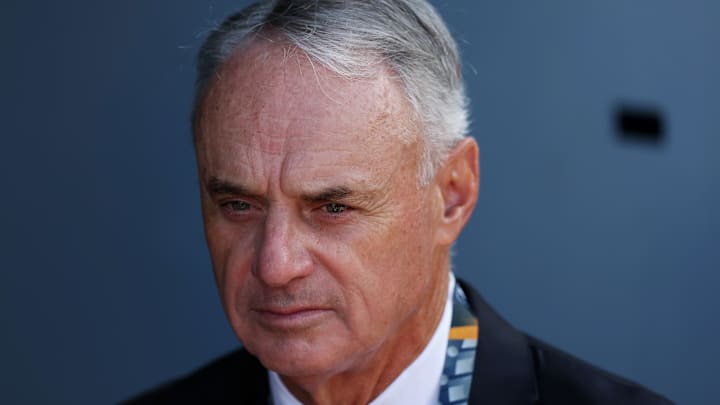
Commissioner Rob Manfred has noticed, and he doesn't appear to be too big of a fan of how his sport's offseason is working right now. In a radio interview earlier this week, Manfred went to bat for an idea he thinks can fix it: a signing deadline, forcing players to make decisions on a tight timeline rather than letting negotiations stretch into January and February (or sometimes even March).
“I think there’s going to be some more conversation about it, because I do believe that there’s a marketing opportunity,” Manfred told WFAN on Thursday. “Let’s face it, we operate in a really competitive environment. Just put entertainment, generally, to one side — just sports, right? It’s really competitive. And I think that you make a mistake, particularly during the offseason, when you don’t take every advantage to push your sport out in front of your fans during that down period.”
Credit where due here: Manfred has proven us wrong before. Several of his ideas, particularly as it relates to the game on the field, seemed nutty in the moment but have been validated in time. But while this one might sound good on paper if you're, say, a Yankees fan desperate for Brian Cashman to make a move already, the ramifications here would be far-reaching — and disastrous.
Why MLB's offseason drags more than other leagues

Yes, it's true: Baseball's offseason player movement does take forever, especially compared to its counterparts in the NFL and NBA. Those leagues manage to wrap things up in a matter of days; MLB, by contrast, measures its Hot Stove in months, sometimes even going beyond Opening Day.
But in order to try and solve the problem — if "problem" is even what we want to call it (more on that later) — it's important to understand that problem exists in the first place. And there's a very simple answer: the salary cap.
The only thing that can change MLB's offseason is a salary cap
Having a hard cap on the amount each team can spend on salary in a given season leaves very little room to negotiate; that goes double for the NBA, which has both a hard cap and max contracts tied to that hard cap. Teams, players and agents enter the offseason with a very well-established idea of what the price will be for the top names at each position, and how much overall money there is in the free agency pool.
So when free agency opens, there isn't all that much to discuss: Once a player decides which interested team he wants to play for, the numbers more or less take care of themselves. And with a finite amount of cap space around the league, players and their reps have all the motivation in the world to make up their minds as quickly as possible — so that they're not the ones left out in the cold.
Of course, the MLBPA has made clear that a salary cap isn't happening any time soon. And nor should it: All it does is let the sport's cheapest owners off the hook from having to actually try. But in Manfred's attempt to inject some artificial urgency into his offseason anyway, he's landed on an idea that is still wildly anti-player ... and won't actually fix much of anything.
Why a free agency deadline is a terrible idea
It does nothing but harm players

If you're going to create some sort of deadline, that deadline requires an enforcement mechanism — sign by a given date, or else. And there's simply no way to come up with a meaningful enforcement mechanism that doesn't wind up harming players far more than it harms teams.
Let's take what appears to be the most popular example of how this system would work: Players have until Jan. 1 to sign whatever contract they want; if they don't reach a deal before that date, they need to sign a one-year contract for the next season. It's not hard to see how that system might wind up being abused, and serving primarily to suppress salary. If you're, say, Pete Alonso, looking to cash in on a long-term deal as you hit 30, are you really going to want to spend one more year without long-term security — running the risk of an injury or other kind of decline that could ruin your chances at a more significant payday?
Of course not. You're going to want more security. Front offices realize that, and know that all they have to do is say "take our deal, or be stuck holding the bag". You may not have actually instituted a salary cap, but you've done it in all but name, creating a process by which downward pressure is exerted on the free agent market and teams around the league know that they're the ones holding all the cards.
And for what, exactly? What problem is all this galaxy-brain thinking supposed to solve? Even when Manfred himself tried to explain it, his logic was far from convincing.
It doesn't actually attack a problem worth solving

There seem to be two real strains of argument when it comes to the need for a free agent deadline. The first is the one common among fans on social media: The current pace of the MLB offseason is, quite simply, boring. We don't like waiting around for something to happen, and we demand action.
This argument is dealt with easily enough: Whether there's a deadline in place or not, you're going to wind up bored all the same, because not having baseball to watch is inherently boring. Sure, you can engineer a week-long dopamine high, a frantic period in which all of the biggest names fly off the board. And then what? You'll still have weeks or months to spend sitting around waiting for baseball to return — only instead of a slow trickle of rumors and potential deals, there won't be anything to fill that void.
The second argument is the one Manfred himself laid out in that interview with WFAN: More deals mean more publicity, and more publicity ultimately means more money for the league.
“From the first of December to the 20th, if we had a period in there when all that free agency activity went on, it’s a great marketing opportunity for the game, at a point in the calendar when you’re not quite in the NFL playoffs, the NBA’s still kind of early," Manfred said. "It’s a great chance to kind of own some offseason weeks, which is crucial to selling tickets, selling season tickets. So that’s why I was interested.”
Does anyone actually buy this? Sure, the middle of December does represent a bit of a down period, with the NFL in the back half of its regular season and college football caught between the end of conference championship weekend and the start of the CFP. But would a week-long free agent frenzy really do much to cut through that noise? Would ESPN spend more than a day talking about Kyle Tucker, Bo Bichette and Alex Bregman all landing with new teams?
Of course they wouldn't. And while it might be easier for teams to lock in a season ticket base if their moves get done earlier, that hardly seems like a strong enough reason for such a massive change. And besides, something tells me that if, say, the Phillies sign Bichette in late January, their ticket office will be able to figure it out.
 Add us as a preferred source on Google