
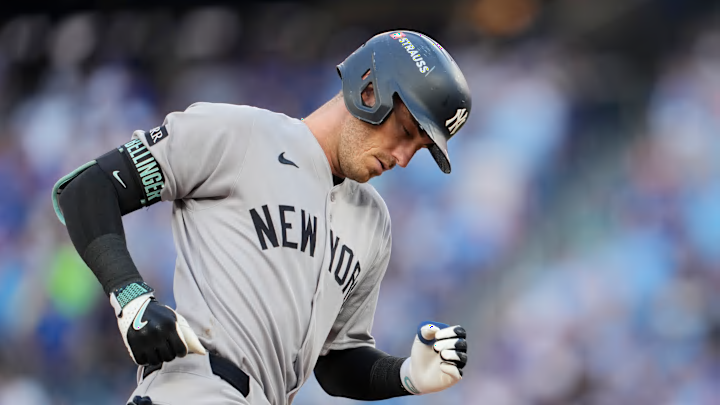
All I really want for Christmas this year is a new kitchen set. Can you blame me for giving up hope that my favorite team will sign Cody Bellinger, Kyle Tucker or Tatsuya Imai before I check my stocking? With how slow the MLB offseason moves, I figured that I was better off making my holiday wishlist just a bit more realistic.
Unfortunately, the MLB offseason has a reputation for its glacial pace, and nothing has changed as we approach the back half of the 2020s. (Doesn’t that hurt to write?) It’s outright frustrating at times that, nearly two months since the new league year began, many of the sport’s premier free agents remain available.
Why is the MLB offseason so slow!?
Where should we start? Believe it or not, the most straightforward answer really has nothing to do with the fact that specific teams don’t spend in free agency. Of course, that’s a significant part of why the MLB offseason feels like it’s making a snail look like an Olympic track runner, but the issues go much deeper.
First off, Major League Baseball does not have a traditional “new league year” the way that the NFL, NBA and NHL do. Free agency and trades in those sports officially begin when the new league year starts. Yes, you’ll hear about moves being agreed to beforehand, like an NFL team intending to cut a player, but a move might be reported on Feb. 10 and not happen until March 10.
That’s not always the case in baseball, partly because the new league year starts immediately when the World Series ends. So when New York Mets first baseman Pete Alonso told reporters in September that he planned to opt out of his contract and re-enter free agency, he couldn’t officially negotiate with teams in October because the season was still ongoing. However, once the Dodgers recorded the last out of the World Series, all that Alonso needed to do was formally tell the Mets he was opting out of his contract now that he had the chance to do so. This wasn’t an instance where he was required to wait until, say, Nov. 15 to officially opt out.

Another reason: Those sports have a salary cap, and teams must rework their finances ahead of the new league year. Major League Baseball does not have a salary cap, and it’s an issue that could force a work stoppage after next season.
We acknowledge that all of this may sound complicated, but wait, there’s more! Major League Baseball holds both the general managers’ meetings and the Winter Meetings during the offseason, which provide opportunities for all 30 teams, player representatives and sometimes even players themselves to gather in one place to talk shop.
If you’re a premium free agent, you also have the benefits of a prolonged offseason and guaranteed money working in your favor. Think about how often you hear about signing bonuses during NFL free agency, and how we’ll see teams cut players after one season of a three-year deal because they front-loaded the contract.
But that still doesn’t explain why the offseason moves so slowly
You also have to keep in mind that so much of the action in MLB, NBA and NHL free agency happens within the first 48 to 72 hours because, again, it’s the start of the new league year. So teams have had transactions planned for weeks, maybe even months!
The best players in those sports sign early, and then things do slow down! At least the NFL has all of the buildup to the draft. The NBA has Summer League, not to mention the Olympics in some years. Plus, those sports have offseason programs before training camp. Ask yourself if we would be having this kind of conversation if Aaron Judge and the Yankees reported to Tampa for December practices.
We’re not denying that the MLB offseason moves slowly. At the same time, what we are saying is that it feels so much slower because there’s nothing else happening, not unless you’re scrolling social media for updates on an intentional league. Part of the selling point of a spring football league was exactly what it says on the tin: giving people a chance to watch football in the spring.
What can Major League Baseball do to make the offseason more exciting?

For the sake of conversation, let’s run through a hypothetical MLB offseason timeline that would begin with the next CBA. This is something that we’re proposing, not something that the league itself is considering.
- The new league year begins on the first Tuesday of December. No trades or external signings can be made during this time. Teams can re-sign players.
- The first day of the new league year coincides with the Winter Meetings. This hypothetically increases the likelihood of top-tier players signing early in the offseason.
- The MLB Draft lottery remains a December event.
- Teams are allowed to have a formal mini-camp no longer than three days before pitchers and catchers report to spring training in mid-February.
Sorry, but this idea just doesn’t strike us as feasible or something that would positively overhaul the offseason pacing. Without a salary cap, you’d still run the risk of allowing players and teams alike to feel comfortable taking their time. And if you do have a salary cap, then you’re asking all parties to rush into a new system. Imagine if Schwarber only had roughly 75 days to sign a new contract before spring training began, but he also had to work through a brave new world where the Phillies could cut him after two years without significant penalty because they front-loaded the deal.
The counter in that situation is that more players could follow the Alonso and Alex Bregman route of signing a short-term contract with an opt-out clause after one year. But if every player wants that kind of deal, would teams catch on and eventually stop limiting such agreements? None of that suggests that teams would be colluding; it’s just us openly wondering whether organizations would nip a trend in the bud.
We do know one thing, though: You can change the MLB offseason all you want, but that doesn’t mean the Pirates or Rays will change their spending habits. As long as I get my new kitchen set, though, I’m set either way.
 Add us as a preferred source on Google