
Key Points
Bullet point summary by AI
- The Los Angeles Dodgers and Toronto Blue Jays are reigniting a heated debate over pitching rules in their latest series matchup.
- A star pitcher found himself under scrutiny as umpires allowed him extra time to warm up after a delayed start, sparking accusations of preferential treatment.
- This situation highlights the tension between accommodating a historic two-way player's unique demands and maintaining fair competition across all MLB teams.
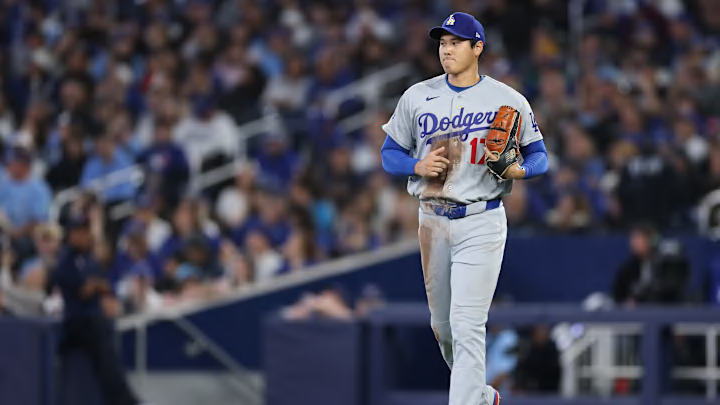
Not that the burgeoning rivalry between the Los Angeles Dodgers and Toronto Blue Jays needed any extra kindling, but Wednesday's series finale added some fuel to the fire in the bottom of the first inning, when Jays outfielder George Springer earned L.A.'s ire by questioning just how long umpires were allowing Shohei Ohtani to warm up on the mound.
Some drama between the #BlueJays and #Dodgers.
— Daniele Franceschi (@Daniele_Media) April 8, 2026
George Springer approached HP umpire Dan Bellino to inquire about the amount of warmup time for Shohei Ohtani.
Dave Roberts was visibly annoyed in the dugout.
(📹: @sportsnet) #BlueJays50 pic.twitter.com/HwghO9tdnQ
Dodgers manager Dave Roberts didn't love the implication, but this is hardly the first time this has come up. The Blue Jays themselves raised the issue in Game 7 of the World Series last fall, and it's not just the complaints of a sore loser, either — plenty of other teams have complained about what they see as the league bending its rules for the benefit of one particular player.
Granted, it wouldn't be the first time. Ohtan is an unprecedented talent, one who will inevitably demand some unprecedented decisions; heck, MLB even adopted a rule that bears his name to allow him to both hit and pitch on the same day. But there comes a point at which accommodation tips over into preferential treatment, and a competitive advantage. Where exactly Wednesday's dustup falls on that spectrum depends on whom you ask — and which team you cheer for.
Why Shohei Ohtani's preferential treatment rankles some opponents

Part of the problem is that this is an area of the MLB rulebook that is intentionally somewhat ambiguous. The minute one half-inning ends, a two-minute clock begins, the end of which is supposed to mark the start of the next half-inning. But how strictly that clock gets obeyed is usually left to the umpire's discretion — discretion that routinely benefits Ohtani.
That was the case on Wednesday, where Ohtani led off the top of the first with a walk and remained on base until the end of the frame. By the time he got back to the dugout, switched his gear and got out to the mound, less than a minute remained on the countdown, meaning there wasn't enough time for him to complete his normal number of warmup tosses. Home-plate umpire Dan Bellino, as has become the norm in this situation whenever Ohtani pitches, opted to give him the leeway to finish up his routine, prompting Springer to question what the hold-up was.
Again, this wasn't the first time Ohtani got this sort of treatment, and it won't be the last. And it's not hard to understand both he and the Dodgers' point of view: Ohtani is late to start warming up through no real fault of his own, and forcing him to start pitching at max effort before he's had a chance to loosen his arm back up would certainly seem to increase the risk of injury. What's the harm in being flexible?
Of course, it's also not hard to understand why the Blue Jays and other teams might start to chafe at one more way baseball is creating an exception to the rules that specifically (and pretty much only) benefits one player — who just so happens to be the league's biggest star, playing for the two-time defending World Series champs. Toronto certainly isn't trying to compromise Ohtani's health; at the same time, though, why would the solution to this particular problem be to simply oblige whatever the Dodgers want?
How far should MLB be willing to bend for its biggest star?
Again, no one is arguing that Ohtani should be put in a position that might risk injury. But if the choices are "allowing one particular player to be governed by a totally different set of rules" and "maybe it's not feasible for Ohtani to be a full-time two-way player", why are we immediately defaulting to the former?
Doing what Ohtani is doing is supposed to be hard — there's a reason we've literally never seen it before in the history of the sport! As much as I marvel at the things he's able to accomplish both on the mound and at the plate, it's not clear to me why the Dodgers should be able to reap the benefits of his singular talent without also having to navigate the consequences.
One of those consequences is trying to navigate both hitting and pitching at the same time. Sure, Ohtani is pretty much the only player in the league right now who has to deal with this problem, but if any other team were to give its pitcher a plate appearance, they'd presumably have to abide by the same countdown clock as every other team does. What's the argument for carving out an exception for Ohtani? Because we all love to watch him?
That's true enough, but I also understand why his competitors don't find it particularly compelling. Again, playing both ways on a full-time basis comes with challenges; those challenges shouldn't be handwaved away simply because Ohtani is arguably the most popular player in the sport — not just in America, but around the world. If there's no way for him to realistically do both while following the same rules that every other team has to follow, well, can you blame the Blue Jays and 28 other teams for thinking that the solution is for him to simply not?
 Add us as a preferred source on Google