
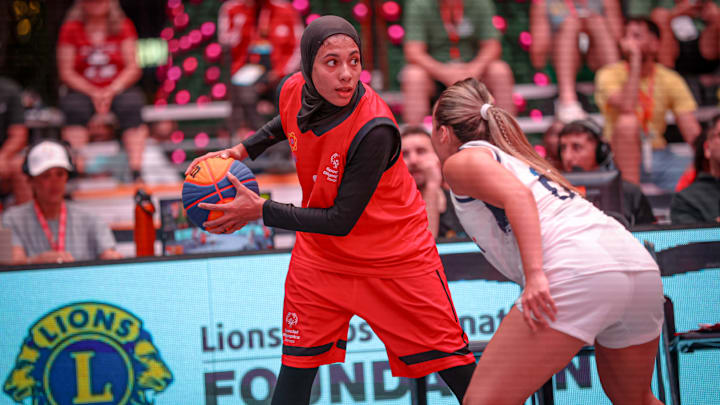
The body language of a die-hard hooper is universal. It's in the way they carry themselves, on and off the court. The way they shift weight on the balls of their feet — left to right, right to left — always ready for a fluid crossover, even if they don't have the rock. The way they clap righteously when they get a call, frustratedly when they don't, then joyfully again when they know a blow-by layup or tough jumper has them living rent-free in the head of an opponent.
Aya El Kalali speaks it fluently.
The 19-year-old Moroccan basketball player arrived at the Special Olympics Unified 3x3 Basketball World Cup with just two teammates (every other team brought five players) and without their regular coach (an assistant filled in) after visa issues kept the full delegation from traveling.
That means El Kalali and her teammates — Fatima Ben Yechou and Saida Charef — played every minute of every game across the three days of competition. They battled the odds and their opponents to come away with a 3-1 record in group play and then beat Costa Rica 5-4 in the semifinals for Division 2. Their run ended with a heartbreaking, 7-6 loss to Egypt in the final.
The three walked off the court together, exhausted. Every loss stings, but the trio can leave Puerto Rico with an immense sense of pride in what they accomplished.
Teammates, competitors, friends

Unified Sports bring together athletes with and without intellectual disabilities (called Unified partners) to compete side-by-side. As the Unified partner for her team, El Kalali was a vocal leader on the court, calling out plays, pointing out defensive coverages and encouraging her teammates to continue to bring the intensity.
And while El Kalali set the emotional tone for her team, Yechou and Charef matched her on every possession, swarming relentlessly on defense and playing an incredibly physical style despite being shorthanded and often undersized compared to their opponents.
What they lacked in reinforcements, they made up for with their deep connection built over the past four months, playing together and preparing for the tournament. El Kalali explained through a translator how that connection helped shape her leadership style:
"I know what they like, what they don't like, what are their strong points and their weaknesses, I know everything about them. So I know how to communicate with them. I know when I have to talk a little bit serious, when I have to calm down and be more soft."
Morocco made a statement at the Special Olympics

But shared competition isn't the only thing that bonds these three basketball players together. As women from Morocco, even playing in a tournament like this is a statement — something they intentionally made clear in their official introduction at the Opening Ceremonies.
"In their own words, our presence on this stage is more than sport, it's a STATEMENT."
"I can do anything," Ben Yechou said through a translator. "It's not like the stereotypes in Morocco that I can just cook, have kids, whatever. I really could do anything."
Basketball is a universal language

Events like The Cup are meant to undo stereotypes — it's what Special Olympics and Unified Sports are all about. But that doesn't just mean undoing stereotypes about athletes with intellectual disabilities. These single-sport events for Special Olympics are about building out the global tribe of basketball players and the truth that gender, race, nationality, religion and ability-level don't matter in the context of the game.
No matter where you're from, or what you bring to the court. Once you step onto it, you're a basketballer.
You might notice that fact more quickly in the way El Kalali moves with the ball in her hands, but it took all three of these Moroccan women to make it through this tournament. And in the end, it was Charef who took home Tournament MVP for her tenacity and energy, ferocious defense and remarkable resiliency. (She was holding an ice pack to her head as she laughed and smiled her way through an interview).
Basketball and competitions link these three women together and connects them with the women of the 16 other teams at this event. It's a universal bond that extends to everyone who picks up a basketball around the world. And hopefully more women in Morocco will get the chance to join this fellowship of hoopers in the future.
Taking the bond of basketball back to Morocco

This was not the first international basketball experience for El Kalali. She was the only woman from Morocco to attend the Basketball Without Borders Africa camp in 2023 — a joint enterprise between FIBA and the NBA "to promote the sport and encourage positive social change in the areas of education, health, and wellness.” A year before that, she participated in the NBA Academy Women’s Camp Africa, again as the only player from Morocco.
She said she'd love to compete in more international tournaments and events but continuing to develop opportunities for woman basketballers, including in 3x3, back in Morocco is important as well.
"I'm really happy to represent Morocco," El Kalali told the translator. "And representing Morocco is not only representing the country. We are also representing our family, their environment, all the things around us."
El Kalali, Ben Yechou and Charef made a statement by being here, representing Moroccan women on a global stage. They made a statement as friends and teammates, by taking care of each other, supporting each other through every minute of every game. They made a statement as basketball players by battling for every bucket and making sure nothing came easy for their opponents.
And when asked what they wanted opponents and fans to remember most about them after this tournament, all three were in agreement.
"Even if we were only three players, we could get to this stage, and we could represent Morocco. Even if we were only three. It was really difficult. But still, we made it."
Why We Play features stories about the power of sports to bring us together, overcome obstacles, make positive change and reach everyone. Read more here.
 Add us as a preferred source on Google