
Starting in 1968, and for the next 50 years, Special Olympics competitions at the international level meant the World Games, held alternately in Winter and Summer in two-year cycles. That framework was the foundation of a movement that, has grown to serve millions of athletes, bringing the powerful message of inclusion to countries around the world.
But in 2018, Special Olympics entered a new era with the launch of its first ever single-sport international event, the 2018 Special Olympics Unified Football World Cup in Chicago. The soccer-only event was another step forward for the Unified Sports program, which brings together athletes with and without intellectual disabilities (Unified partners) to compete side-by-side. It was also the trial run of a new approach to international events.
Single-sports events aren’t replacing the multi-sport Winter and Summer Games. But they have become an essential part of the future of Special Olympics, an opportunity to expand program offerings and grow infrastructure in more places and give more athletes, coaches and volunteers the chance to compete in world-class events.
“The other thing nice about the single sport events is it's within reach for a lot more countries,” said Jon-Paul St. Germain, Vice President of Sport Development for Special Olympics. “So the flexibility and the interest is different because we're not asking for the massive, multi-day event. So it opens up new opportunities for some of our Programs who are wanting the stage to raise the profile of their own Program and host something like this.”
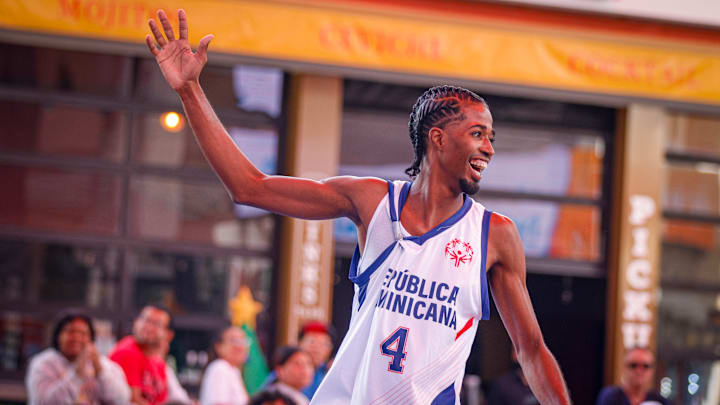
Staging an event on the level of the World Summer Games — which will be in Santiago, Chile in 2027, with as many as 6,000 athletes and partners attending from more than 200 countries — may be out of reach of a place like Puerto Rico. But the smaller scale of an event like this week’s Special Olympics Unified 3x3 Basketball World Cup, with 180 athletes and Unified partners from 27 countries, is right in their wheelhouse.
And to be clear, smaller scale, doesn’t mean anything less grand.
Games for this event are split between courts at the Puerto Rico Department of Sports and Recreation and a showcase court at Distrito T-Mobile, a sparkling outdoor shopping and event center in the heart of San Juan, Puerto Rico.

Every element of the event is carefully curated to give these basketball players the experience of a lifetime. In the words of Christian Guiralt, Senior Director of Sport Competition Management, Special Olympics, this is what “our athletes deserve. They deserve to live the same experience as anyone else.”
At a raucous and joyous Opening Ceremony, each country’s delegation was welcomed onto the showcase court, smiles larger than life, streamed onto the massive screen behind them for everyone to see. It was a celebration, replete with marching band and inclusive dance troupe — celebrating Puerto Rican heritage and showing that inclusion doesn’t stop at sports. Before the evening was over, basketball players from every country were dancing together on the court as Puerto Rican artist Luis Vázquez sang his hit, Birim Bim Bim.
Once the games started, it was all business on the court — competitiveness and sportsmanship in equal measure.
Single-sport events are the next evolution of Special Olympics

The Unified 3x3 Basketball World Cup is the fourth single-sport international event Special Olympics has staged — the 2018 Unified Football World Cup was followed by the 2022 iteration in Detroit, Michigan; and the 2025 Unified Volleyball World Cup was held in Poland this October. The next Unified Football World Cup is scheduled for 2026 in Paris, France and planning is already underway for subsequent editions of the basketball, soccer and volleyball events, with other sports potentially getting the same treatment in the future.
These new single-sport events don’t just give Special Olympics the opportunity to feature and connect more athletes and in more locations. They also provide a mechanism for strengthening programs in host nations and other participating countries, ensuring a lasting impact beyond the tournaments themselves.
As part of the selection process, nation hosts have to plan for how staging one of these events will extend the work of their local programs, even when the tournament is over. But even nations who want to attend have to build out a detailed plan for how sending a team to an event like the Unified 3x3 Basketball World Cup will serve the rest of their national Special Olympics program at home.
“Part of that application is putting down on paper, articulating how they're going to leverage this event to grow their program,” said St. Germain. “They commit to what the status of their current program is, and then we do a consultation with them. We're meeting with the coaches and the sport directors while they're here. And then we do a follow-up after the event as well, to understand how were they able to follow up on some of the things that they do, and even work with them to divide, to maybe prioritize some of their plans for development.”
Special Olympics has a massive reach, serving nearly 5 million athletes and Unified partners (as of 2024). The structure — with a national umbrella overseeing programs in 204 countries and nations, divided into seven regions — means every opportunity for direct connection and communication is an essential opportunity for growth.
Understandably, it can take a while for top-down initiatives aimed at influencing impact and growth to make their way through that structure and become entrenched at the grassroots level. But St. Germain explained that bringing together representatives and coaches from so many countries, along with regional sports directors, can remove roadblocks.
“Using these events and creating this application process and asking them to articulate this gives us immediate insight into understanding the struggles they have, and the challenges they have.”
Team work makes the dream work

These events also provide an opportunity to build connections and partnerships with international sports federations like FIFA and FIBA, which was an organizing partner for the Unified 3x3 Basketball World Cup.
The FIBA partnership began in 2019 after the World Summer Games in Abu Dhabi and “is rooted in shared values of quality, empowerment and access to sport.”
This partnership helped standardize the tournament — games were played with FIBA-certified officials and rules — but also to help the national Special Olympics programs make and deepen relationships with their national basketball federations and provide additional resources to everyone involved. The FIBA Foundation ran a mini-basketball clinic Friday, with “young athletes between the ages of 5-8 with and without intellectual disabilities” as they rotated through stations and activities that focused on building fundamental basketball skills.
‘They [FIBA Foundation] did a coaching seminar with our coaches,” said St. Germain, “where they engaged in the educational opportunity that sport provides, talking about how, in using the sport of basketball, you can also talk about healthy eating habits and incorporate that into your drills — things like that we're working alongside of them on, because that's our ambition. It's not who wins the gold medal here. It's that we're changing lives off the court.”
The benefits for growth in programming and organization development are clear, but the benefit to athletes isn’t just about access and opportunity. It’s also a chance for them to build a unique identity and one that’s subtly different than what legacy Special Olympics events have sometimes provided.
As St. Germain explained, “It’s a cultural change right now for us is to lean into what sport specificity means and defining quality around the culture of the sport; even the identification of individuals with intellectual disability as a basketball player or a footballer or a golfer, rather than referring to everyone as a Special Olympics athlete … really leaning into the dignity of being part of a global tribe of basketball players.”
Special Olympics has built a movement and a powerful legacy of inclusion, access and mutual respect over the past five decades. But they’re not done. What’s come before is a foundation to build on, to continue experimenting, iterating and refining.
“The single-sport [event] is all about quality,” said St. Germain. “We're able to do things that we were never able to do at World Games. Some of these things are transferring over into World Games, quicker than I think we even expected. And in other cases, we're able to do things just differently and try some things that the scale and scope of this allows us to lean into.”
Why We Play features stories about the power of sports to bring us together, overcome obstacles, make positive change and reach everyone. Read more here.
 Add us as a preferred source on Google